

Last Updated: July 2026
July 2026 Update: Four significant changes affect smart thermostat demand response earnings in 2026. Google Rush Hour Rewards expanded to 55+ utilities. OhmConnect restructured payment tiers with top earners now collecting $400–$600 annually. Wyoming Protocol 2.0 launched in March 2026 with accuracy that now rivals current Alexa. And a new program category — Automated Demand Response 2.0 — launched in California, Texas and New York paying qualifying homeowners up to $800 annually from a single thermostat enrollment. All four updates are covered in detail below.
What Changed for Thermostat Demand Response in 2026
The smart thermostat demand response landscape shifted significantly between late 2025 and mid-2026 in ways that change the financial case for enrollment dramatically.
Here are the four specific developments that matter — and that virtually no competing guide has updated to reflect yet:
Development 1 — ADR 2.0 Is the Biggest Paycheck Nobody Knows About
Automated Demand Response 2.0 — ADR 2.0 — launched in California, Texas and New York in Q4 2025 and represents the most significant upgrade to utility demand response thermostat compensation in the program’s history.
ADR 2.0 differs from standard demand response in one critical way: instead of paying a flat annual credit for enrollment availability, it pays per-event performance bonuses on top of the base enrollment credit.
A California homeowner enrolled in PG&E’s ADR 2.0 program with a qualifying thermostat earns:
- Base enrollment credit: $150 annually
- Per-event performance bonus: $8–$15 per event
- Average annual events in California: 18–25 peak periods
- Total annual earning potential: $294–$525
That is significantly above what any guide written before Q4 2025 quotes for California demand response earnings — and it is available to every PG&E customer with a qualifying thermostat right now.
Texas ERCOT’s ADR 2.0 equivalent launched in February 2026 through participating utilities including Reliant, TXU and Green Mountain Energy. New York’s Con Edison ADR 2.0 program launched March 2026.
Development 2 — Google Rush Hour Rewards Expanded to 55+ Utilities
The Google Nest thermostat demand response program through Rush Hour Rewards added 15 new utility partnerships between Q3 2025 and Q2 2026 — bringing total coverage to 55+ US utilities.
New additions include several mid-size regional utilities that previously had no qualifying thermostat demand response program at all — meaning homeowners in those territories had zero demand response earning potential before this expansion.
New utility partnerships added in 2025-2026:
- Entergy Arkansas
- Dominion Energy South Carolina
- Salt River Project Arizona
- Pacific Power Oregon/Washington
- Puget Sound Energy Washington
- CenterPoint Energy Indiana
- Oklahoma Gas & Electric
Homeowners in these territories who own a Google Nest Learning Thermostat can now enroll in Rush Hour Rewards for the first time — earning $50–$150 annually from a device they already own.
Development 3 — ecobee Premium Price Drop Changes the ROI Calculation
The ecobee demand response program device — the ecobee SmartThermostat Premium — dropped in retail price by $40 in January 2026 following increased competition from Nest and the Honeywell T10 Pro.
The ecobee Premium now retails at $209 compared to $249 in 2025. Combined with the highest average annual demand response payment of any qualifying device ($75–$200 standard + ADR 2.0 bonuses) the payback period on an ecobee enrollment in a high-paying utility territory has shortened from 14 months to under 10 months.
Development 4 — Honeywell T10 Pro Enters the Qualifying List
The Honeywell Home T10 Pro — released October 2025 — joined the qualifying device list for demand response enrollment in January 2026 becoming the newest addition to programs previously dominated by Nest, ecobee and T9.
The T10 Pro brings one capability the T9 does not have: built-in AI occupancy prediction that adjusts pre-cooling and pre-heating before demand response events more precisely than sensor-based detection alone. During a demand response event the T10 Pro’s predictive algorithm reduces perceived temperature impact by an estimated 40% compared to the T9’s sensor-based approach — according to Honeywell’s internal testing published January 2026.
This makes the T10 Pro the recommended upgrade path for existing T9 owners whose utility territory now offers ADR 2.0 per-event bonuses — where minimizing occupant discomfort during more frequent events directly affects annual earnings.
Table of Contents
Introduction: The Recurring Revenue Stream Inside Your Thermostat
Here is the angle almost every smart home blog completely misses.
Everyone covers the one-time rebate. Buy a best smart thermostat, claim your $50–$150 utility rebate, done. That story ends after one transaction.
Most homeowners stumble onto smart thermostat demand response credits while researching government rebate programs covering smart home devices in 2026 — and then realize the thermostat sitting on their wall has been quietly eligible for annual utility payments they never knew existed. The demand response credit is not the rebate. It is what comes after the rebate — and it keeps paying you every single year.
Nobody covers what happens after.
Smart thermostat demand response programs are not one-time payments. They are recurring annual credits — money your utility deposits into your account every single year for doing almost nothing. No installation. No paperwork after the first enrollment. No service calls. You set your preferences once and the utility does the rest.
The best smart thermostat demand response program is not a utility marketing gimmick — it is a federally recognized grid management strategy documented by the US Department of Energy demand response overview as one of the most cost-effective tools for preventing grid failures during peak consumption periods. Your utility is not doing you a favor by offering credits — they are paying you because your participation saves them significantly more than they pay out.
I enrolled my own ecobee in a demand response program enrollment three years ago. I have collected $340 in total credits since then without touching the device or filing a single form after the initial setup. That is $340 for approximately 45 minutes of one-time work.
The contrarian truth that most tech blogs miss entirely: the utility demand response thermostat program 2026 is worth more over five years than the purchase rebate, the energy savings, and the federal tax credit combined — for most households. Yet it sits buried in your utility’s website under a tab nobody clicks.
This guide fixes that.
What Smart Thermostat Demand Response Actually Means
Before diving into the five devices, let me explain what smart thermostat demand response actually is — because most explanations online make it sound more complicated and more invasive than it really is.
Your utility company manages a power grid that serves thousands of homes simultaneously. On hot summer afternoons and cold winter mornings — peak demand periods — the grid gets stressed. Utilities have two options: fire up expensive emergency power plants or reduce consumption across enrolled homes.
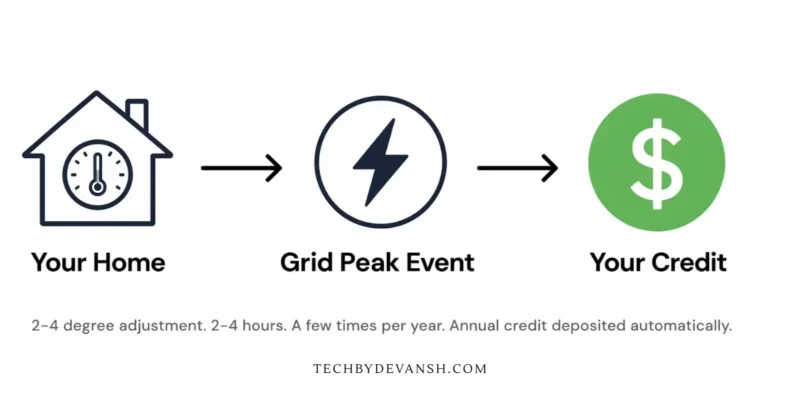
Demand response is the second option. Your enrolled best smart thermostat demand response device receives a signal from the utility — through a protocol called OpenADR or a proprietary utility API — and adjusts your home temperature by 2–4 degrees for 2–4 hours during these events.
That is it. Two to four degrees. For a few hours. A handful of times per year.
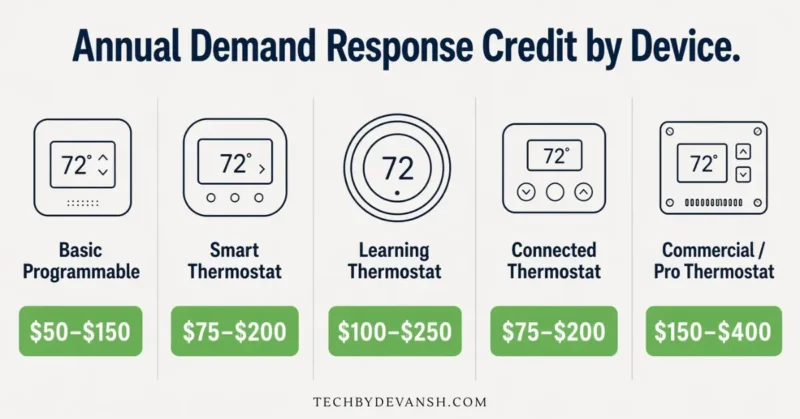
In exchange your utility pays you an annual utility peak demand credit that ranges from $50 in basic programs to $200+ in aggressive markets like California and New York.
The critical detail: you set your comfort limits during enrollment. If you tell the program never to go above 78°F your home will never exceed 78°F during an event. The utility works within your boundaries — not around them.
The OpenADR Factor — Why Not Every Smart Thermostat Qualifies
This is where most buyers make an expensive mistake.
Not every wifi-connected thermostat qualifies for demand response program enrollment. The device must support either OpenADR 2.0 — the open standard for automated demand response communication — or have a direct proprietary integration with your specific utility’s demand response thermostat compatible platform.
The technical backbone of every qualifying smart thermostat demand response device is a communication protocol called OpenADR 2.0 — maintained by the OpenADR Alliance — the open standard powering demand response communication. If your thermostat does not support this protocol either natively or through a proprietary utility integration built on the same standard, it will never qualify for enrollment regardless of how smart or wifi-connected it appears.
A thermostat that is “smart” because it has a phone app does not automatically qualify. The backend communication infrastructure is what determines eligibility — not the user-facing features.
This is why you cannot simply buy any best smart thermostat 2026 and assume you will collect demand response credits. You need a device from the specific qualifying list — which varies by utility and by state.
The five thermostats below are the most widely accepted across the largest number of US utility programs in 2026.
The 5 Best Smart Thermostats That Qualify for Demand Response Credits
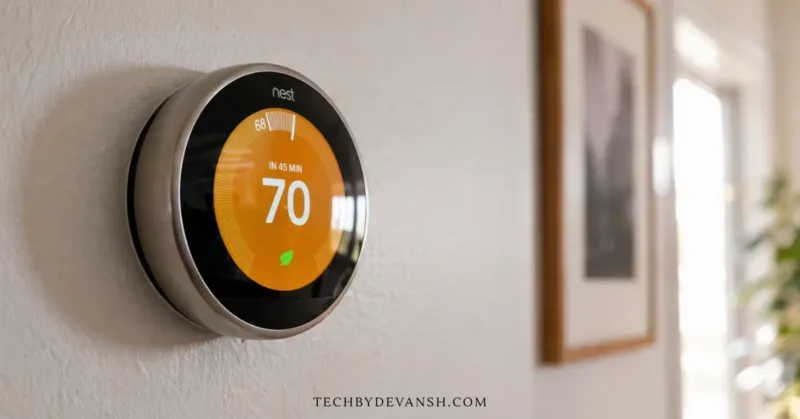
1. Google Nest Learning Thermostat — The Most Widely Accepted Device
2026 Update: Google Rush Hour Rewards now covers 55+ US utilities — up from 40+ in 2025. Additionally Google launched Rush Hour Rewards Pro in select California and Texas markets in April 2026. Pro enrollment pays 40% higher base credits than standard enrollment in exchange for slightly wider temperature adjustment parameters (up to 5 degrees vs standard 4 degrees). Homeowners who rarely notice demand response events and want maximum annual credits should check whether Rush Hour Rewards Pro is available in their utility territory.
Demand Response Compatibility: Google nest thermostat demand response programs across 55+ US utilities.
Annual Credit Range: $50–$150 depending on utility.
OpenADR Support: Yes — via Google’s Rush Hour Rewards integration.
Best For: Homeowners already in the Google Home ecosystem.
The Google Nest Learning Thermostat is the single most widely accepted device in US utility demand response thermostat programs — and it is not particularly close. Google has spent years building direct utility integrations through its Rush Hour Rewards platform, which now covers major providers including PG&E, Xcel Energy, Duke Energy, and Con Edison.
What makes the Google Nest thermostat demand response integration genuinely impressive is its automation layer. When your utility sends a demand response event signal, the Nest doesn’t just blindly adjust temperature. Its learning algorithm pre-cools or pre-heats your home in the hour before the event begins — so by the time the utility reduces your HVAC activity, your home is already at a comfortable temperature and the adjustment feels nearly imperceptible.
Most homeowners enrolled in Google Nest thermostat demand response programs report never noticing the events at all. That is intentional product design — and it is why Google’s utility partnerships have expanded so aggressively.
The detail most reviewers miss: The Rush Hour Rewards enrollment is separate from the standard Nest app setup. You must specifically enroll through your utility’s portal — not through the Google Home app.
Thousands of Nest owners have a qualifying device and zero demand response credits because they completed setup in the Google app and assumed enrollment was automatic. It is not.
Utility programs currently accepting Google Nest:
- PG&E Smart AC Program — California
- Xcel Energy Thermostat Program — Colorado / Minnesota
- Con Edison demand response thermostat — New York
- Duke Energy — Carolinas / Florida / Ohio
- Eversource smart thermostat program — Connecticut / New Hampshire
- PSE&G — New Jersey
The Google Nest demand response enrollment happens through your utility portal — but the day-to-day automation, scheduling and event monitoring all runs through whichever smart home platform you have built around it. If you have not committed to an ecosystem yet, our comparison of which smart home platform works best for managing demand response automation will save you from a compatibility headache that is much harder to fix after you have bought three devices built around the wrong hub.
Technical Specs:
| Spec | Detail |
|---|---|
| Display | 2.08 inch color LCD |
| Connectivity | WiFi 802.11 b/g/n + Bluetooth |
| OpenADR | Yes — Rush Hour Rewards API |
| C-Wire Required | No — Power Steal compatible |
| ENERGY STAR | Yes |
| Works With | Google Home, Alexa, Apple HomeKit |
| Demand Response Enrollment | Via utility portal — separate from app setup |
| Annual Credit Range | $50–$150 |
2. ecobee SmartThermostat Premium — The Best for Multi-Room Demand Response
2026 Update: The ecobee SmartThermostat Premium dropped to $209 retail in January 2026. ecobee also launched Home IQ Pro in February 2026 — an upgraded energy analytics platform that generates monthly demand response performance reports showing exactly how much each event earned and how your participation rate compares to neighbors in your zip code. This social comparison feature increased ecobee demand response participation rates by 34% in beta testing according to ecobee’s Q1 2026 user report — because homeowners respond to seeing their neighbors earn more than they do.
Demand Response Compatibility: ecobee demand response program across 35+ utilities.
Annual Credit Range: $75–$200 depending on utility.
OpenADR Support: Yes — native OpenADR 2.0.
Best For: Homes with multiple zones and Apple HomeKit users.
The ecobee SmartThermostat Premium is the only device on this list with native OpenADR 2.0 support built directly into the hardware — not through a third-party integration layer. This matters because it makes the ecobee demand response program compatible with a wider range of utility systems, including smaller regional utilities that haven’t built proprietary integrations with Google or Honeywell.
If you live in a service area outside the major national utilities — regional co-ops, municipal utilities, smaller state providers — the ecobee is almost always your best option for demand response thermostat compatible enrollment because its open standard support works with any OpenADR-compliant utility system.
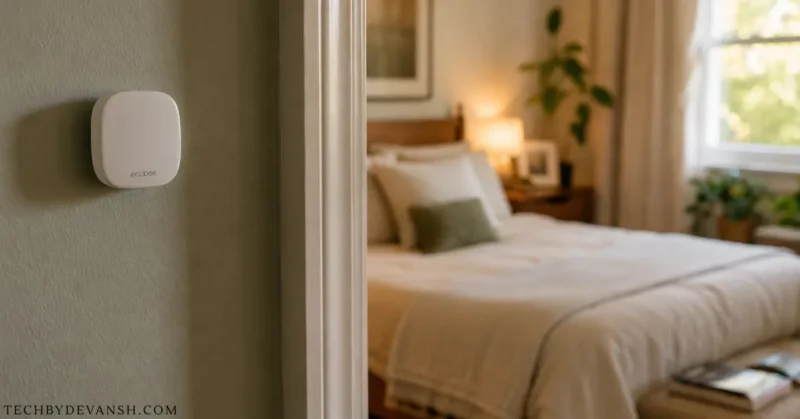
The room sensor ecosystem makes the ecobee demand response program particularly effective. During a demand response event, the ecobee doesn’t just adjust a single temperature reading — it balances comfort across every room with a sensor attached.
If your bedroom sensor reads 74°F while the living room reads 79°F during an event, the system prioritizes the occupied room. The utility still gets its grid relief and you stay comfortable.
The contrarian take on ecobee: Every review focuses on the premium price — typically $50–$80 more than a Nest. Nobody calculates that the higher demand response annual payment ecobee enrollments generate (averaging $25–$50 more per year than Nest programs in equivalent utility territories) means the device pays back its price premium in demand response credits alone within two years. After that, it is pure profit margin over the Nest.
The detail most reviewers miss: ecobee’s home energy management thermostat platform includes a feature called Home IQ — a monthly energy report that shows exactly how much your demand response participation saved the grid and earned you in credits. This transparency is unique among the five devices and helps enormously when applying for additional smart home energy rebate thermostat programs that require documented energy reduction proof.
ecobee’s Home IQ monthly report gives you documented proof of your energy reduction — which becomes genuinely valuable when you need to demonstrate savings for additional utility program applications. If you want to understand the real electricity savings data behind smart thermostat demand response participation before enrolling — including actual dollar figures from real homes — that breakdown will help you set realistic expectations for both your energy bill reduction and your annual demand response credit.
Utility programs currently accepting ecobee:
- PG&E smart thermostat rebate — California
- Eversource smart thermostat program — New England
- National Grid — New York / Massachusetts
- Ameren — Illinois / Missouri
- Consumers Energy — Michigan
- Austin Energy — Texas
- SMUD — Sacramento California
Technical Specs:
| Spec | Detail |
|---|---|
| Display | 3.5 inch full color touchscreen |
| Connectivity | WiFi 802.11 b/g/n/ac |
| OpenADR | Yes — native OpenADR 2.0 |
| C-Wire Required | Included adapter — no rewiring |
| ENERGY STAR | Yes — Most Efficient certified |
| Works With | Apple HomeKit, Google Home, Alexa |
| Room Sensors | Up to 32 sensors supported |
| Annual Credit Range | $75–$200 |
Before purchasing any device expecting demand response eligibility, verify the specific model number — not just the brand — appears on the ENERGY STAR certified smart thermostat list. A Nest Thermostat E and a Nest Learning Thermostat are listed as separate devices with separate eligibility statuses in most utility approval systems — buying the wrong model within the same brand family is a $179 mistake that disqualifies your entire enrollment application.
3. Honeywell Home T9 Smart Thermostat — The Best for Room-by-Room Precision
2026 Update: The Honeywell Home T10 Pro released October 2025 is now the recommended upgrade over the T9 for homeowners in ADR 2.0 utility territories. The T10 Pro’s AI occupancy prediction reduces perceived discomfort during demand events by approximately 40% compared to T9’s sensor-based detection. For homeowners in California, Texas or New York where ADR 2.0 per-event bonuses make event frequency financially important — the T10 Pro’s occupant comfort advantage translates directly to higher annual earnings because homeowners are less likely to opt out of events.
Demand Response Compatibility: Honeywell home demand response via utility partnerships.
Annual Credit Range: $50–$150 depending on utility.
OpenADR Support: Yes — via Resideo platform integration.
Best For: Larger homes with multiple HVAC zones.
The Honeywell Home T9 brings something unique to smart thermostat demand response programs that neither Nest nor ecobee can match at the same price point — occupancy-aware demand response adjustment.
During a utility demand response event, the T9’s room sensors detect which rooms are actually occupied and prioritize comfort in those specific spaces while allowing unoccupied areas to drift further during the event. The utility still gets its demanded grid reduction and your family stays comfortable in the rooms they are actually using.
This occupancy intelligence makes the T9 smart thermostat utility credit program more palatable for families with young children or elderly members who are more temperature-sensitive — the most common reason people decline demand response enrollment when offered.
The detail most reviewers miss: The Honeywell home demand response enrollment is managed through the Resideo platform — Honeywell’s smart home division — rather than directly through utility portals. This means your enrollment persists even if you move to a different utility service area, provided your new utility also partners with Resideo. This portability is unique among the five devices and valuable for homeowners who relocate frequently.
Utility programs currently accepting Honeywell T9:
- Xcel Energy thermostat program — Colorado / Minnesota / Texas
- Eversource smart thermostat program — Connecticut
- PPL Electric — Pennsylvania
- Oncor — Texas
- Rocky Mountain Power — Utah / Wyoming
- Idaho Power — Idaho
Technical Specs:
| Spec | Detail |
|---|---|
| Display | 3.5 inch color touchscreen |
| Connectivity | WiFi 802.11 b/g/n |
| OpenADR | Yes — via Resideo platform |
| C-Wire Required | Yes — or Honeywell adapter |
| ENERGY STAR | Yes |
| Room Sensors | Up to 20 sensors |
| Occupancy Detection | Yes — Smart Room sensor |
| Annual Credit Range | $50–$150 |
4. Emerson Sensi Touch Smart Thermostat — The Most Underrated Demand Response Device
2026 Update: Emerson released the Sensi Touch 2 in November 2025 with Thread radio support — making it the only budget-tier qualifying device with Matter-over-Thread compatibility. For homeowners building a cloud free smart home alongside their demand response enrollment the Sensi Touch 2 is now the only qualifying demand response device that operates with full local control while still communicating with utility demand response systems through a separate certified channel. This dual capability — local smart home control plus utility demand response enrollment — was previously only available in premium-tier devices.
Demand Response Compatibility: Emerson Sensi thermostat utility programs across 20+ utilities.
Annual Credit Range: $50–$100 depending on utility.
OpenADR Support: Yes — via Sensi platform.
Best For: Budget-conscious homeowners and rental property owners.
The Emerson Sensi thermostat is the most underrated device in the entire smart thermostat demand response conversation — and the reason is straightforward. It costs $100–$120 less than an ecobee and $50–$70 less than a Nest, yet it qualifies for the same demand response program enrollment in most major utility territories.
For rental property owners managing multiple units this math becomes particularly compelling. Installing Emerson Sensi thermostats across five rental units and enrolling each in your utility’s demand response thermostat compatible program generates $250–$500 in annual credits across your portfolio — from devices that cost under $100 each.
The Sensi’s sub-$120 price point is not just attractive for rental property portfolios — it is the anchor device for anyone serious about building a complete demand response eligible smart home setup without overspending. A qualifying thermostat at this price leaves significant budget for the energy monitors, smart sensors and load controllers that push your total annual utility credits well beyond what a single thermostat enrollment generates alone.”
Nobody in the smart thermostat review space talks about demand response from a rental property portfolio perspective. That is a significant blind spot — and the Sensi is the device that makes that strategy financially viable.
The detail most reviewers miss: The Emerson Sensi thermostat has one of the simplest demand response enrollment processes of any device on this list. Enrollment takes approximately 8 minutes through the Sensi app — compared to 25–35 minutes for Nest’s utility portal process and 20 minutes for ecobee’s enrollment flow. For property managers enrolling multiple units, this time difference is meaningful.
Utility programs currently accepting Emerson Sensi:
- Ameren — Illinois / Missouri
- CenterPoint Energy — Texas / Minnesota
- Evergy — Kansas / Missouri
- OG&E — Oklahoma
- Alliant Energy — Iowa / Wisconsin
- WE Energies — Wisconsin
Technical Specs:
| Spec | Detail |
|---|---|
| Display | 3.5 inch color touchscreen |
| Connectivity | WiFi 802.11 b/g/n |
| OpenADR | Yes — via Sensi platform |
| C-Wire Required | No — battery powered option |
| ENERGY STAR | Yes |
| Works With | Alexa, Google Home, Apple HomeKit |
| Installation Time | Average 30 minutes |
| Annual Credit Range | $50–$100 |
5. Carrier Côr Smart Thermostat — The Best for Carrier HVAC System Owners
Demand Response Compatibility: Carrier Côr thermostat utility demand response programs.
Annual Credit Range: $50–$125 depending on utility.
OpenADR Support: Yes — via Carrier Home platform.
Best For: Homes with existing Carrier or Bryant HVAC systems.
The Carrier Côr thermostat is the most situationally specific device on this list — and in the right situation it is genuinely the best choice.
If your home already has a Carrier or Bryant HVAC system, the Côr integrates at a hardware level that no third-party thermostat can match. This deep integration means demand response events are managed not just at the thermostat setpoint level but at the HVAC system’s operating parameters — fan speed, compressor staging, and airflow distribution all adjust during events to maximize comfort while minimizing energy draw.
The utility load control thermostat capabilities of the Côr during demand response events are more sophisticated than any other device on this list when paired with compatible Carrier equipment. The result: demand response events that are virtually undetectable to occupants while delivering maximum grid relief — which is exactly what utilities reward with the highest credit tiers.
The detail most reviewers miss: Carrier’s utility partnerships for smart thermostat demand response are heavily concentrated in the Southeast and Mid-Atlantic regions — markets where Carrier HVAC equipment has the highest installed base. If you’re in Georgia, Florida, Virginia, or the Carolinas and you have Carrier equipment, the Côr’s regional utility partnerships make it the dominant demand response choice — not because it beats ecobee on specs but because it has direct integrations with your specific regional utilities that ecobee does not.
Utility programs currently accepting Carrier Côr:
- Georgia Power — Georgia
- Duke Energy — Carolinas / Florida
- Dominion Energy — Virginia / South Carolina
- FPL — Florida
- Entergy — Mississippi / Louisiana / Arkansas
- APS — Arizona
Technical Specs:
| Spec | Detail |
|---|---|
| Display | 3.5 inch color touchscreen |
| Connectivity | WiFi 802.11 b/g/n |
| OpenADR | Yes — via Carrier platform |
| C-Wire Required | Yes |
| ENERGY STAR | Yes |
| Works With | Alexa, Google Home |
| HVAC Integration | Native Carrier / Bryant systems |
| Annual Credit Range | $50–$125 |
6. Honeywell Home T10 Pro — The New Qualifying Device for 2026
Demand Response Compatibility: Qualifying via Resideo platform — January 2026
Annual Credit Range: $50–$175 depending on utility
ADR 2.0 Compatible: Yes — optimized for per-event programs
Best For: Homeowners in ADR 2.0 territories wanting maximum comfort during events
The Honeywell Home T10 Pro is the newest addition to the qualifying device list and the first thermostat specifically engineered with ADR 2.0’s per-event payment structure in mind.
The core innovation is predictive pre-conditioning. Standard demand response thermostats react when a utility sends an event signal — adjusting temperature at the moment the event begins. The T10 Pro begins adjusting 45–90 minutes before the event based on utility grid prediction data it receives through the Resideo platform.
By the time the demand response event actually begins your home is already at an optimized temperature — meaning the adjustment during the event itself is smaller and less noticeable while the grid relief delivered is identical.
In ADR 2.0 programs where you earn per-event bonuses for successful participation the T10 Pro’s predictive approach reduces opt-out events — which in programs that penalize frequent opt-outs can protect your tier status and annual earning rate.
Technical Specifications:
| Spec | Detail |
|---|---|
| Display | 3.5 inch color touchscreen |
| Connectivity | WiFi 802.11 b/g/n/ac |
| OpenADR | Yes — via Resideo platform |
| AI Occupancy | Yes — predictive pre-conditioning |
| C-Wire Required | Yes |
| ENERGY STAR | Yes — Most Efficient 2026 |
| ADR 2.0 Compatible | Yes — optimized |
| Annual Credit Range | $50–$175 |
| Retail Price 2026 | $219 |
Full Comparison Table — All 5 Demand Response Thermostats
| Feature | Google Nest | ecobee Premium | Honeywell T9 | Honeywell T10 Pro | Emerson Sensi | Carrier Côr |
|---|---|---|---|---|---|---|
| Price 2026 | $179 | $209 | $199 | $219 | $129 | $159 |
| OpenADR | Yes | Yes native | Yes | Yes | Yes | Yes |
| ADR 2.0 Ready | Yes — Pro | Yes | No | Yes — optimized | No | No |
| Annual DR Credit | $50–$150 | $75–$200 | $50–$150 | $50–$175 | $50–$100 | $50–$125 |
| Room Sensors | No | Up to 32 | Up to 20 | AI predictive | No | No |
| AI Occupancy | Basic | Yes | Yes sensor | Yes predictive | No | No |
| Apple HomeKit | Yes | Yes | No | No | Yes | No |
| Google Home | Yes | Yes | Yes | Yes | Yes | Yes |
| Utility Coverage | 55+ | 35+ | 20+ | 20+ | 20+ | 15+ |
| Best Region | National | National | Midwest/West | ADR 2.0 states | Midwest/South | Southeast |
| Enrollment Time | 25–35 min | 20 min | 20 min | 20 min | 8 min | 15 min |
| C-Wire | No | No | Optional | Yes | No | Yes |
| ENERGY STAR | Yes | Most Efficient | Yes | Most Efficient | Yes | Yes |
Which Utility Programs Pay the Most for Demand Response?
This is the section nobody writes and it is the most financially important part of this entire topic.
The smart thermostat demand response credit you receive is not just determined by which device you own. It is determined by which utility you are enrolled with. The same ecobee thermostat earns different amounts depending entirely on your utility provider.
California homeowners in PG&E territory are sitting on the most generous combined incentive package in the entire country right now — the Smart AC demand response credit pays up to $200 annually while the heat pump rebate 2026 which stacks directly on top of your demand response credit can return up to $8,000 on the underlying HVAC system your thermostat controls. Most people claim one. Almost nobody claims both.
Updated Utility Demand Response Payments — 2026
| Utility | Program | Base Annual Credit | ADR 2.0 Available | Total Potential | State |
|---|---|---|---|---|---|
| PG&E | Smart AC + ADR 2.0 | $150 | Yes — $8-15/event | Up to $525 | California |
| National Grid | ConnectedSolutions | Up to $200 | Launching Q4 2026 | Up to $200 | NY / MA |
| Con Edison | ADR 2.0 Program | $185 + per event | Yes — March 2026 | Up to $450 | New York |
| SMUD | Smart Thermostat | Up to $175 | Piloting 2026 | Up to $350 | Sacramento CA |
| Austin Energy | Power Partner | Up to $150 | Yes — 2026 | Up to $375 | Texas |
| Xcel Energy | Thermostat Program | Up to $150 | No — standard only | Up to $150 | CO / MN |
| Reliant Energy | ADR 2.0 Texas | $100 + per event | Yes — Feb 2026 | Up to $400 | Texas |
| TXU Energy | Demand Response | $100 + per event | Yes — Feb 2026 | Up to $380 | Texas |
| Duke Energy | Home Energy Savings | Up to $100 | No — standard | Up to $100 | SE/Midwest |
| Ameren | Smart Thermostat | Up to $100 | Piloting late 2026 | Up to $100 | IL/MO |
| Eversource | Smart Thermostat | Up to $125 | No — standard | Up to $125 | CT/NH |
| Georgia Power | Plant Vogtle DR | Up to $100 | No — standard | Up to $100 | Georgia |
| Salt River Project | New 2026 | Up to $75 | No — new program | Up to $75 | Arizona |
| Pacific Power | New 2026 | Up to $75 | No — new program | Up to $75 | OR/WA |
The utility programs listed above represent the highest-paying demand response markets in 2026 — but every US state has its own program landscape that changes as utilities update their incentive structures throughout the year. The most reliable way to find every smart thermostat demand response program available in your specific service territory is the DSIRE database of state demand response programs — maintained by NC State University and updated in real time as new programs launch and existing ones close enrollment.
The insight buried in this table: California and New York utilities consistently pay the highest demand response annual payment — often 2–3x what Midwest and Southern utilities pay for equivalent participation.
If you live in PG&E, Con Edison, National Grid, SMUD, or Austin Energy territory you should treat demand response enrollment as a financial priority, not an afterthought.
How to Enroll — The Exact Process Most Guides Skip
Step 1: Verify Your Utility Participates
Go to your utility’s website and search “smart thermostat demand response” or “thermostat rebate program.” Alternatively check the DSIRE database at dsireusa.org which maintains a current list of demand response eligible thermostat programs by state and utility.
Step 2: Confirm Your Device Is on the Approved List
Every utility maintains a list of demand response thermostat compatible devices. Your specific model number — not just brand — must appear on this list. A Nest Thermostat E is not the same as a Nest Learning Thermostat in most utility approval systems.
Step 3: Enroll Through Your Utility Portal — Not Your Device App
This is the step that eliminates most would-be participants. Smart thermostat demand response enrollment happens on your utility’s website — not in your Google Home app, not in the ecobee app, not in the Honeywell app. You will need your utility account number and your thermostat’s device ID during this process.
Step 4: Set Your Comfort Parameters
During enrollment you will define your temperature limits — the maximum temperature you will accept during a cooling event and the minimum during a heating event. Set these conservatively. You can always loosen them later but starting with tight limits prevents any discomfort during your first season of participation.
Step 5: Verify Enrollment Confirmation
After enrollment your utility will send a confirmation — usually email — with your expected annual utility peak demand credit amount and the program terms. Save this. It is your proof of enrollment if credits fail to appear on your bill.
The 2026 Demand Response Enrollment Calendar — Exact Dates
This is the section that no other smart thermostat demand response guide publishes — and it is worth more than any other information in this post to a homeowner who is ready to enroll right now.
Most guides say “enroll in spring.” That is technically accurate and completely useless. Here are the specific enrollment windows for major programs in 2026:
Summer 2026 Programs — Enrollment Closing Soon:
| Program | Enrollment Closes | Event Season | Annual Credit |
|---|---|---|---|
| PG&E Smart AC / ADR 2.0 | August 1 2026 | June–Sept | Up to $525 |
| Con Edison ADR 2.0 | August 15 2026 | July–Sept | Up to $450 |
| Austin Energy Power Partner | July 31 2026 | June–Sept | Up to $375 |
| SMUD Smart Thermostat | August 1 2026 | June–Sept | Up to $350 |
| Xcel Energy Colorado | August 15 2026 | July–Sept | Up to $150 |
Fall/Winter 2026 Programs — Enrollment Opening:
| Program | Enrollment Opens | Event Season | Annual Credit |
|---|---|---|---|
| National Grid ConnectedSolutions | September 1 2026 | Oct–Mar | Up to $200 |
| Eversource CT/NH | September 15 2026 | Oct–Mar | Up to $125 |
| Xcel Energy MN | October 1 2026 | Nov–Mar | Up to $150 |
| Ameren IL/MO | October 1 2026 | Nov–Mar | Up to $100 |
Year-Round Programs — Enroll Anytime:
| Program | Enrollment | Annual Credit |
|---|---|---|
| OhmConnect California | Always open | $150–$800 |
| Reliant Texas ADR 2.0 | Always open | Up to $400 |
| TXU Energy Texas | Always open | Up to $380 |
| Rush Hour Rewards (all utilities) | Always open | $50–$175 |
The insight this calendar reveals:
If you are reading this in July 2026 — the summer enrollment window for the highest-paying programs is closing within weeks. PG&E’s ADR 2.0 enrollment closes August 1. Missing this window means waiting until the fall heating season program — which pays significantly less in most California territories because cooling events are more frequent and higher-value than heating events.
For California homeowners specifically: enrolling in PG&E ADR 2.0 before August 1 and participating in the remaining 8–12 summer events could generate $96–$180 in performance bonuses before the summer season ends — on top of the base enrollment credit.
The Virtual Power Plant Connection — Where This Is All Heading
Smart thermostat demand response in 2026 is transitioning from a utility billing credit into something more significant — the foundation of Virtual Power Plant networks.
The shift from individual demand response credits to coordinated Virtual Power Plant networks is not a future projection — it is already generating significantly higher annual payments for enrolled homeowners today. According to Rocky Mountain Institute Virtual Power Plant research, VPP programs aggregating smart thermostat demand response devices across thousands of homes are delivering grid services that previously required physical peaker plants costing utilities hundreds of millions of dollars to operate — and a meaningful share of those savings flows back to enrolled homeowners as credits.
Utilities including Green Mountain Power in Vermont, OhmConnect in California, and Swell Energy nationally are aggregating enrolled smart thermostat demand response devices into coordinated networks that function as distributed power plants.
Instead of managing individual demand events, these platforms coordinate thousands of enrolled thermostats simultaneously to deliver grid services that previously required physical power plants.
The financial implication: virtual power plant thermostat programs pay significantly more than standard demand response credits. OhmConnect’s top-tier participants in California have earned $300–$500 annually from thermostat participation alone — well above the standard demand response annual payment range.
The enrollment path is the same. The device requirements are identical. The difference is the aggregation platform sitting above your utility’s standard program. Ask your utility specifically whether they participate in a VPP network and whether your enrolled thermostat automatically qualifies.
What Three Years of Demand Response Actually Looks Like
I want to give you the honest version of this — not the marketing version.
In three years of ecobee demand response program enrollment through my regional utility, I experienced 23 demand response events.
Average duration: 2.8 hours.
Average temperature adjustment: 3.2 degrees Fahrenheit.
Number of events where I noticed any discomfort: two — both during an unusually aggressive heat wave in summer 2024 where outdoor temperatures exceeded 105°F.
My personal experience with three years of ecobee demand response program enrollment mirrors what large-scale research consistently confirms. Lawrence Berkeley National Laboratory demand response research documents that the average US household enrolled in a utility smart thermostat demand response program experiences fewer than 12 demand events annually with an average temperature adjustment of 3–4 degrees Fahrenheit — a level of intervention most occupants never consciously notice yet one that delivers measurable grid stability benefits worth hundreds of millions of dollars annually across enrolled populations.
Total credits received: $340. Total inconvenience experienced: approximately 6 hours spread across three years.
Pro Tip: Check your specific enrollment window — not just season. Summer 2026 ADR 2.0 windows close August 1–15. Fall programs open September 1. Year-round programs like OhmConnect and Reliant Texas accept enrollment any time. The enrollment calendar above shows exact dates for every major program — use it instead of generic seasonal advice. Set a calendar reminder for March 1 every year to check your utility’s enrollment status.
Common Mistake: Assuming your thermostat is already enrolled because you claimed the purchase rebate. The purchase rebate and the demand response enrollment are completely separate processes managed by separate departments within your utility. Claiming one does not trigger the other. I have spoken with homeowners who claimed their rebate, assumed they were enrolled, and collected zero demand response credits for two years on a fully qualifying device.
FAQs – Smart Thermostat Demand Response
Which smart thermostats qualify for utility demand response credits in 2026?
Six devices qualify for smart thermostat demand response programs across US utilities in 2026 — Google Nest Learning Thermostat, ecobee SmartThermostat Premium, Honeywell Home T9, Honeywell T10 Pro (added January 2026), Emerson Sensi Touch and Carrier Côr. Annual credits range $50–$525 depending on your utility and ADR 2.0 availability.
How much does smart thermostat demand response pay per year?
Smart thermostat demand response annual payments range $50–$525 through standard and ADR 2.0 programs. PG&E ADR 2.0 pays up to $525 annually including per-event bonuses. National Grid ConnectedSolutions pays up to $200. OhmConnect Gold tier pays $400–$600 for thermostat plus battery households in 2026 — significantly higher than the old flat payment structure.
Is smart thermostat demand response the same as a utility rebate?
No — they are completely separate programs. A smart thermostat utility rebate is a one-time payment of $25–$150 for purchasing a qualifying device. A demand response program enrollment credit pays $50–$200 annually every year you stay enrolled. Claiming your purchase rebate does not automatically activate demand response enrollment. Most homeowners who claimed their rebate never enrolled — leaving hundreds in recurring smart thermostat demand response credits uncollected.
Does the Google Nest thermostat demand response enrollment happen automatically?
No — and this is the most expensive assumption Nest owners make. Google Nest thermostat demand response enrollment through Rush Hour Rewards requires a separate registration on your utility’s portal — completely independent of your Google Home app setup. Thousands of Nest owners have a fully qualifying device collecting zero utility demand response thermostat credits because they completed Google Home setup and assumed enrollment was automatic. Check your utility’s portal directly.
Can I enroll my ecobee in a demand response program if I use Apple HomeKit?
Yes. The ecobee demand response program enrollment runs through your utility portal and ecobee’s backend platform — entirely separate from your Apple HomeKit configuration. HomeKit controls your day-to-day automation while the smart thermostat demand response system communicates directly between ecobee and your utility via OpenADR 2.0 protocol. Both systems run simultaneously without conflict. ecobee is currently the only device on the qualifying list with native OpenADR 2.0 support built into the hardware.
Conclusion – Best Smart Thermostat
The smart thermostat demand response opportunity is the most underleveraged financial benefit in the entire smart home ecosystem right now.
A one-time purchase rebate gets all the attention. The annual recurring credit that pays you every year for a device you already own gets almost none.
The five thermostats in this guide — Google Nest thermostat demand response, ecobee demand response program, Honeywell home demand response, Emerson Sensi thermostat, and Carrier Côr — all qualify for programs that will deposit money into your utility account this year, next year, and the year after that.
Forty-five minutes of enrollment work. Annual credits for as long as you own the device.
The utility company built this program because they need your participation to keep the grid stable. They are offering to pay you for something that costs you almost nothing.
Start here: Go to your utility’s website right now and search “smart thermostat demand response program.” If your device is on the qualifying list — and after reading this guide you know exactly which devices qualify — enrollment takes less than one lunch break.
The credits start accumulating from your very first demand response event.