
Last Updated: August 2026
Most “future tech trends 2030” articles are just guesswork dressed up as forecasting. This one isn’t. Every trend below is already showing up in real labs, real launches, and real product roadmaps as of mid-2026 — so instead of vague predictions, you’re getting a status update on where each technology genuinely stands right now, four years out from 2030.
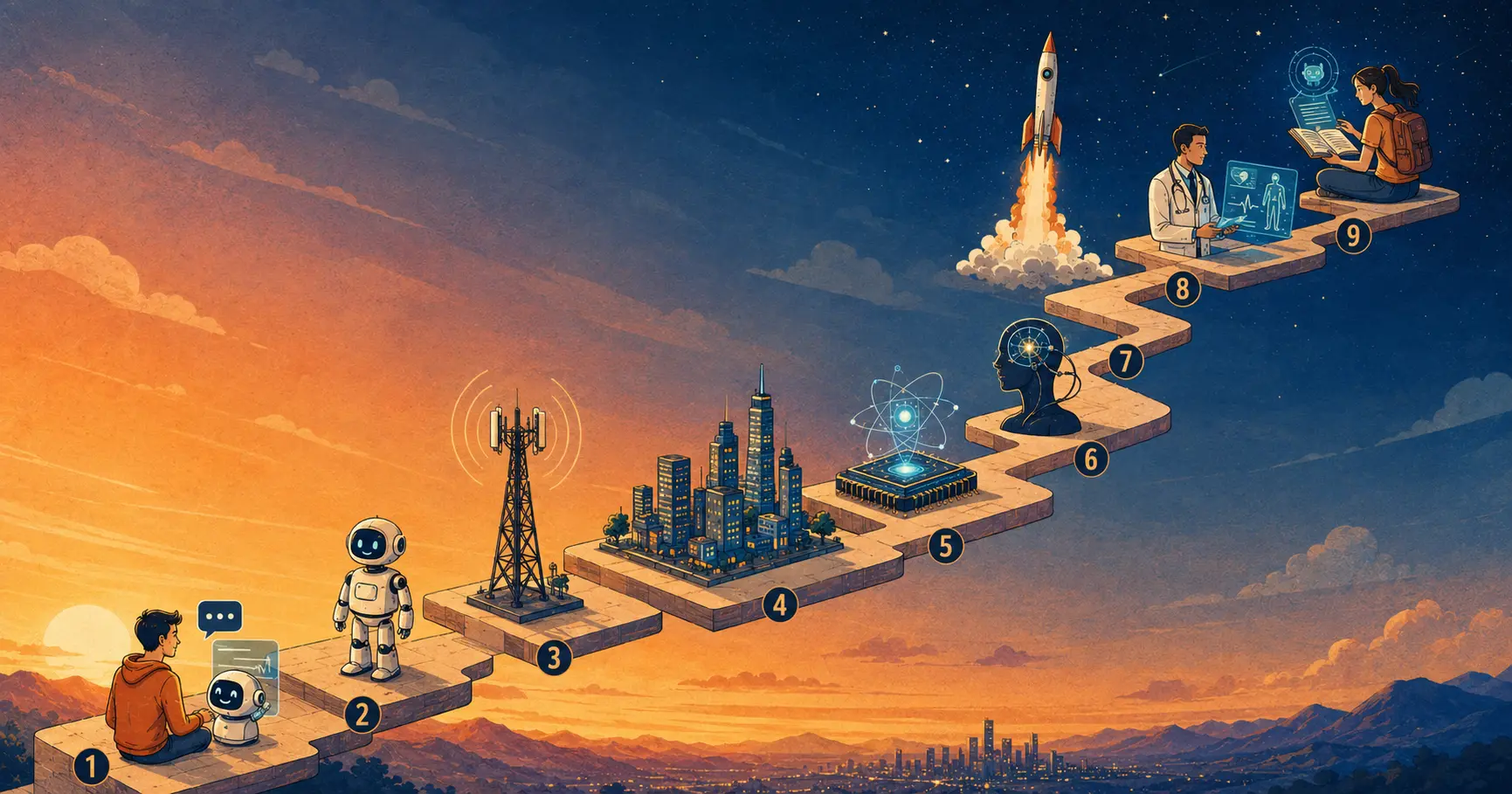
Quick answer: By 2030, the biggest shifts will come from AI agents handling real tasks autonomously, 6G standards locking in for early rollout, quantum computers hitting practical (not just theoretical) milestones, brain-computer interfaces moving from single patients to real trial programs, and NASA’s Artemis missions putting humans back on the Moon as a stepping stone to Mars. None of this is speculation anymore — it’s already underway.
Ten years ago, nobody expected AI tools, self-driving cars, smart homes, or face recognition to become part of daily life — and now they’re normal. The next few years will bring changes just as big, and 2026 has already given us hard evidence of what’s coming.

Table of Contents
Top Future Tech Trends Actually Shaping 2030
1️⃣ AI Agents Are Replacing “AI Assistants”
The AI conversation moved past chatbots in 2026. The real trend now is agentic AI systems that don’t just answer questions but actually complete multi-step tasks on their own: booking things, managing workflows, debugging code, and coordinating with other tools without you supervising every step.
If you want to actually build these skills instead of just reading about them, I put together a full Agentic AI Learning Path for 2026 that walks through it from beginner to expert. And if you’re curious how these agents perform in the real world versus the hype, I reviewed one of the most talked-about ones in Manus AI: Is This New AI Agent Better Than Devin?
What to expect by 2030:
- AI agents that manage entire workflows, not single tasks
- Personal AI that tracks health, finances, and study progress together
- Real-time multilingual translation baked into everyday apps
- AI-assisted coding and research as the default, not the exception
AI won’t replace people outright but it’s already changing what a “normal” job looks like, and that shift accelerates every year between now and 2030.
2️⃣ Robotics & Automation Everywhere
Robots are one of the clearest future tech trends 2030 will be judged by not as novelty demos, but as genuinely useful tools. Japan and the US are already piloting real deployments at scale:
| Type of Robot | Purpose |
|---|---|
| Service Robots | Restaurants, hotels, deliveries |
| Care Robots | Elderly care & hospitals |
| Industrial Robots | Manufacturing & heavy work |
| Personal Robots | Home cleaning & assistance |
By 2030, expect this to be less “cool tech demo” and more “normal appliance” — the same way robot vacuum cleaners went from novelty to standard household item.
3️⃣ 6G: Standards Are Locking In Now, Not “Someday”
This is where a lot of older tech-trend articles get it wrong 6G isn’t a vague future idea anymore.
In June 2026, the 3GPP (the body that sets global mobile standards) finalized the timeline for Release 21, the first release expected to formally define 6G.
Full specifications are targeted for completion around 2029, with early commercial deployments realistically starting in 2028–2029 in countries like South Korea, Japan, and China, and broader rollout following into 2030.
When it does arrive, 6G will enable:
- Holographic calls and instant VR/XR experiences
- Massive IoT device communication at once
- Real-time self-driving car coordination
- Remote surgery with near-zero latency
The honest takeaway: 6G in 2030 will still be in its early rollout phase for most of the world, not fully mainstream — so don’t expect it to replace 5G overnight.
4️⃣ Smart Cities Powered by IoT
Smart cities are one of the most practical future tech trends 2030 will bring to everyday life — IoT managing daily infrastructure like traffic signals, energy-efficient street lighting, waste management, and emergency alerts, all connected and automated.

With IoT, we will see the rise of smart cities technology 2030, improving daily life such as:
- Traffic signals & parking
- Energy-efficient street lights
- Garbage and waste management
- Smart energy usage
- Emergency alerts
I’ve actually built a hands-on version of this kind of safety-focused IoT system myself — check out my IoT-based driver sleep detection and alarm system using Raspberry Pi, and if you want the bigger picture of how AI and IoT are merging in homes right now, I’ve also covered that in AI and IoT Smart Homes.
Everything — from home appliances to transportation — will be connected and automated, creating safer and smarter cities.
5️⃣ Quantum Computing: From Lab Curiosity to Engineering Reality
This is the trend that’s changed the most since the original predictions.
Quantum computing crossed a real threshold in 2026: Google’s Willow processor demonstrated genuine below-threshold error correction, and IBM has publicly targeted quantum advantage by the end of 2026 and a fault-tolerant quantum computer by 2029 on its official quantum roadmap.
What quantum computing is realistically good for by 2030:
- Accelerating new medicine and materials discovery
- Modeling climate change scenarios faster
- Advanced cybersecurity and post-quantum encryption
- Complex logistics and optimization problems
The honest caveat: fully practical, everyday quantum computing is still further out than 2030. What’s changing right now is that it’s moved from “theoretical someday” to “actively being engineered on a public timeline” — which is a meaningfully different stage.
6️⃣ Brain–Computer Interfaces (BCI) Are No Longer Just One Patient
Brain-computer interfaces are one of the most surprising future tech trends 2030 will inherit early. The original BCI story was about one Neuralink patient playing chess with his thoughts. That’s no longer the whole picture.
By 2026, Neuralink has implanted its device in over a dozen patients, secured FDA Breakthrough Device Designation for speech restoration, and is targeting high-volume production with a more automated surgical process.
Competing approaches like Synchron’s less invasive Stentrode are also progressing through real clinical trials.

How it works:
A tiny device is implanted in the brain that listens to neural signals and translates them into digital commands — allowing users to control devices just by thinking.
Realistic BCI uses by 2030:
- Helping paralyzed patients control computers and prosthetics by thought
- Early-stage vision restoration research
- Treatment pathways for certain brain-related conditions
- Long-term: hands-free device control for broader use cases
This is still medical-first technology, not consumer tech — but the pace of real clinical progress between 2024 and 2026 has been faster than most predictions expected.
7️⃣ Space Tech: Moon Missions Are Already Happening

Space exploration might be the most visible of all future tech trends 2030 will be remembered for. This isn’t a future prediction anymore it’s current events. NASA’s Artemis II mission launched in April 2026, carrying astronauts on a roughly 10-day crewed flight around the Moon the farthest humans have traveled from Earth.
It’s the first crewed lunar mission since Apollo in the 1970s. Artemis III and IV are set to follow with the actual crewed lunar landing, building toward the long-term goal of a sustained Moon presence and, eventually, crewed Mars missions.
Alongside NASA, SpaceX and Blue Origin are racing to build the lunar landers needed for these missions, and satellite internet coverage is expanding rapidly worldwide. Space is steadily becoming a commercial industry, the same way commercial air travel once was.
8️⃣ AI-Based Personalized Healthcare
Healthcare is one of the future tech trends 2030 will change the most for ordinary people. Expect AI and real-time sensors to drive early disease detection, digital medical reports, personalized diet guidance, and virtual health assistants.
The goal isn’t replacing doctors — it’s catching problems earlier and reducing unnecessary hospital visits.
9️⃣ Education Will Go Fully AI-Based
Education is where future tech trends 2030 will show up earliest, since students are already living it. Classrooms by 2030 will center on AI tutors, VR-based lessons, real-time feedback, and practical simulations with a growing emphasis on skills over degrees.
If you’re a student trying to get ahead of this shift now rather than in 2030, I’ve put together a practical breakdown of AI tools for content creators and workflows that are already useful today, not just future concepts.
How Technology Will Change Jobs by 2030
Some roles will shrink. Others will grow. Skills will matter more than degrees.
| Jobs That May Reduce | Jobs That Will Increase |
|---|---|
| Data entry | AI trainers & auditors |
| Manual labor | Robotics technicians |
| Basic support | Machine learning engineers |
| Cashiers | Cybersecurity experts |
| Drivers (automation) | Drone operators |
This shift isn’t limited to AI roles either — it’s already reshaping entire fields like DevOps, where automation and AI are changing what the job actually looks like day to day.
Future tech trends 2030 jobs will reward creativity, critical thinking, AI literacy, and human judgment — the things automation still can’t fully replace.
Challenges We Must Face
Progress this fast doesn’t come free, and no honest look at future tech trends 2030 can skip the risks:
- Job displacement fear in automatable roles
- Cybersecurity risks scaling alongside connected infrastructure
- Data privacy concerns, especially with BCI and health tech
- Overdependence on AI systems for critical decisions
- Mental health impact of an increasingly automated, always-connected world
Building ethical, human-centered technology isn’t optional here — it’s the difference between a 2030 that works for people and one that just works.
FAQs – Future Tech Trends 2030
What are the biggest tech trends for 2030?
AI agents handling real autonomous tasks, 6G network standardization, practical quantum computing milestones, brain-computer interfaces moving into broader clinical trials, and continued Moon and Mars space missions are the trends with the most concrete evidence right now.
Will 6G be available by 2030?
Early commercial 6G rollout is expected to begin around 2028–2029 in leading markets like South Korea, Japan, and China, with broader global availability continuing to expand through and beyond 2030.
Is quantum computing practical yet?
Not for everyday use, but 2026 marked a real turning point — Google and IBM have both hit verified error-correction and advantage-related milestones, with IBM targeting a fault-tolerant quantum computer by 2029.
Will AI replace jobs by 2030?
Some repetitive, automatable roles will shrink, but new roles in AI training, robotics, cybersecurity, and machine learning are growing just as fast. Skills will matter more than job titles.
What is the current status of brain-computer interfaces?
As of 2026, Neuralink has implanted devices in more than a dozen patients and is scaling toward high-volume production, while competitors like Synchron are progressing through their own clinical trials — this is still medical technology, not consumer tech, going into 2030.
Conclusion — The Future Isn’t Coming, It’s Already Here
The honest version of “future tech trends 2030” isn’t a list of sci-fi predictions — it’s a snapshot of technology that’s already shipping, already in clinical trials, already standardized, and already in orbit.
By 2030, the difference won’t be that these things exist; it’ll be how mainstream and refined they’ve become.
The AI-powered future has already started. What happens between now and 2030 will decide how well we actually use it.
If you want to stay ahead of these shifts instead of reading about them after the fact, follow TechByDevansh — I break down complex tech trends in plain, easy-to-understand language as they actually happen.