

Last Updated: September 2026
In today’s world, technology is growing faster than ever, and one skill that keeps climbing every year is DevOps. Students, freshers, developers, and even working professionals constantly search:
👉 “Is DevOps a good career in India?”
The short answer is still yes — but the honest 2026 answer is more specific than that, and it matters. DevOps as a single, static job title is quietly splitting into several higher-paying specializations, and which path you take from here will affect your salary ceiling far more than just “learning DevOps” ever will. Let’s go through the real picture, not just the encouraging headline.
Table of Contents
What Is DevOps? (Simple Explanation)
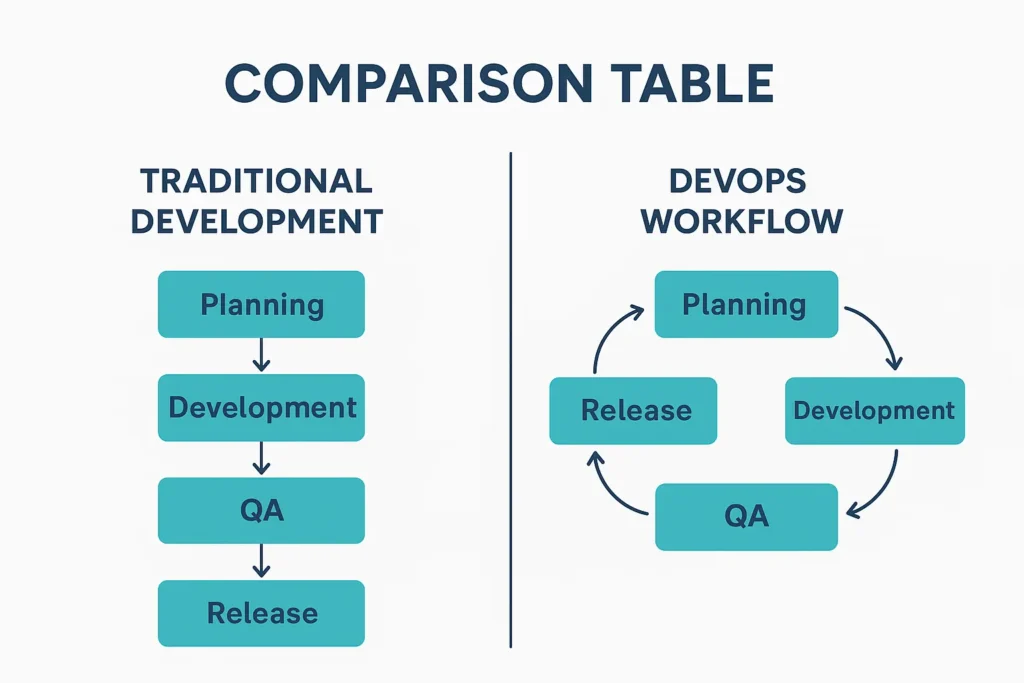
DevOps is a culture and process where development (Dev) and operations (Ops) teams work together to build, test, and deploy software faster and more efficiently.
Instead of working separately, both teams collaborate using automation tools, cloud platforms, scripting, CI/CD pipelines, containers, and monitoring systems.
The Goal of DevOps Is Simple:
- Build software quickly
- Fix errors faster
- Deploy updates automatically
- Improve quality and security
- Work smarter — not harder
Why DevOps Matters in 2026
The tech industry is changing rapidly. Companies demand speed, automation, cloud computing, reliability, and security—and DevOps provides exactly that.
That’s why DevOps demand in India is increasing every year.
DevOps is also deeply tied to future technologies — read my blog on Future Tech Trends 2030 if you want the bigger picture.
Why Companies Need DevOps
| Reason | Impact |
|---|---|
| Faster software delivery | Quick release cycles |
| Automation | Less manual work |
| Cost reduction | Saves resources |
| Better collaboration | Smooth teamwork |
| Strong security | Fewer bugs & crashes |
In simple words: DevOps = Speed + Automation + Quality
The Real 2026 Shift: DevOps Is Splitting Into Specializations
This is the part most “is DevOps a good career in india” articles still haven’t caught up to, and it’s genuinely the most important update for anyone planning their next few years.
DevOps as a single generalist title is fragmenting into distinct, higher-paying specializations:
Platform Engineering (building internal developer platforms with self-service tooling and automated compliance guardrails),
SRE — Site Reliability Engineering (owning uptime, SLOs, and error budgets),
DevSecOps (security folded directly into the pipeline using dedicated devops security tools, especially in demand across compliance-heavy industries like banking and healthcare), and
MLOps (managing AI infrastructure — arguably the fastest-growing technical niche in India right now, given how much AI deployment work has exploded since 2025).

Engineers who build internal developer platforms with self-service capabilities and automated guardrails are commanding salary premiums of 30–45% over generalist DevOps roles. This isn’t a future prediction — it’s already showing up in 2026 hiring data.
If you’re early in your DevOps career roadmap, the smartest move isn’t just “learn DevOps” anymore. It’s picking one of these four lanes deliberately once you have the fundamentals down.
I go deeper into exactly which skills will and won’t matter in Is DevOps Dead in 2027? The 3 Skills You Actually Need Now, if you want to plan further ahead than just this year.
Who Should Choose DevOps?
DevOps is not only for hardcore coders or cloud experts. It is a good fit for anyone who enjoys solving real problems, automating boring tasks, and working close to both code and infrastructure.
DevOps is a strong option if you are:
- BCA student or graduate who wants a skill‑based IT career instead of only support roles. For a detailed breakdown, read this full guide on DevOps career after BCA in India.
- BTech / BSc CS or IT student who likes both coding and systems, and does not want to stay only in pure development or pure support.
- Support engineer, system admin, or NOC engineer who already works with servers and wants to move into a higher‑paying, more modern role.
- Manual tester or QA engineer interested in automation, CI/CD pipelines, and working closer to production.
- Software developer who wants more ownership over deployments, reliability, and performance, not just writing features.
If you see yourself in any of these groups and enjoy learning tools and workflows, DevOps — or one of its emerging specializations — can be a genuinely strong long-term career path.
DevOps Engineer Salary in India (2026) — The Real Numbers
Salary is usually the deciding factor in whether is devops a good career in india for someone specifically, so let’s get the actual numbers right.
Salary data varies a lot depending on the source, company type, and city, so here’s a realistic, honest range pulled from multiple 2026 hiring reports rather than one optimistic number.
| Experience Level | Realistic Salary Range (Per Year) |
|---|---|
| Freshers | ₹4 LPA – ₹9 LPA |
| 2–5 Years Experience | ₹15 LPA – ₹35 LPA |
| Senior Level (5–8 yrs) | ₹35 LPA – ₹60 LPA |
| Principal / Staff Platform Engineer (8+ yrs) | ₹52 LPA – ₹80 LPA at top product firms |
| Remote Jobs (USA) | $118K – $220K+ per year |

A few honest nuances worth knowing: product companies and unicorns pay 40–60% more than IT services firms for the same title and experience, because always-on infrastructure directly drives their revenue. Bengaluru continues to pay 20–35% more than tier-2 cities. And if you have 5 years of experience and you’re earning under ₹16 LPA in 2026, you’re meaningfully below market — the fix is usually just interviewing elsewhere, since even one product-company offer resets your benchmark entirely.
Did you know? Many DevOps engineers work remotely for US and European companies while living in India — earning international salary packages and experience without relocating.
Most Used DevOps Tools in Real Companies
| Tool | Purpose |
|---|---|
| Git | Version control |
| Jenkins | CI/CD automation |
| Docker | Create containers |
| Kubernetes | Manage containers |
| Terraform | Infrastructure as code |
| Ansible | Server automation |
| AWS / Azure / GCP | Cloud platforms |
Tip: If you learn one cloud platform, CI/CD, and scripting well, you’re already ready for entry-level devops engineer jobs. Depth in fewer tools beats shallow exposure to everything.
DevOps Certifications That Actually Move Your Salary in 2026
This is genuinely new information most “is DevOps a good career” guides skip entirely, and it’s directly actionable.
Certifications reliably add real money to your offer, especially between 2–6 years of experience:
AWS DevOps Engineer Professional (+20–30%),
CKA — Certified Kubernetes Administrator (+18–28%),
GCP Professional DevOps Engineer (+20–30%),
HashiCorp Terraform Associate (+10–18%), and
Azure DevOps Expert (+12–20%).
Stacking multiple cloud certifications compounds these premiums further.
The honest caveat: certifications get you past resume screening and into interviews. They don’t replace real production experience — demonstrated reliability and cost impact are what actually push you into the higher offer band once you’re in the room.
Skills Required for a DevOps Job
Many beginners think they need to master everything at once — that’s not true. Learn even 50–60% of the core skills well, and you can genuinely apply for entry-level jobs and internships.
Core Skills to Learn:
- Git & GitHub
- Linux basics
- Shell / Python scripting
- CI/CD pipeline fundamentals
- Docker & Kubernetes
- AWS / Azure / GCP (pick one deeply first)
- A genuine problem-solving mindset
If you’re learning on a budget, I’ve put together a full list of Best Free DevOps Courses & Certifications to help you get started without spending anything upfront.
DevOps Career Roadmap for Beginners (2026)
| Step | What to Learn |
|---|---|
| Step 1 | Linux + Git |
| Step 2 | Shell/Python scripting |
| Step 3 | CI/CD pipelines |
| Step 4 | Docker |
| Step 5 | Kubernetes |
| Step 6 | AWS / Azure / GCP |
| Step 7 | Real projects & resume, then pick a specialization (Platform, SRE, DevSecOps, or MLOps) |

If you’ve decided that DevOps is right for you, follow this DevOps engineer roadmap 2026 to see exactly what to learn step by step.
DevOps Demand in India (2026 Statistics)
- DevOps continues to be one of the most reliably well-paid specializations in Indian tech, because engineers who keep systems reliable, scalable, and cost-efficient remain genuinely scarce relative to demand
- Highest demand remains concentrated in Bengaluru, Pune, Hyderabad, Mumbai, and the NCR region
- Global Capability Centers (GCCs) now pay 30–60% more than IT services firms for the same title — arguably the most underused lever in most engineers’ career planning
- Remote DevOps roles for US and European companies continue expanding rapidly
Digital transformation, AI infrastructure growth, and cloud migration together mean more DevOps-adjacent jobs and rising salaries, not fewer.
Is DevOps a good career in india for Freshers?
Yes — DevOps remains a strong career option for freshers in 2026. Many companies still hire freshers and train them if they arrive with basic Linux, Git, and scripting knowledge already in place.
Why freshers should still learn DevOps:
- No advanced coding required to get started
- Genuinely easy to pivot in from different IT backgrounds
- Practical, demonstrated knowledge matters more than pure theory
- Multiple future paths open up from here — Cloud, AI/MLOps, IoT, Security
Real Companies Using DevOps in India
| Industry | Companies |
|---|---|
| IT & Cloud | TCS, Infosys, Wipro, Cognizant |
| Ecommerce | Amazon, Flipkart, Meesho |
| Banking | HDFC, ICICI, SBI |
| Startups | Zomato, Paytm, Swiggy |
| Global Giants | Google, Netflix, Microsoft |
Most of these companies now run Cloud + DevOps + AI automation together — some through in-house teams, others via managed devops services providers — which is exactly why MLOps has become such a fast-growing niche within the broader devops career umbrella.
Is DevOps the Future in India?
India continues moving toward cloud computing, automation, AI, edge computing, remote work, and IoT — and DevOps sits at the intersection of all of them. If anything, the rise of AI-driven infrastructure has made the underlying skill set more valuable, not less, since someone still has to build, secure, and maintain the systems AI runs on.

I’ve covered this shift in more depth in AI DevOps 2026: The Shocking Truth Most Teams Miss, which is worth reading alongside this if you’re planning your learning path.
DevOps isn’t just a job anymore — it’s becoming a foundational skill for the future tech industry generally. Start with the basics, build step by step, and you can realistically grow into a high-salary DevOps engineer — or one of its specialized branches — in India.
DevOps = a genuinely future-proof tech career, provided you keep evolving with it.
Final Words – Should You Learn DevOps in 2026?
If you want a stable, high-paying, and future-ready career, then yes — DevOps remains one of the best choices in India and globally. Whether you’re a student, fresher, IT graduate, or job seeker, learning DevOps today can genuinely shape your career trajectory for years to come.
Start small, practice daily, build real projects, and pick a specialization once your fundamentals are solid — your career can meaningfully shift within months, not years.
Your DevOps journey starts now.
FAQs – Is DevOps a good career in India
Q1. Is DevOps a good career in India?
Yes, DevOps remains one of the fastest-growing tech careers in India with strong salaries and genuine long-term growth, especially as it splits into higher-paying specializations like Platform Engineering, SRE, DevSecOps, and MLOps.
Q2. What is the devops engineer salary in India in 2026?
Freshers typically earn ₹4–9 LPA, mid-level engineers (2–5 years) earn ₹15–35 LPA, and senior/principal engineers at top product companies can earn ₹52–80 LPA, with some remote-for-US roles clearing significantly higher.
Q3. Can freshers get DevOps engineer jobs?
Yes. Many companies hire and train freshers who arrive with basic Linux, Git, and scripting knowledge already in place.
Q4. Is DevOps hard to learn?
No — if you learn it step by step. It’s more about tools, automation, and logical thinking than heavy, theory-dense coding.
Q5. Can AI replace DevOps engineers?
No. AI is making DevOps faster and smarter, but DevOps engineers are still required to manage automation, security, and system reliability — and the rise of AI infrastructure has actually created a new specialization (MLOps) rather than eliminating the role.
Q6. What DevOps certification pays the most in India?
AWS DevOps Engineer Professional and GCP Professional DevOps Engineer both reliably add 20–30% to offers, with the AWS DevOps Pro + CKA combination considered one of the strongest certification pairings for salary negotiation in 2026.
Q7. What are common devops interview questions I should prepare for?
Expect a mix of CI/CD pipeline design scenarios, Kubernetes troubleshooting, infrastructure-as-code (Terraform) questions, incident response/SLO discussions if interviewing for SRE-adjacent roles, and genuine hands-on scripting challenges rather than purely theoretical questions.
Stay Connected with TechByDevansh
I’ll continue sharing DevOps tutorials, tools, projects, and honest career guidance to help students and freshers grow in tech.
Want to start learning DevOps step by step? Visit my DevOps learning section
Stay connected — your tech journey is just beginning.