
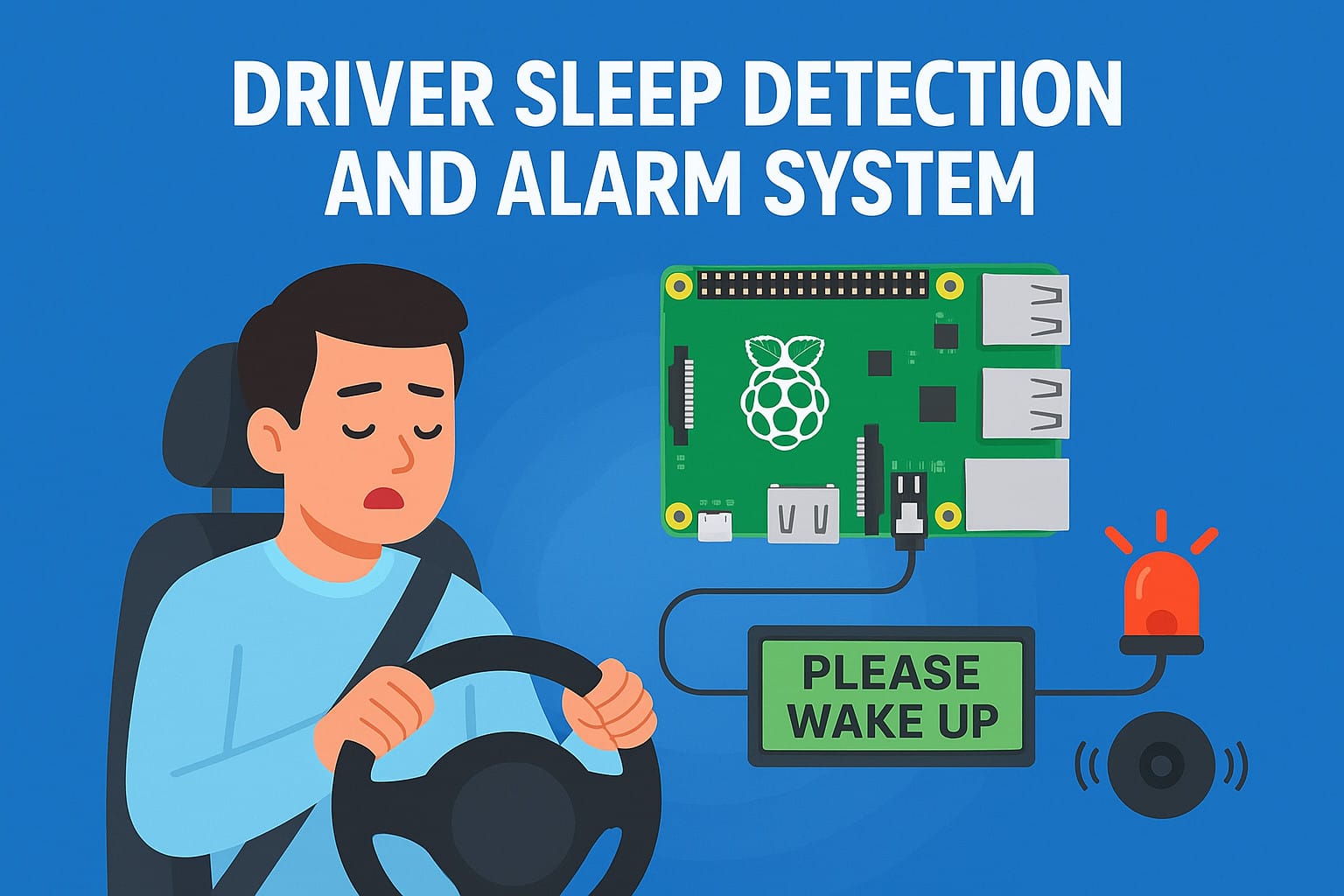
Last Updated: September 2026
Every year, thousands of road accidents happen for one avoidable reason: the driver simply fell asleep. It’s such a quiet, unremarkable-sounding cause compared to speeding or drunk driving — but the numbers behind it are genuinely alarming, and I’ll get into those shortly.
To actually do something about it during my college days, I built a working driver sleep detection and alarming system using Raspberry Pi that watches a driver’s eyes in real time. If the driver’s eyes stay closed for a few seconds the telltale sign of dozing off the system triggers an alarm immediately to wake them up before it becomes dangerous.
This post walks through the entire build — every component, every library, the actual code logic, and the real testing results (including where it struggled), so you can build your own version, adapt it, or just understand how this class of driver fatigue detection system actually works under the hood.
Quick answer: this driver drowsy detection system uses a Raspberry Pi, a webcam, OpenCV, and dlib to track eye landmarks and calculate whether the eyes are open or closed. If the eyes stay shut past a set threshold, it triggers a buzzer, LED, and LCD warning — all for well under ₹3,000 in components if you already own a Raspberry Pi.
Table of Contents
Why This Project Actually Matters (The Real Numbers)
I want to spend a moment on this before diving into hardware, because the scale of the problem is what made this project worth building in the first place, not just an assignment to finish.
In the US alone, drowsy driving is linked to roughly 100,000 police-reported crashes and over 1,500 deaths every year according to NHTSA data — and a 2025 analysis by the Governors Highway Safety Association found the real toll is likely far higher: over 6,300 suspected drowsy-driving deaths in a single year, nearly ten times the officially reported figure, because fatigue leaves no physical evidence the way alcohol does.
It’s not just a Western-roads problem either. India’s Road Transport and Highways Minister Nitin Gadkari stated in 2025 that 66% of road accident fatalities in the country involve people aged 18 to 45 — and confirmed the government has already started implementing sleep and fatigue detection devices specifically to prevent accidents caused by driver fatigue. That’s a strong signal that this exact category of car drowsiness detection system isn’t just a college project topic — it’s becoming a real policy priority.
The frustrating part: most affordable cars still don’t have this kind of safety feature built in. It’s largely limited to luxury vehicles with expensive built-in driver monitoring systems. My goal with this build was simple — make a low-cost drowsy driver alert system that literally anyone could build and fit into any car, regardless of the model or budget.
If you want to see how this same concept scales up into a full commercial-grade system, I’ve also broken down the AI Driver Monitoring System 2025 that’s increasingly standard in newer vehicles.
Objective of the Driver Sleep Detection Project
The main goal: reduce road accidents caused by sleepy drivers using an affordable, replicable system. The system detects the driver’s eyes in real time, tracks whether they’re blinking normally, and triggers an alarm if the eyes remain closed for a few seconds — the standard early sign of someone drifting off at the wheel.
Hardware Components Used (With Approximate 2026 Pricing)
Here’s the full parts list, with rough current pricing in India (based on current Raspberry Pi India pricing) so you can budget your own build — this is genuinely one of the more affordable options if you’re looking at iot mini projects for a final year submission.
| Component | Description | Approx. Price (India, 2026) |
|---|---|---|
| Raspberry Pi 3B+ | Main processing unit | ₹3,500 – ₹4,500 |
| Web Camera | Captures driver’s face | ₹500 – ₹1,200 |
| Buzzer | Gives alarm when driver sleeps | ₹20 – ₹50 |
| LCD Display | Shows messages like “Please Wake Up” | ₹150 – ₹300 |
| Red LED | Glows during alert | ₹5 – ₹10 |
| Power Supply 5V 3A | Provides stable power | ₹300 – ₹500 |
| Breadboard & Jumper Wires | Circuit connections | ₹150 – ₹250 |
| Micro SD Card 32GB | Stores Raspberry Pi OS and program | ₹350 – ₹500 |
Total (excluding the Pi itself, if you already have one): roughly ₹1,500 – ₹2,800 — which is what makes this such an accessible project for students working with a tight budget.
a) Raspberry Pi 3B+ :- Acts as the main processor (like a mini-CPU). It takes video input from the webcam, processes it, and controls the output devices like the LCD and buzzer.
b) Web Camera :- Captures real-time video of the driver’s face. The system analyzes eye movements to detect sleepiness.
c) Buzzer :- Produces a loud sound whenever the system detects that the driver is sleeping.
d) LCD Display :- Displays real-time messages such as “All OK – Drive Safe” or “Please Wake Up!”
e) Red LED :- Turns ON during alerts to give a visual warning.
f) Power Supply (5V 3A) :- Powers the Raspberry Pi and other components.
g) Breadboard & Jumper Wires :- Used for circuit connections between the components.
h) Micro SD Card (32GB) :- Stores the operating system, code, and required libraries.
If you’re specifically building Driver Sleep Detection for a final year project and want more processing headroom, a Raspberry Pi 4 (₹4,500–₹6,500) will run the same code noticeably faster, especially the dlib facial landmark detection — but the 3B+ is genuinely sufficient for this project and keeps costs down.
Software and Libraries Used
a) Operating System:
Raspberry Pi OS — installed to make the Raspberry Pi a fully functional system capable of interacting with hardware and software.
b) Programming Language:
Python — used to build and run the detection logic easily with the help of libraries.
c) Libraries Used in Driver Sleep Detection Project:
- OpenCV : For image and video processing; detects the driver’s eyes and blinks.
- NumPy : Handles mathematical operations and multi-dimensional arrays, useful in calculating eye aspect ratio.
- RPi.GPIO : Controls GPIO pins for external hardware like the buzzer, LED, and LCD.
- dlib : Detects the driver’s face and eye landmarks accurately.
- time : Used to measure time intervals and manage alarm delays.
d) Other Tools:
VNC Viewer : Used for remote access to the Raspberry Pi system.
Testing & Results
a) Software Testing – Laptop Screen
For testing, I opened VNC Viewer on my laptop and ran the Python code on Raspberry Pi. The webcam started detecting my face and tracking my eyes in real time.
When I blinked normally, the laptop screen showed “Active.”
But when I closed my eyes for a few seconds, it laptop screen displayed “Sleeping” and triggered the buzzer. (Face blurred for privacy.)
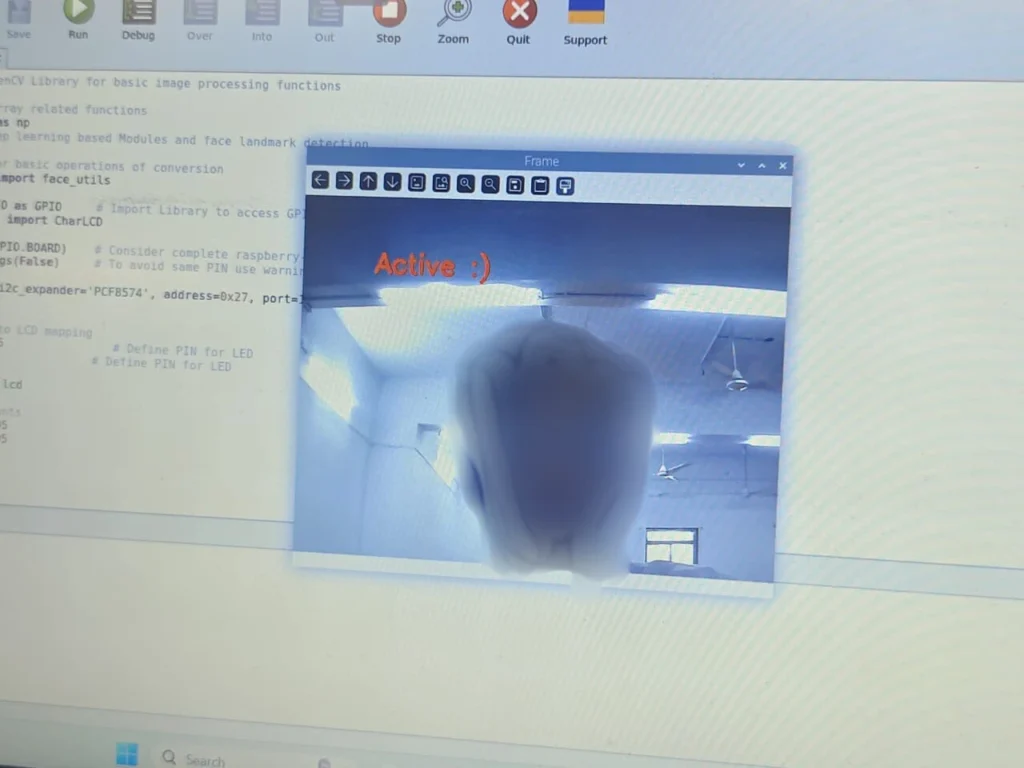
This image shows my laptop screen during testing when the system detected normal eye blinks. The Laptop screen displayed “Active,” and no alarm was triggered.
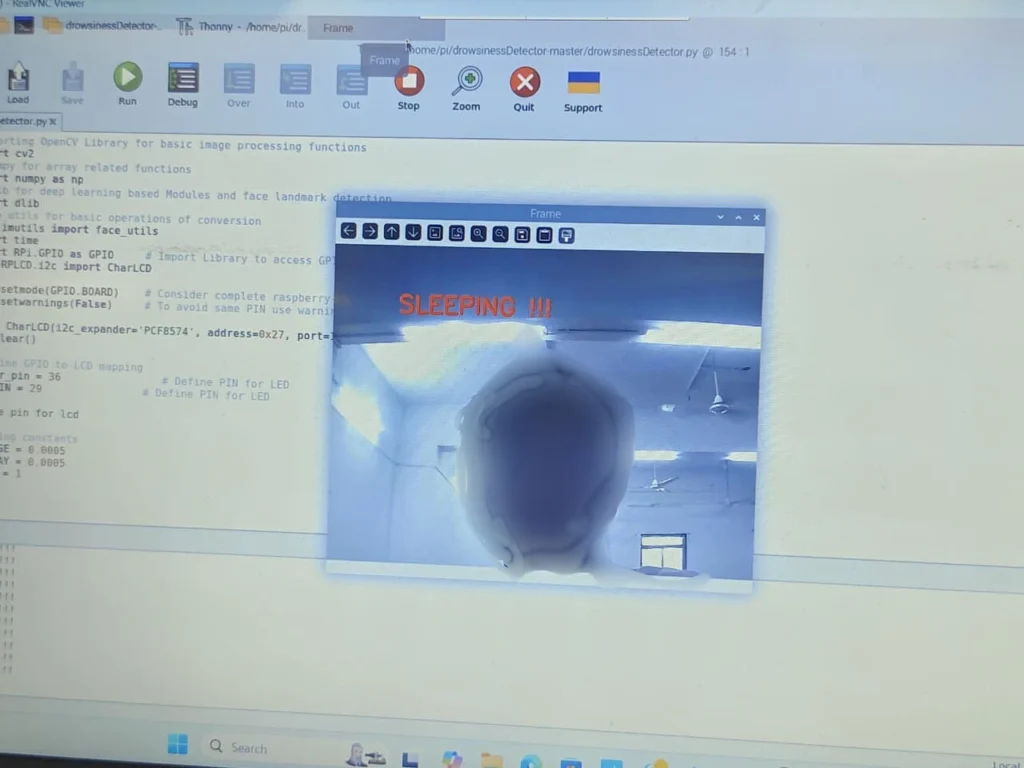
Here, the system detected that my eyes were closed for a few seconds. The laptop screen displayed “Sleeping” and the buzzer activated to alert the driver. (Face blurred for privacy.)
b) Hardware Output – LCD and Buzzer
After testing the software, I checked the physical hardware response.
The LCD ,LED and buzzer worked exactly as expected — showing different messages based on eye movement.
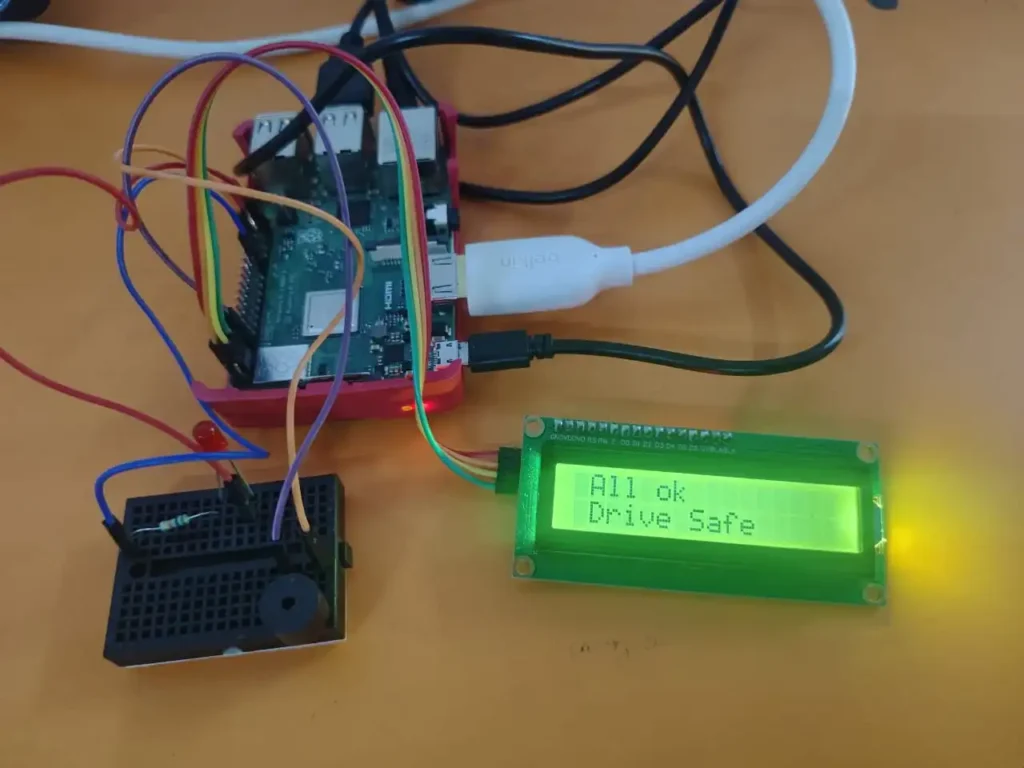
This is the hardware display showing “All OK Drive Safe.” The driver is alert, so the buzzer and LED remains off.
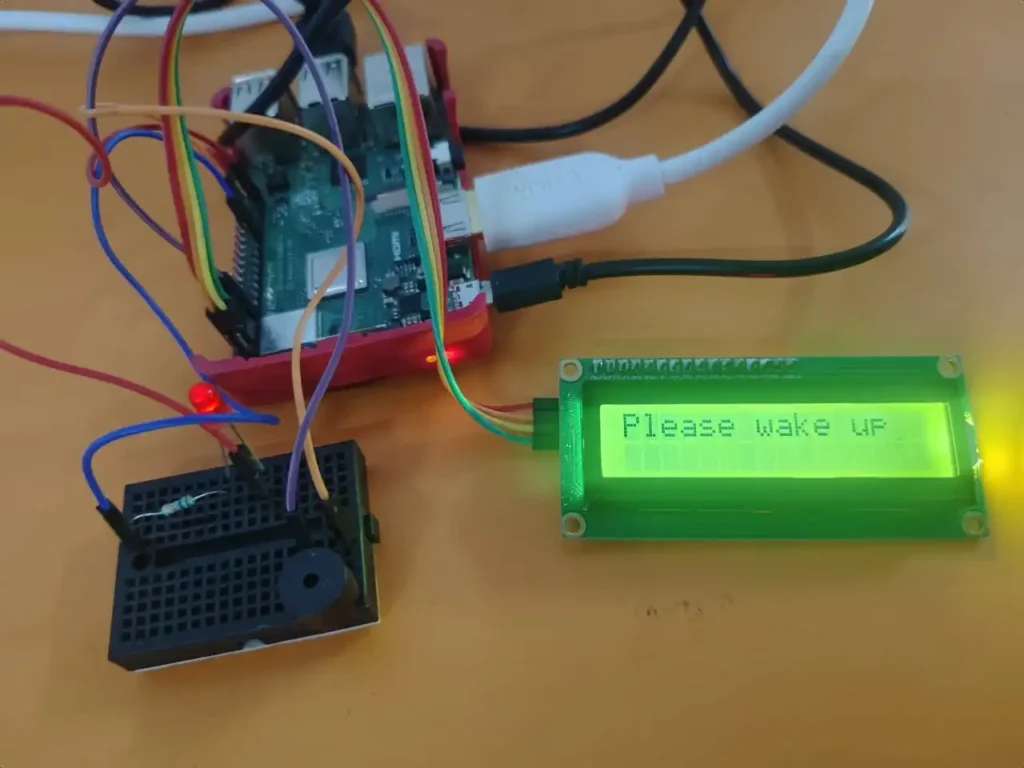
In this state, the LCD displays “Please Wake Up” and the buzzer & LED turns ON, alerting the driver to regain focus.
Final Testing Result :- After several tests, the system consistently detected whether the driver was active or drowsy.
Both the software output (on the laptop screen) and hardware output (on the LCD or LED) matched perfectly, showing that the detection algorithm and alert system are working in real time.
Outcome & Accuracy
The system worked well in most cases, but detection accuracy sometimes dropped with low-quality or blurry cameras. Good lighting and a high-resolution camera greatly improved results — worth knowing if you’re planning to replicate this as your own driver fatigue detection system.
For best performance:
- Use a stable camera mount
- Ensure proper lighting inside the vehicle
- Use HD or night-vision cameras for better accuracy in low-light or nighttime driving conditions, which is exactly when drowsy driving risk is highest
Future Improvements / Scope
This system can be further enhanced in several genuinely practical ways:
- Improve detection accuracy with advanced AI models and more training data
- Add a GPS module to send automatic emergency alerts with live location to hospitals and police stations
- Integrate the system with the vehicle to auto-slow down or alert nearby vehicles
- Connect the data to a smartphone IoT dashboard for real-time monitoring
Why This Makes a Strong Final Year IoT Project
If you’re browsing iot based projects for final year submissions specifically, this one has a few advantages worth pointing out honestly: the component cost is low, the core logic (OpenCV + dlib eye tracking) is well-documented online if you get stuck, and — unlike a lot of iot based mini projects that just blink an LED based on a sensor reading — this one solves a real, statistically significant problem, which tends to score better with evaluators looking for genuine applicability over novelty.
It also scales well as a project you can keep improving after submission — the GPS and mobile dashboard extensions mentioned above are realistic next steps rather than hypothetical ones, which is useful if you want a project you can keep building on for a portfolio.
If you’re still exploring options before committing to a topic, I’ve also covered two other strong IoT directions worth comparing: Smart Home IoT 2026: Devices, Setup & Real Savings and AI and IoT Smart Homes, both of which follow a similar sensor-plus-automation structure to this project.
FAQs – Driver Sleep Detection
What is the main purpose of the Driver Sleep Detection System?
The goal of this driver sleep detection and alarm system using raspberry pi project is to detect when a driver feels sleepy and automatically trigger an alarm to prevent accidents.
Which technology is used in this driver drowsy detection project?
It uses IoT and Raspberry Pi technology with Python libraries such as OpenCV and dlib to detect the driver’s eyes and face in real time.
Can this car drowsiness detection system work in all lighting conditions?
It performs best in good lighting or with a high-quality camera. Low-light situations may reduce accuracy slightly — an HD or night-vision camera helps significantly for real nighttime driving use.
How is this different from commercial car fatigue detection systems?
This version is low-cost, open-source, and can be built by anyone. It brings smart safety technology to normal cars — not just luxury ones with built-in driver monitoring.
Is this a good choice among iot mini projects for beginners?
Yes — the hardware list is short, the total cost is low (roughly ₹1,500–2,800 excluding the Pi itself), and the core concept is well-documented, making it approachable even if you’re relatively new to OpenCV or Raspberry Pi projects.
What improvements can be made in the future?
It can be upgraded with GPS tracking, automatic emergency alerts, and mobile app connectivity for real-time monitoring of driver fatigue.
How much does it cost to build this driver fatigue detection system?
Excluding the Raspberry Pi itself, the remaining components (camera, buzzer, LCD, LED, power supply, wiring, SD card) cost roughly ₹1,500–2,800 in India as of 2026, making it one of the more budget-friendly IoT safety projects available.
Conclusion – Driver Sleep Detection
This project shows how AI and IoT can make driving safer by detecting drowsiness and preventing accidents. It’s a simple yet powerful idea that can save lives if integrated into everyday cars.
In the future, I plan to improve accuracy and integrate GPS + AI for automatic emergency responses and smarter road safety.
Also Read :- 5 Free AI Tools you’ve never heard of that Save 5+ Hours in 2025