

Every few months, someone in my comments asks the same question in a slightly different way: will AI replace video editors, or is this just another overblown tech panic? I get why people keep asking — the tools genuinely have gotten scary good. But there’s a story from earlier this year that most “can AI replace video editors” articles completely missed, and it actually answers the question better than any feature comparison could.
Quick answer: No — will AI replace video editors in 2026? Not the skilled ones. AI has taken over the repetitive, mechanical parts of editing — cutting, subtitles, noise removal, rough assembly — but storytelling, emotional pacing, and client trust still need a human behind the timeline. The editors actually at risk aren’t the ones AI is competing with directly; they’re the ones doing purely template-based, no-creativity work that was already low-value before AI showed up.
Here’s the part almost nobody’s covering: in March 2026, OpenAI announced it was shutting down Sora — the same tool that, eighteen months earlier, had editors convinced their jobs were finished. The consumer app went dark on April 26, 2026.
That’s not a footnote. That’s the actual lesson underneath this whole “will AI replace video editors” conversation: even the tools that look unstoppable can get discontinued, deprioritized, or replaced overnight. Betting your entire career strategy on any single AI tool staying dominant is a genuinely risky bet — betting on your own editing judgment isn’t.
Table of Contents
What AI Can Actually Do in Video Editing Right Now (2026 Reality)

Text-to-video generation matured fast, then consolidated
Sora 2 briefly set the bar for photorealism after its December 2025 release — then got shut down within months.
Right now, the tools actually worth using are Google’s Veo 3.1 (best all-around, native synced audio, strong prompt-following)
Runway Gen-4.5 (best when you need genuine editing control, not just generation — camera moves, motion brush, and character consistency across shots).
Kling 3.0 has emerged as the strongest option for cinematic lighting and complex motion like hair, liquid, and fabric, plus a multi-shot storyboard mode most people haven’t heard of yet.
Runway’s Aleph feature is the one nobody’s talking about enough
It lets you edit an already-shot video “in context” — meaning you can change lighting, remove an object, or adjust a scene using natural language, directly on existing footage rather than generating something from scratch.
This is closer to what actually threatens repetitive editing work than any pure text-to-video tool, because it works on your real footage, not a generated substitute.
Automatic editing is now genuinely reliable, not just a gimmick
Adobe Premiere Pro’s Sensei AI, Runway, Kapwing, and Filmora AI can cut scenes, remove silences, add subtitles, and match pacing to music with minimal supervision.
AI-generated B-roll removed a real bottleneck
No stock footage license, no searching — describe the shot, get usable B-roll in seconds.
I’ve actually put together a full breakdown of the best AI B-roll generators worth using in 2026 if you want to skip the trial-and-error.
Long-to-short repurposing became a default workflow, not a novelty. Turning a 20-minute video into five Shorts or Reels is now a one-click starting point for most creators.
I’ve covered the specific tactics for both in This AI Trick Makes YouTube Shorts Go Viral Overnight and AI Tools for Instagram Reels That Actually Go Viral.
Face and voice replacement tools raised real questions
This is where the “AI video editor replace face” concern people search for actually comes from — deepfake-adjacent face-swap and voice-cloning tools inside editing suites are powerful for legitimate uses (dubbing, de-aging, consistent AI presenters) but have also made platforms tighten disclosure rules around synthetic media.
If you’re using this kind of tool professionally, labeling AI-generated faces or voices clearly isn’t optional anymore on most major platforms — it’s becoming policy.
What AI Still Cannot Replace
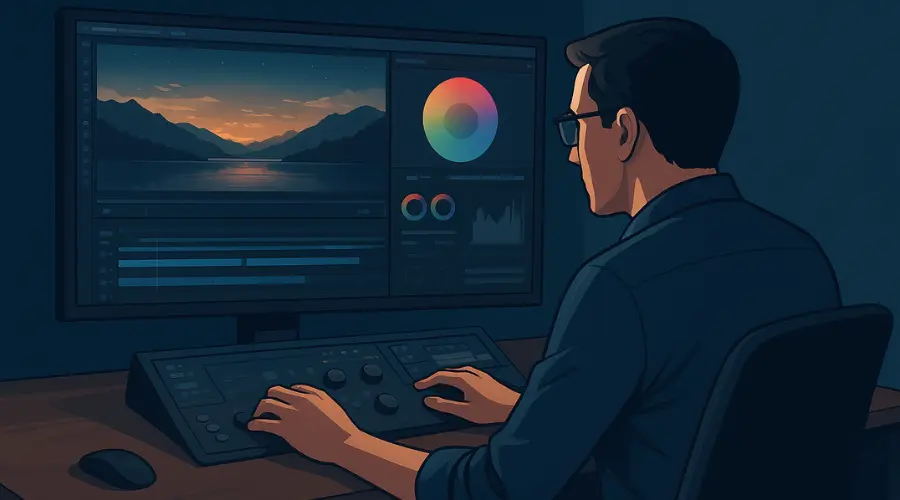
Human creativity and emotional timing
AI still can’t reliably tell you when a pause should linger a half-second longer to let a moment land, or when a cut should be jarring on purpose.
Cinematic and narrative judgment
Wedding films, documentaries, and brand campaigns still need someone who understands story structure, not just scene sequencing.
Client relationships
No AI tool negotiates scope, interprets vague feedback like “make it pop more,” or manages a client’s actual expectations.
Brand consistency at scale
Brands enforce specific color science, pacing rhythm, and font rules across every video — AI still drifts from these guidelines without a human checking every output.
AI Video Editing vs Human Editing (2026)
| Feature | AI Editing | Human Editing |
|---|---|---|
| Speed | Very fast | Slower |
| Creativity | Low | High |
| Emotion | Weak | Strong |
| Storytelling | Basic | Advanced |
| Client Understanding | None | Excellent |
| Cost | Low | Medium |
| Quality | Good | Excellent |
| Consistency | High | Medium |
| Complex Projects | Poor | Strong |
| Final Output | Needs review | Professional |
Will AI Replace Video Editors in 2026? The Real Breakdown
No — but let’s be precise about who’s actually at risk, because “no” without nuance isn’t useful.
AI will replace: purely template-based editors, editors doing only mechanical cuts with zero creative input, and the lowest end of the freelance market where clients were already choosing based on price alone.
AI will not replace: editors who combine storytelling with technical skill, colorists with a trained eye, motion graphics artists, and anyone clients trust with their actual creative vision.
Look at who’s actually thriving. MrBeast, Ali Abdaal, Marques Brownlee, and Dhruv Rathee all use AI tools somewhere in their pipeline now — and every one of them still employs human editors, because the thing that makes their videos work isn’t the cut itself, it’s the storytelling underneath it. Automation didn’t remove that need. It just removed the boring parts around it.
Will AI Replace Video Editors by 2030? Looking Further Ahead
This is the honest long-view answer to where the “will ai replace video editors 2026 predictions” conversation actually leads. By 2030, expect AI to handle nearly all mechanical editing tasks by default — cutting, subtitles, rough assembly, noise cleanup, color matching to a reference.
What it almost certainly won’t handle is the layer above that: deciding why a scene should feel a certain way, negotiating what a client actually wants versus what they said, or building a signature style that becomes the reason someone hires you specifically instead of a competitor charging less.
The realistic 2026-to-2030 trend isn’t “editors disappear.” It’s “editors who only did mechanical work disappear, and editors who do creative and strategic work get busier, because AI cleared their schedule of the tedious parts.”
New Job Roles Emerging From This Shift
The industry is genuinely expanding, not shrinking, and new titles are already appearing on job boards:
- AI Video Editing Specialist
- AI Content Workflow Manager
- AI Storyboard Designer
- Text-to-Video Director
- Prompt-Based Editor
These didn’t exist three years ago. They exist now specifically because someone still needs to direct the AI, review its output, and make the creative calls it can’t make on its own — which is essentially the same skillset behind the broader shift toward agentic AI. If that’s a space you want to get ahead of, I put together an Agentic AI Learning Path for 2026 that walks through it from beginner to expert.
Best AI Video Editing Tools in 2026
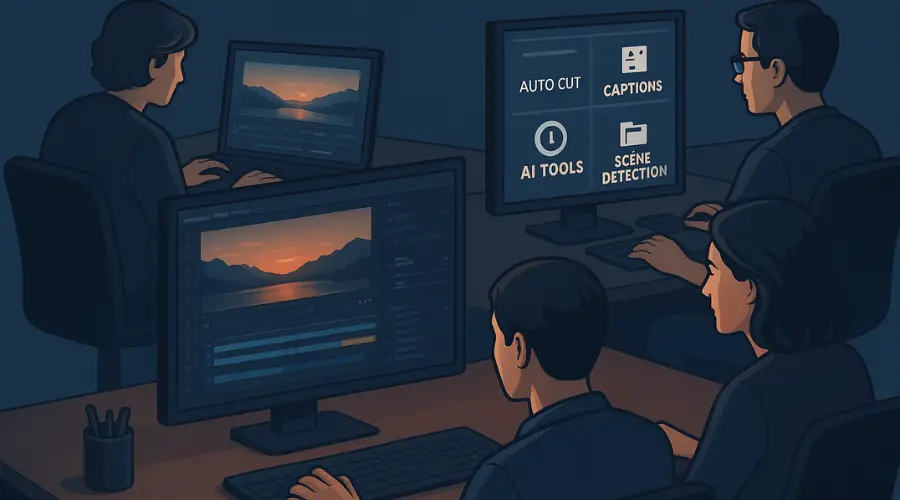
- Adobe Premiere Pro (Sensei AI) — scene detection, noise removal, auto color correction
- Runway Gen-4.5 — the strongest pick when editing control matters as much as generation, especially with Aleph’s in-context editing
- Google Veo 3.1 (via Flow) — best all-around cinematic generation with native audio
- Kling 3.0 — strongest for complex motion and multi-shot storyboarding
- CapCut AI Suite — smart cut, auto captions, AI highlights, still the fastest option for short-form
- Filmora AI Copilot — script assistance, auto-editing, transitions
- Descript — text-based editing and AI audio cleanup, ideal for podcast-to-video workflows
- DaVinci Resolve Neural Engine — advanced color grading and smart masking, still unmatched for professional color work
Worth noting: Sora is no longer a realistic recommendation for creators. OpenAI’s API access winds down entirely by September 2026, and the consumer app already went offline in April — a genuinely useful reminder not to build your entire workflow around one vendor’s tool.
If you want the fuller picture beyond just editing, I’ve tested a broader lineup in Best AI Tools for Content Creators in 2026.
How Editors Can Stay Safe From AI Replacement
- Learn the AI tools rather than avoiding them — ignoring this shift is the fastest way to actually fall behind. This applies beyond editing too; I’ve rounded up 5 free AI tools to automate daily office work that are worth learning alongside your editing stack.
- Master storytelling — still the single skill AI can’t duplicate
- Learn color grading — cinematic color judgment stays human-led for the foreseeable future
- Learn motion graphics and VFX (After Effects) — this combination with editing is where real opportunity is growing
- Build a genuinely recognizable personal style — clients increasingly pay for a specific signature look, not a generic edit
Can Beginners Start Video Editing in 2026?
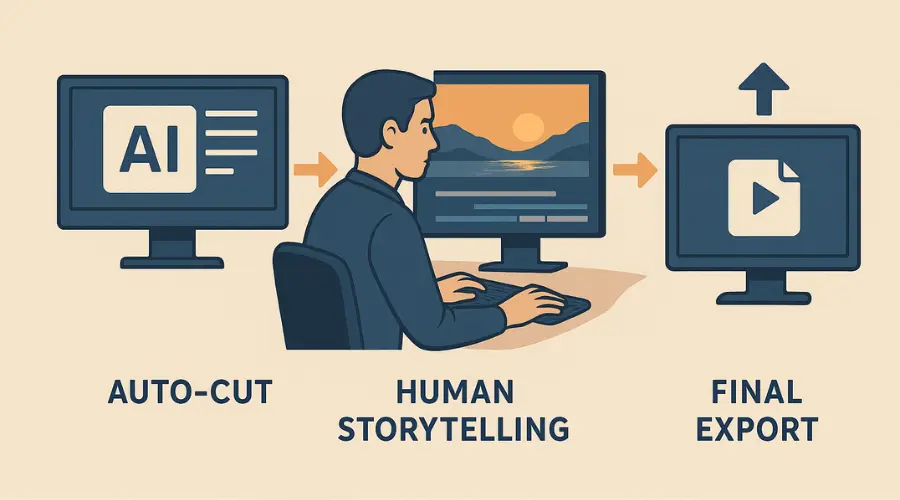
Yes, and honestly it’s a better time to start than ever. AI handles noise removal, auto-cutting, subtitles, templates, and B-roll generation — the tedious groundwork that used to take beginners months to get comfortable with.
That said, long-term success still comes down to developing real storytelling and technical judgment, not just knowing which AI button to press.
Video Editor Salaries in 2026 (India)
| Level | Average Monthly Salary |
|---|---|
| Beginner | ₹15,000 – ₹25,000 |
| Mid-Level | ₹30,000 – ₹60,000 |
| Professional | ₹70,000 – ₹1.5 lakh |
| Freelancers | ₹20,000 – ₹3 lakh+ |
Editors who’ve genuinely integrated AI into their workflow are reporting 30–50% higher earnings than those who haven’t — not because AI does the creative work for them, but because they can take on more projects in the same amount of time.
FAQs – will AI replace video editors
Will AI replace video editors in 2026?
No. AI automates repetitive editing tasks like cutting, subtitles, and cleanup, but creativity, emotional pacing, and client relationships still require a human editor.
Is AI going to replace video editors completely by 2030?
Unlikely. AI will likely handle nearly all mechanical editing tasks by 2030, but storytelling judgment, brand strategy, and creative direction are expected to remain human-led roles.
What editing tasks will AI take over first?
Cutting, subtitle generation, noise removal, rough assembly, color matching, and short-form repurposing are already largely automated in 2026.
Which AI video editing tool is best in 2026?
Runway Gen-4.5 for editing control, Google Veo 3.1 for cinematic generation, Kling 3.0 for complex motion, and CapCut AI for fast short-form editing are the current leaders. Sora is no longer a viable recommendation following its 2026 shutdown.
Do top YouTubers still hire human video editors?
Yes. Creators like MrBeast, Ali Abdaal, and MKBHD all use AI tools but continue employing human editors specifically for storytelling, pacing, and creative direction.
Will video editors be replaced by AI face-swap or voice-cloning tools?
No, but these tools are changing parts of the workflow — particularly dubbing and synthetic presenters — and most major platforms now require clear disclosure when AI-generated faces or voices are used.
Final Verdict: Is AI Going to Replace Video Editors?
Is AI going to replace video editors entirely? No. Will video editors be replaced by AI if they refuse to adapt? Quite possibly, yes — but that’s always been true of every technology shift in this industry, going back to the move from tape to digital editing decades ago.
The honest 2026 truth: AI will not replace video editors. But editors who use AI well will absolutely replace those who don’t — and that shift is already visible in who’s getting hired and who isn’t.
If you want to stay ahead of every shift in AI tools, careers, and technology as it actually happens — not months later — follow TechByDevansh.