

Last Updated: July 2026
I had a contractor tell me something last month that stopped me cold.
“Most of my customers have no idea this credit is expiring. They find out in January when it’s already too late to do anything about it.”
Before we dive into what is changing and why 2026 matters more than most homeowners realize — bookmark the IRS Energy Efficient Home Improvement Credit official guidelines right now. Every claim, every eligibility requirement and every product threshold in this guide traces back to that single source — and checking it directly before your installation begins could save you from a rejection that costs thousands.
He was talking about the home energy tax credit 2026 — and after spending three weeks researching exactly what is changing, when it changes, and what homeowners can realistically still claim before the window closes, I can tell you this: he is absolutely right. Most people are going to miss this.
The home energy tax credit 2026 is not a standalone program sitting in isolation — it is one piece of a much larger government-funded ecosystem that most American homeowners have never been told about in full. If the idea that your government is actively subsidizing smart home upgrades, heat pumps, solar installations and energy management systems simultaneously feels new — it absolutely should not. Our complete guide to every US government program paying homeowners in 2026 maps the entire landscape in one place — and the tax credit you are about to learn how to claim is just the beginning of what is available to you right now.
Table of Contents
What Exactly Is the Home Energy Tax Credit in 2026?
The home energy tax credit 2026 is not a single credit — it is two separate federal programs that most people treat as one:
Section 25C — Energy Efficient Home Improvement Credit Covers upgrades like smart thermostats, insulation, heat pumps, windows, doors and HVAC systems. Gives you 30% back on qualifying costs up to $3,200 annually. This is the energy efficient home improvement credit most homeowners interact with directly.
Section 25D — Residential Clean Energy Credit Covers solar panels, battery storage, wind energy and geothermal systems. The residential clean energy tax credit 2026 currently sits at 30% with no dollar cap — meaning a $20,000 solar installation returns $6,000 directly off your federal tax bill.
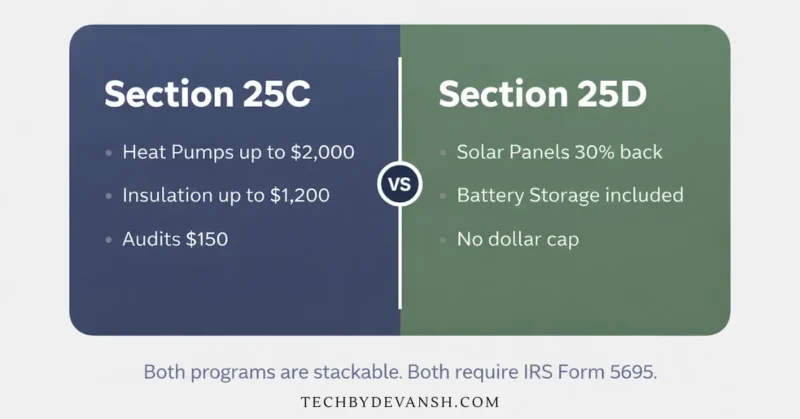
Both programs exist because of the Inflation Reduction Act signed in 2022. Both are currently scheduled to begin stepping down after 2032 — but here is what most blogs get wrong about the expiration question.
The Real Expiration Risk Nobody Is Covering Accurately in 2026
The official IRA schedule has these credits running through 2032. Here is the specific legislative situation that changes the urgency calculation in July 2026 — and that most energy guides are not reporting accurately.
The One Big Beautiful Bill Act — What It Actually Contains
The House of Representatives passed the One Big Beautiful Bill Act in May 2026 — a budget reconciliation package that includes specific provisions targeting IRA clean energy credits. The bill as passed by the House would:
- Eliminate the Section 25D residential clean energy credit for new solar installations beginning January 1 2027
- Reduce the Section 25C energy efficient home improvement credit from 30% to 15% for most upgrades beginning January 1 2027
- Maintain the 25C credit at 30% only for heat pumps through December 31 2027
- Remove battery storage from residential clean energy credit eligibility if installed after December 31 2026
As of July 2026 the bill is in Senate review where significant modifications are expected. The Senate version will almost certainly differ from the House version. A conference committee reconciliation process could extend the timeline into late 2026 or early 2027.
What This Means for the Average Homeowner Right Now
The honest interpretation of the current legislative situation is this:
The home energy tax credit 2026 at its current 30% rate is confirmed for the remainder of 2026 regardless of what the Senate does. No legislation currently in consideration retroactively eliminates credits for installations completed before the bill’s effective date.
If you install and pay for qualifying upgrades before December 31 2026 — your credit is locked in at the current rate regardless of what passes after that date.
If you are waiting to see how the Senate votes before scheduling installation — you are gambling a 30% credit against a 15% credit for the sake of avoiding a contractor appointment.
The IRS Notice 2026-14 Update Nobody Covered
In March 2026 the IRS issued Notice 2026-14 clarifying a question that had confused homeowners and contractors for three years: battery storage systems installed without solar panels now qualify for the full 30% residential clean energy tax credit 2026 as standalone upgrades.
Previously many contractors and guides — including earlier versions of this one — stated that battery storage required solar installation to qualify for the 25D credit. That interpretation was incorrect and Notice 2026-14 confirmed it definitively.
A standalone Powerwall or Enphase IQ Battery installation in 2026 returns 30% of the total cost — equipment and installation labor — with no dollar cap. A $12,000 whole-home battery system returns $3,600 directly off your federal tax bill with no solar panels required.
This is the single most financially significant IRS clarification for smart home energy upgrades in 2026 — and it appears on almost no consumer-facing energy guide published before March 2026.
What the 25C Credit Actually Covers in 2026
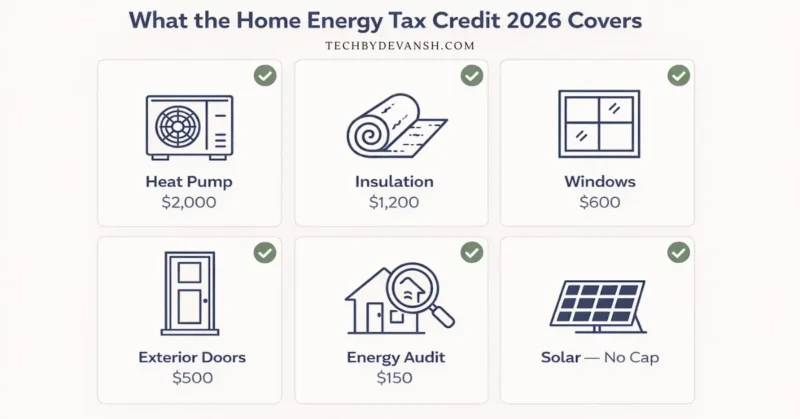
The home energy efficiency tax credit 2026 under 25C covers more than most homeowners realize:
- Home insulation tax credit 2026 — 30% back up to $1,200 for qualifying insulation and air sealing
- Home energy audit tax credit 2026 — $150 credit for a professional home energy assessment
- Heat pumps and heat pump water heaters — up to $2,000
- Exterior doors — up to $500 total
- Energy efficient windows — up to $600
- Central air conditioners and furnaces — up to $600
The 2026 25C Updates Most Guides Missed
Two specific changes to 25C eligibility took effect in 2026 that expand what qualifies:
Smart Electric Panels Now Have Clearer Eligibility
The IRS issued additional guidance in January 2026 confirming that smart electric panels — including the Span Smart Panel and Leviton Smart Panel — qualify for the 25C credit when installed as part of a home electrification project that includes at least one other qualifying upgrade (heat pump, EV charger or battery storage).
The credit covers 30% of the panel cost up to $600 — the same cap as windows and doors. When stacked with the HEEHRA upfront rebate of up to $4,000 on the same panel the combined return can exceed the panel’s total installation cost for qualifying households.
The Annual Reset Strategy Nobody Calculates
Every guide mentions the $3,200 annual cap. Almost none of them show you what strategic multi-year claiming looks like in dollar terms:
| Year | Upgrade | 25C Credit |
|---|---|---|
| 2026 | Heat pump + audit | $2,150 |
| 2027 | Insulation + windows | $1,800 |
| 2028 | Smart panel + doors | $1,100 |
| 2029 | Heat pump water heater | $2,000 |
| Total | 4 years | $7,050 |
Four years of strategic claiming from the same Section 25C program — $7,050 in total federal credits on upgrades most homeowners were already planning to make over that timeframe.
This multi-year strategy works regardless of what happens legislatively in 2026 — because credits claimed in 2026 are locked in and future years can be adjusted based on whatever program exists then.
Every product on this list must meet a specific efficiency threshold to qualify — and ENERGY STAR certification alone is not always sufficient for the full credit amount. Before purchasing any device verify your specific model number appears on the ENERGY STAR federal tax credit eligible products list — buying the wrong efficiency tier within the right product category is the single most expensive mistake US homeowners make when claiming the home energy tax credit 2026.
These stack within an annual $3,200 maximum — meaning a homeowner installing insulation, upgrading windows and getting a professional audit can claim close to the full annual limit in a single tax year.
The federal energy tax credit 2026 resets every year. If you maxed it in 2025 you can claim it again in 2026 on different qualifying upgrades.
The Solar Situation — Act Before the Math Changes
The federal solar energy tax credit 2026 is where the largest single dollar amounts live — and where the legislative risk is most acute.
The solar energy tax credit 2026 currently returns 30% of your total system cost with zero cap. A $25,000 solar installation with battery storage returns $7,500 directly off your federal taxes.
The federal residential clean energy tax credit 2026 is scheduled to drop to 26% in 2033 — but early phase-out legislation could accelerate that timeline significantly.
If solar is on your radar for the next three years — the smartest financial move is pulling it forward to 2026 while the 30% rate is both available and politically stable.
Should You Upgrade Before the Tax Credit Expires?
This is the question I get most often — and the honest answer depends on three things:
1. What upgrade are you considering? Small upgrades like insulation and a home energy audit carry low installation cost and high credit return. These are no-brainer 2026 projects regardless of your broader home improvement timeline.
2. What is your federal tax liability? The residential energy tax credit 2026 is non-refundable — it reduces what you owe, not what you get back as a refund. If your federal tax bill is $1,500 you cannot claim a $3,000 credit in full in one year. Plan accordingly.
3. How confident are you in the political stability of the program? If you were planning a solar or heat pump upgrade in 2027 or 2028 anyway — moving it to 2026 costs you nothing except earlier installation scheduling and protects you from any early phase-out risk.
4. Are you in a state where the legislative risk is highest?
The home energy tax credit 2026 federal credit applies equally to all 50 states. But the political risk of program modification is not equal across states — because state-level programs that stack on top of the federal credit vary dramatically in their own stability.
California, New York and Massachusetts have state-level clean energy programs that are funded independently of the IRA and are not affected by federal legislative changes. Homeowners in these states have a stronger multi-year stacking case regardless of federal program modifications.
Texas, Florida and states without independent state clean energy programs are more dependent on federal IRA programs exclusively — making the 2026 timing argument stronger for homeowners in those states specifically.
How to Claim the Energy Tax Credit in the USA
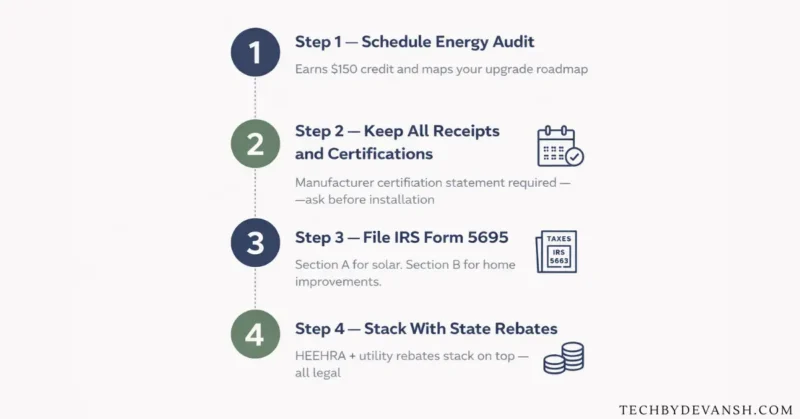
Claiming the home energy tax credit 2026 is simpler than most homeowners expect:
Step 1 — Get a home energy audit first The home energy audit tax credit 2026 gives you $150 back on the audit itself — and more importantly, it tells you exactly which upgrades will deliver the highest energy savings and the largest credit return for your specific home.
Step 2 — Keep all receipts and manufacturer certification statements The IRS requires proof that your installed product meets the ENERGY STAR or efficiency threshold required for the credit. Your contractor should provide this — ask specifically before installation begins.
Step 3 — File IRS Form 5695 The IRS energy tax credit 2026 is claimed on Form 5695 when you file your federal return. Section A covers the residential clean energy credit. Section B covers the energy efficient home improvement credit. Both are straightforward if your documentation is in order.
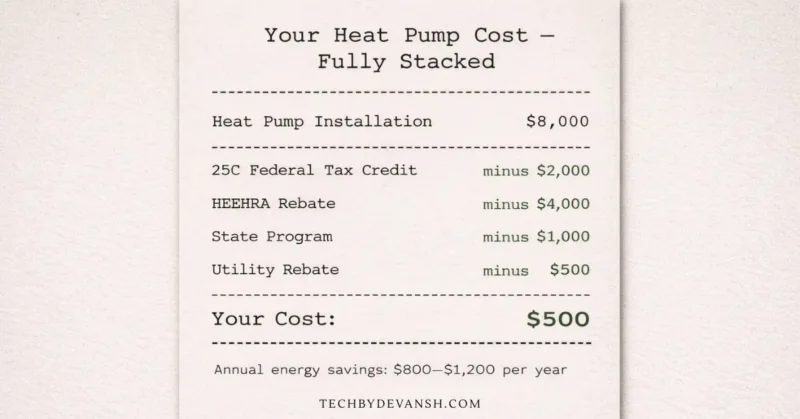
Step 4 — Stack with state and utility rebates The federal credit is stackable with state programs and utility rebates — claiming all three on the same upgrade is legal and common. A heat pump installation can simultaneously qualify for the 25C federal credit, a state HEEHRA rebate and a utility incentive.
Step 4 in the stacking strategy is where most financially savvy homeowners find money they genuinely did not know existed. The federal tax credit covers your upfront cost. State and utility rebates cover more of the installation. But the program almost nobody mentions — the one that keeps paying you every single year after everything else is done — is the annual utility demand response credit that qualifying smart thermostats generate automatically once enrolled. We have identified the five specific smart thermostats that earn annual demand response credits on top of your tax credit and the exact enrollment process most homeowners never complete — because nobody told them the program existed alongside the tax credit they were already claiming.
Mistakes That Cost Homeowners Their Credit
Mistake 1 — Buying before verifying product eligibility Not every efficient product qualifies. The specific model must meet the IRS efficiency threshold — ENERGY STAR certification alone is not always sufficient for 25C. Verify at energystar.gov before purchasing.
Mistake 2 — Confusing the credit with a rebate The federal energy tax credit 2026 reduces your tax liability — it does not put cash in your account. Homeowners expecting a check are consistently disappointed. Plan your cash flow around this distinction.
Mistake 3 — Missing the annual reset opportunity The $3,200 annual cap resets every December 31. Homeowners who hit the cap in one year can claim it again the following year on different qualifying upgrades. Spreading upgrades across two tax years intentionally is a legitimate and valuable optimization strategy.
Mistake 4 — Waiting for certainty on expiration By the time legislative changes are confirmed and publicized, the installation backlog is typically 3–6 months. Homeowners who wait for official expiration news before scheduling work routinely miss the credit entirely because qualified contractors are fully booked.
Mistake 5 — Missing the Standalone Battery Credit
Before March 2026 homeowners commonly skipped battery storage because they believed it required solar installation to qualify for the federal credit. IRS Notice 2026-14 eliminated that barrier.
Homeowners who installed a standalone battery in 2024 or early 2025 based on incorrect guidance that it did not qualify for the 25D credit may be able to file an amended return. Consult a tax professional about amended filing eligibility — the three-year amended return window may apply to installations as far back as 2023.
Mistake 6 — Not Accounting for Tax Liability Before Choosing Upgrades
The home energy tax credit 2026 is non-refundable — it reduces what you owe but cannot exceed your tax liability in a single year. A homeowner with a $1,500 annual federal tax bill cannot claim a $3,600 battery credit in one year.
But they can carry the excess forward. The residential clean energy credit (25D) allows unused credit amounts to carry forward to the following tax year. The 25C credit does not carry forward — it is use-it-or-lose-it annually.
Plan your upgrade sequence around your annual tax liability — not just the credit amount. A tax professional can model your optimal multi-year credit sequence in one appointment.
Mistake 7 — Paying Contractor Premium for “Rebate Processing” Services
A significant and growing problem in 2026: contractors and third-party services charging homeowners $200–$500 to “process” their HEEHRA rebate or federal tax credit paperwork.
HEEHRA rebate applications are submitted by homeowners directly through state energy office portals — not by contractors. Federal tax credits are claimed by homeowners or their tax preparer on Form 5695 — not through a contractor service.
Legitimate certified contractors will provide documentation (model numbers, certification statements, installation invoices) that you need for your applications. They are not authorized to file applications on your behalf for a fee — and any contractor claiming otherwise is charging for a service they have no legitimate role providing.
Best Upgrades Before the Tax Credit Ends
If you are deciding where to start — here is the priority order based on credit value and installation speed:
Fastest and highest ROI: Home energy audit ($150 credit — book this week) + air sealing and insulation ($1,200 credit — 1–2 day installation)
The single best first move for any homeowner planning to claim the home energy tax credit 2026 is a professional energy audit — and the US Department of Energy certified home energy auditor locator will find vetted professionals in your specific area. The audit itself earns you a $150 federal credit and gives you a personalized roadmap showing exactly which upgrades will return the most money for your specific home — not a generic list that applies to every house equally.
Medium timeline — 4 to 8 weeks: Heat pump water heater ($2,000 credit) + exterior doors and windows ($1,100 credit combined)
Larger project — 6 to 12 weeks: Heat pump HVAC system ($2,000 credit) + solar installation ($6,000–$9,000 credit at 30%)
Heat pumps sit at the absolute top of the upgrade priority list for one reason that most guides completely miss — they are the only home improvement that simultaneously qualifies for the home energy tax credit 2026 under 25C, the HEEHRA upfront rebate program and annual utility demand response credits. Three separate funding sources from one installation. If a heat pump is anywhere on your home improvement radar for the next two years, our breakdown of the heat pump rebate 2026 which stacks directly on top of your tax credit shows you exactly how to combine all three programs — and why moving that project to 2026 could be the single best financial decision you make this year.
The audit tells you which of these your specific home needs most. Do not skip it.
Updated Key Takeaways — July 2026
- The home energy tax credit 2026 at 30% is confirmed for the remainder of 2026 — installations completed before December 31 2026 are protected regardless of pending Senate legislation
- The One Big Beautiful Bill Act passed the House in May 2026 and would reduce the 25C credit from 30% to 15% beginning January 2027 — Senate vote pending — acting in 2026 eliminates this risk entirely
- IRS Notice 2026-14 confirmed standalone battery storage qualifies for the full 30% Section 25D credit without requiring solar installation — a $3,600+ credit previously missed by millions of qualifying homeowners
- The energy efficient home improvement credit resets every December 31 — strategic four-year claiming can generate $7,050 in total credits from the same program
- Smart electric panels now have confirmed 25C eligibility when installed alongside a qualifying upgrade — 30% credit up to $600 plus stackable HEEHRA rebate of up to $4,000
- The federal solar energy tax credit 2026 returns 30% with no dollar cap — and the House bill would eliminate this credit for new installations beginning January 2027
- Start with a home energy audit tax credit 2026 — $150 back and a personalized upgrade roadmap that maximizes your total credit return
- File IRS Form 5695 — Section A for solar and battery, Section B for home improvements — keep all receipts and manufacturer certification statements
- Stack federal credits with state HEEHRA rebates and utility incentives — three separate funding sources on one installation
- Contractors charging fees to “process” your rebate or tax credit applications are charging for services they have no legitimate role providing — all applications are submitted directly by homeowners
FAQs – Home Energy Tax Credit 2026
Is the home energy tax credit 2026 expiring this year?
The home energy tax credit 2026 is not officially expiring in 2026 — it is currently scheduled through 2032 under the Inflation Reduction Act. However, active Congressional discussions about modifying clean energy incentives ahead of schedule create genuine risk of early phase-out or eligibility changes. Homeowners planning upgrades in the next 2–3 years are advised to move forward in 2026 while the 30% rate is confirmed and politically stable.
How do I claim the home energy tax credit in the USA?
Claim the home energy tax credit 2026 by filing IRS Form 5695 with your federal tax return. Keep all product receipts and manufacturer certification statements proving your installation meets the required efficiency threshold. Section A of Form 5695 covers the residential clean energy credit for solar. Section B covers the energy efficient home improvement credit for insulation, heat pumps and windows.
What is the maximum home energy tax credit for 2026?
The energy efficient home improvement credit maximum is $3,200 per year — $2,000 for heat pumps and $1,200 for insulation, windows, doors and audits combined. The residential clean energy tax credit 2026 for solar and battery storage has no dollar cap — it returns 30% of your total system cost regardless of project size. Both credits reset annually and can be stacked with state and utility rebates.
Does the home energy audit qualify for the tax credit in 2026?
Yes. The home energy audit tax credit 2026 under Section 25C gives homeowners a $150 federal tax credit for a professional home energy assessment conducted by a certified auditor. This credit is separate from and does not count toward the $3,200 annual maximum for other improvements. It is the lowest-cost highest-ROI credit available and the recommended starting point for any homeowner planning energy upgrades.
Can I claim the solar energy tax credit in 2026?
Yes. The federal solar energy tax credit 2026 under Section 25D returns 30% of your total solar installation cost with no maximum dollar limit. A $20,000 system returns $6,000 directly off your federal tax bill. The credit applies to panels, battery storage, installation labor and permitting costs. It is non-refundable — meaning it reduces tax owed rather than generating a refund — so plan your timeline around your annual federal tax liability.
Conclusion – Energy Efficient Home Improvement Credit
The home energy tax credit 2026 is the most generous home improvement financial incentive most American homeowners will ever have access to — and it is available right now at its maximum value.
Whether it expires early due to legislative changes or phases down on schedule after 2032 does not change what you should do today. The credits exist. The savings are real. The installation backlog grows every month more homeowners wake up to this opportunity.
Schedule your home energy audit this week. It costs under $200, returns $150 in federal credit, and gives you a personalized roadmap for claiming every dollar available to your specific home before this window closes.