
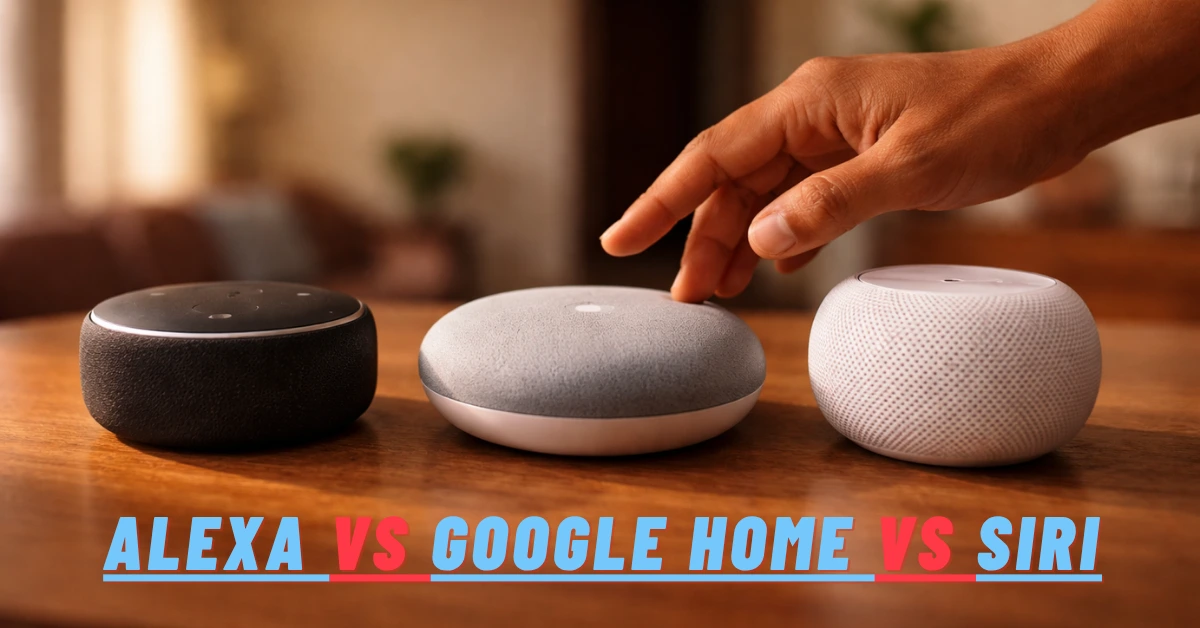
Picking the wrong smart home assistant in India costs you more than money — it costs you every future device purchase too. Alexa vs Google Home vs Siri in 2026 isn’t a minor preference decision. It’s the choice that determines which devices you can buy, how smoothly your automations run, and whether your smart home actually works the way you imagined it would.
Most comparison articles give you a neat scorecard and declare a winner. That’s not what this is. Three years of testing all three platforms in Indian homes — dealing with power cuts, concrete walls, Hindi-speaking family members, and ₹800 smart plugs — gives a very different perspective than a Western tech reviewer ever will.
For the complete foundation of how these platforms fit into a broader smart home system, the complete guide to smart home IoT in 2026 covers everything before you commit to any platform. But if you’re ready for the honest verdict right now — keep reading.
Table of Contents
Alexa vs Google Home vs Siri in 2026 — What Actually Changed
In the Alexa vs Google Home vs Siri comparison for 2026, Alexa wins on Indian device compatibility, Google Home wins for Android users wanting contextual automation, and Siri HomeKit wins on privacy but costs significantly more. All three now support Matter protocol. For Indian beginners under ₹5,000, Alexa or Google Home are the practical choices — Siri requires premium hardware most Indian budgets don’t justify.
The biggest change in 2026 isn’t which assistant sounds smarter. It’s Matter protocol reaching critical mass — 4,000-plus certified devices from 400-plus brands as of Q4 2025 according to the Connectivity Standards Alliance. This matters because it fundamentally changes the stakes of this decision.
Before Matter, choosing Alexa meant you were locked into Amazon’s ecosystem permanently. Choosing Google Home meant abandoning Alexa-only devices. Choosing HomeKit meant paying a premium tax on every single purchase. Matter dissolves those walls — a Matter-certified TP-Link Tapo device works with all three platforms simultaneously.
The Alexa vs Google Home vs Siri debate in India has a dimension Western reviewers consistently miss — joint family living. In Indian homes with 4–6 people across two generations, multi-user voice profiles matter enormously. Alexa supports 10 voice profiles. Google Home supports 6. HomeKit supports however many Apple IDs share your home — but requires every person to own an iPhone. In a mixed Android and iPhone family, HomeKit immediately becomes impractical regardless of its technical merits.
Amazon Alexa in India 2026 — The Widest Net
Alexa’s single biggest advantage in India isn’t its AI — it’s distribution. Every major Indian smart home brand has an Alexa skill — TP-Link Tapo, Wipro Smart, Syska, Philips WiZ, Xiaomi Mi Home, Havells, Orient Electric, and Aqara all work natively. No workarounds. No third-party bridges.
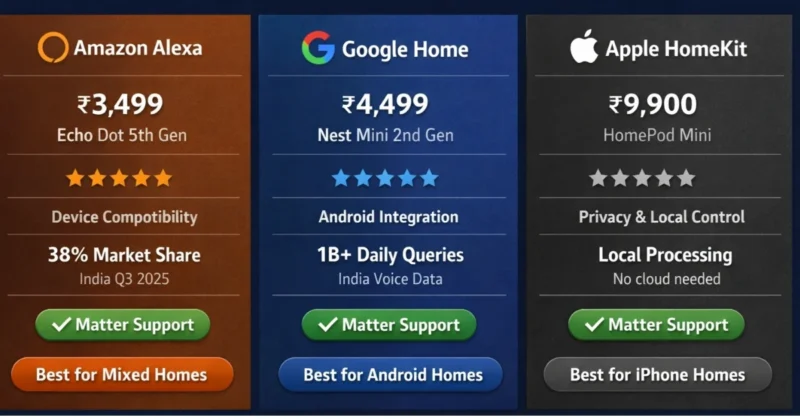
The Amazon Echo Dot 5th Gen at ₹3,499 — frequently discounted to ₹1,999 during Amazon sales — is the most affordable entry point into any smart home ecosystem in India. No other platform controller comes close at that price.
Before committing to Alexa as your platform, browse the full list of Alexa compatible smart home devices India — seeing every Indian brand that works natively with Alexa is the fastest way to confirm it covers everything you already own or plan to buy.
Alexa’s Hindi support has improved meaningfully. Commands like “Alexa, geyser band karo” work in straightforward setups. Complex Hinglish sentences still trip it up occasionally — but for the 70% of commands that are simple device control, it’s reliable enough for Hindi-speaking households.
What most Alexa guides never mention: enable Brief Mode immediately after setup. Go to Alexa app → Settings → Voice Responses → Brief Mode. This removes the “OK” confirmation sound after every command. Without it, living with Alexa daily becomes genuinely irritating within the first week.
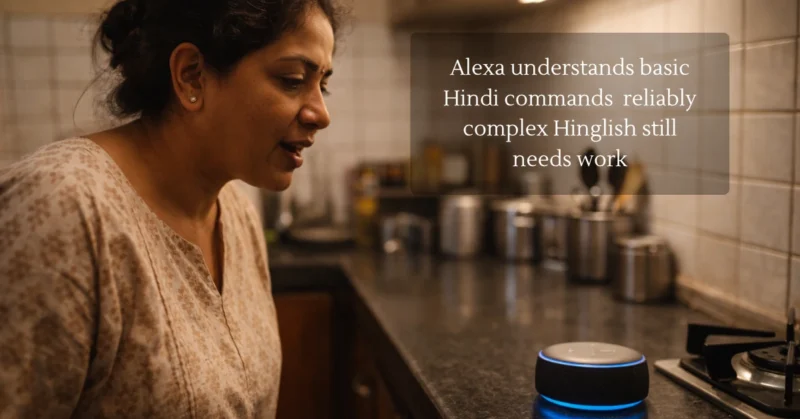
Honest limitation: Alexa is increasingly commercial. It occasionally suggests buying things, promotes Prime benefits unprompted, and the ad-adjacent experience grows slightly every year. If that bothers you — Google Home is cleaner.
Best for: Budget buyers, maximum device compatibility, mixed brand households, anyone wanting the widest Indian smart home device selection.
Controller device: Amazon Echo Dot 5th Gen — ₹3,499
Google Home in India 2026 — The Android Household’s Best Friend
Google Home’s advantage isn’t its device catalogue — it’s context. No other smart home platform understands your life the way Google does when you’re already living inside Google’s ecosystem.
Your morning routine says “good morning” and Google Home knows your first meeting is at 10 AM, your commute takes 35 minutes, and rain is forecast — so it adjusts your alarm suggestion, reads traffic, and dims your bedroom light to wake you gently. Alexa can’t do this. HomeKit can’t do this. This is genuine intelligence, not just scheduled automation.
The Google Nest Mini at ₹4,499 delivers this experience with surprisingly good audio for its size and a physical microphone mute switch on the back — a hardware-level privacy feature that cuts the mic completely rather than just pausing it in software.
Android users who’ve already decided on Google Home should bookmark the Google Home supported devices and setup India page — it shows every compatible Indian brand, the complete app setup process, and how to link your existing Google account to your first smart device in one place.
Google Home has one underrated advantage in Indian apartment buildings specifically — its superior handling of overlapping WiFi networks. Indian apartment blocks often have 20–30 competing WiFi networks on the same channel. Google Home’s device pairing algorithm handles this interference more gracefully than Alexa during initial setup — which is why Google Home devices report fewer “failed to connect” complaints in Indian apartment reviews compared to equivalent Alexa devices in the same building.
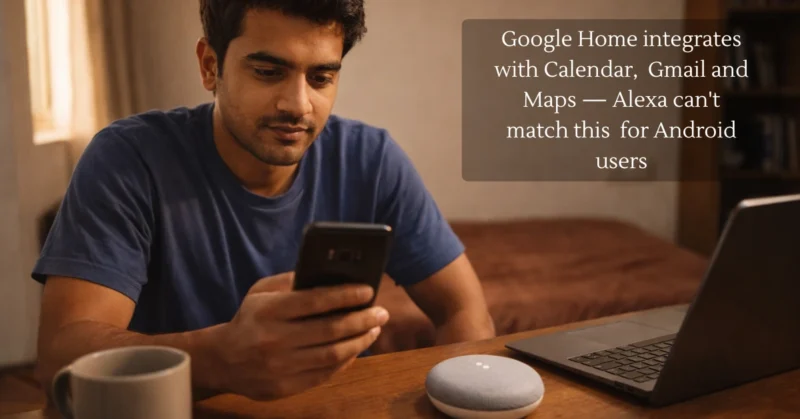
Honest limitation: Google Home’s app has been redesigned three times in four years. Features move around. Routines that worked one month occasionally need reconfiguring after an update. The platform is powerful but less stable in its interface than Alexa.
Best for: Android-only households, Google Workspace users, anyone wanting intelligent context-aware automation rather than just scheduled control.
Controller device: Google Nest Mini 2nd Gen — ₹4,499
Apple Siri and HomeKit in India 2026 — Powerful, Private, Expensive
HomeKit is technically the most sophisticated of the three platforms. Local processing means commands execute on your device rather than routing through a cloud server — which means faster response, better privacy, and automation that continues working even during internet outages.
Apple’s Secure Enclave handles all HomeKit automation data locally. No Amazon server. No Google server. No data leaving your home network unless you explicitly share it. For privacy-conscious Indian families — particularly those with domestic staff who shouldn’t access certain automations — HomeKit’s granular permission system is genuinely valuable.
The problem is the entry cost. An Apple HomePod Mini starts at ₹9,900. HomeKit-native devices cost significantly more than equivalent Alexa or Google Home devices. A HomeKit smart lock costs ₹8,000–15,000 where an Alexa-compatible equivalent costs ₹3,000–6,000.
Most affordable Indian brands — Wipro, Syska, Havells — don’t support HomeKit natively. You’d need a Homebridge server running on a Raspberry Pi to connect them, which defeats the simplicity argument entirely.
Honest limitation: HomeKit only makes financial sense if every person in your household uses an iPhone. One Android user in a joint family breaks the shared control experience completely — that person cannot use the Apple Home app at all.
If HomeKit genuinely fits your household — everyone on iPhones, privacy is a priority, budget isn’t a blocker — check the Apple HomeKit compatible devices India page before buying anything, because the list of natively supported Indian brands is significantly shorter than Alexa or Google Home and you’ll want to verify your specific devices are covered.
Best for: iPhone-only households, privacy-first buyers, professionals who value local processing and granular permission control over cost savings.
Controller device: Apple HomePod Mini — ₹9,900
The Head-to-Head Verdict — India Specific
| Feature | Alexa | Google Home | Siri HomeKit |
|---|---|---|---|
| Indian device range | ★★★★★ | ★★★★☆ | ★★☆☆☆ |
| Android compatibility | ★★★★☆ | ★★★★★ | ★★☆☆☆ |
| Hindi support | ★★★☆☆ | ★★★★☆ | ★★☆☆☆ |
| Privacy and local control | ★★★☆☆ | ★★★☆☆ | ★★★★★ |
| Entry price India | ₹3,499 | ₹4,499 | ₹9,900 |
| Matter support | Yes | Yes | Yes |
| Best for joint families | ★★★★★ | ★★★★☆ | ★★☆☆☆ |
| Subscription required | No | No | No |
Which One Should You Actually Buy — The Straight Answer
Stop reading comparison articles if you’re still undecided. Here is the decision made for you based on one question.
What phone does your household use?
If everyone uses Android — buy Google Home. The Nest Mini at ₹4,499 and native Google integration makes it the objectively better experience for Android households in India.
If your household mixes Android and iPhone — buy Alexa. The Echo Dot at ₹3,499 works for everyone regardless of phone type and gives you the widest Indian device compatibility.
If everyone uses iPhone and budget isn’t a concern — buy HomeKit. The privacy, local processing, and permission control justify the premium for the right household.
The real winner of the Alexa vs Google Home vs Siri debate in India isn’t determined by features — it’s determined by which ecosystem your family’s most tech-resistant member can actually use without help. The best smart home assistant for Indian homes is the one that works for everyone in the house, not just the person who set it up. A technically inferior platform that your parents and household staff can operate confidently beats a technically superior one that requires explanation every time.
What About Matter — Does It Change This Decision?
Matter changes the stakes but not the decision logic. Every Matter-certified device you buy from 2025 onwards works with all three platforms simultaneously — so platform lock-in on devices is largely over.
What Matter doesn’t change: the controller experience. Your voice assistant, your app, your routines, and your automations still live inside one platform’s ecosystem. Matter gives you device freedom — it doesn’t merge three separate platforms into one.
Before your next smart home device purchase — regardless of which platform you choose — check the Matter protocol certified device list 2026 and look for the Matter logo on any product you’re considering — this single habit future-proofs every rupee you spend on smart home devices from this point forward.
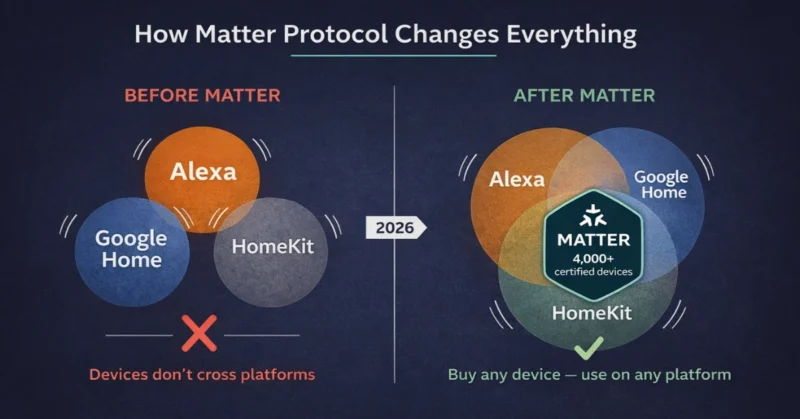
Buy the platform that suits your household. Buy Matter-certified devices going forward. You get the best of both — the right assistant experience plus future-proof device compatibility.
For a deeper look at how Matter protocol works and which Indian devices already support it, the complete smart home IoT guide for 2026 covers the full compatibility picture.
Smart Home Assistant India — The Numbers
Stat 1: Amazon Echo holds 38% of India’s smart speaker market as of Q3 2025. Source: IDC India Smart Speaker Report Q3 2025 Alexa’s market dominance means more Indian-specific skills, more local language improvements, and more Indian brand partnerships — advantages that compound over time.
The Indian smart home market numbers tell a clear story about where adoption is heading — Statista India smart home market data shows the broader global context that explains why Indian-specific features like Hindi support and rupee pricing are becoming priorities for all three platforms simultaneously.
Stat 2: Google Assistant processes over 1 billion daily voice queries in India — more than any other voice assistant platform. Source: Google India Developer Report 2025 Volume of usage directly correlates with accent training data — which is why Google Assistant handles Indian English and regional accent variations better than any competitor.
Stat 3: Matter protocol certified devices crossed 4,000 globally by Q4 2025 — a 200% increase from Q4 2023. Source: Connectivity Standards Alliance Q4 2025 Platform lock-in through devices is ending — which makes the controller experience the only meaningful differentiator between platforms going forward.
Stat 4: 67% of Indian smart home buyers cite “works with my existing devices” as the primary platform selection criteria. Source: Deloitte India Consumer Technology Survey 2025 This single stat explains Alexa’s dominance in India — widest compatibility wins with pragmatic Indian buyers who already own mixed-brand devices.
The Alexa vs Google Home vs Siri decision in India is not a technical question — it’s a household question. The right answer depends entirely on which phones your family uses, how many people share the system, and whether you prioritise device compatibility, contextual intelligence, or privacy. In 2026, all three platforms are genuinely capable. The gap between them is narrower than ever. The decision should take 5 minutes — not 5 hours of research.
FAQ — Alexa vs Google Home vs Siri India
Which is better — Alexa or Google Home for Indian homes in 2026?
Google Home is better for Android-only households wanting contextual automation. Alexa is better for mixed households wanting maximum Indian device compatibility. Both are free to use with no subscription required. Google Nest Mini costs ₹4,499 versus Echo Dot at ₹3,499 — the ₹1,000 difference is worth it for Android-first households who use Google Calendar and Gmail daily.
Does Siri work well for smart homes in India?
Siri HomeKit works excellently in India — but only if your entire household uses iPhones. HomeKit’s local processing means faster response and better privacy than Alexa or Google Home. The honest problem is cost — HomeKit-native devices cost 2–3x more than equivalent Alexa-compatible Indian brands. For mixed Android-iPhone households it creates friction that outweighs the technical benefits.
Can I use Alexa and Google Home together in one Indian home?
Yes — but avoid it as a beginner. Mixed ecosystems mean two separate apps, two separate routine systems, and double the complexity for no meaningful benefit. Pick one platform and build around it for your first 6 months. After that, Matter-certified devices work across both platforms simultaneously if you genuinely need both.
Does Alexa support Hindi in India?
Alexa supports basic Hindi commands for device control — “band karo,” “chalu karo,” “volume kam karo” work reliably. Complex Hinglish sentences and regional language variations still cause occasional misrecognition. Google Assistant handles Hindi and Indian English accents more naturally because it processes significantly more Indian voice data daily than Alexa.
Conclusion
Alexa vs Google Home vs Siri in 2026 comes down to one question — what phone does your household use? Android household — Google Home or Alexa. Mixed household — Alexa. iPhone-only household with budget — HomeKit.
Three actions to take right now. First — check which phone every person in your household uses daily. Second — download either the Alexa app or Google Home app tonight and explore the Routines section before buying any hardware. Third — when buying any new device from this point forward, check for the Matter logo on the box so every future purchase works across all three platforms regardless of which you choose today.
The best smart home assistant for Indian homes isn’t the most technically advanced one — it’s the one your entire family will actually use without asking for help every time.
Drop a comment below — which platform are you running in your home and what made you choose it? Your experience helps every reader who’s still deciding.For setting up whichever platform you choose without buying any hub, the smart home automation setup guide without a hub walks through every step. And for the best devices to pair with your chosen assistant, the 10 best smart home devices for beginners under ₹5000 in India gives you the complete shopping list.