
Last Updated: September 2026
Let me be honest — the stock market always looked confusing to me. Charts, candlesticks, ratios, all of it felt like a language other people had somehow learned and I’d missed the class. Then sometime in 2026, I noticed something shift: normal people, not hedge fund analysts, were using AI tools for stock market analysis to actually understand what they were looking at.
It’s part of a broader pattern I’ve noticed too — I’ve covered a similar shift in how to make money online using AI tools, and stock market analysis is turning out to be one of the more legitimate versions of that trend.
I want to be upfront about something before we go further, because it matters more here than in almost any other topic I write about: this isn’t financial advice, and I’m not a financial advisor. What follows is what I found testing these tools and researching how they actually work — the decision to invest, and how much, is yours to make with your own judgment, ideally alongside a licensed professional if the amounts involved matter to you.
With that said — here’s what I actually learned.
Table of Contents
What AI in the Stock Market Actually Does
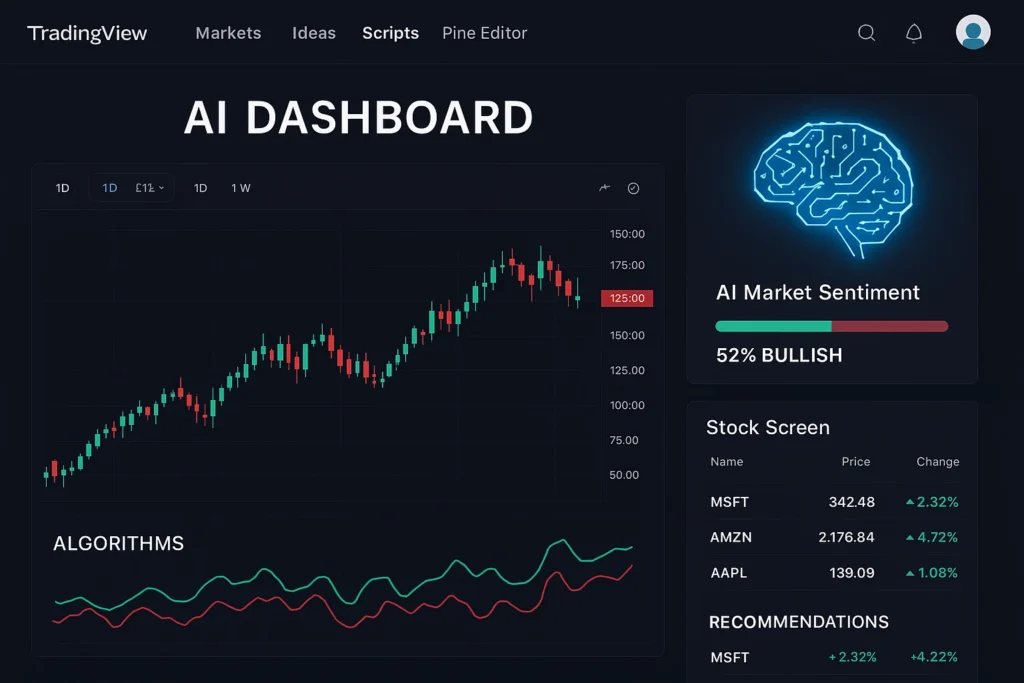
AI stock market software works by processing enormous amounts of historical price data, breaking news, and market sentiment to surface patterns a human would take hours to spot manually. It doesn’t guarantee profit — nothing legitimate does — but it’s genuinely useful for avoiding avoidable mistakes.
A solid ai stock analyzer can:
- Flag whether a stock’s momentum is building or fading
- Alert you when volatility or risk spikes unexpectedly
- Surface strategy ideas based on historical pattern matches
- Read and summarize financial news for its likely market impact
- Track broad market sentiment — fear versus confidence — across large numbers of stocks at once
Instead of staring at a chart wondering what fifteen indicators mean at once, good stock trading ai software turns that noise into something closer to a plain-English read: “this setup looks strong,” or “risk is elevated right now, be cautious.”
It’s the same pattern showing up across other parts of daily life too — I’ve rounded up a similar set of free AI tools that automate daily office work if you want to see how far this trend extends beyond trading.
Best AI Stock Trading Software for Beginners in 2026
Here’s the current, tested landscape — not a list some tools quietly stopped supporting years ago. TrendSpider and Finviz Elite remain two of the strongest names in this space in 2026, alongside the newer entrants below.
| Tool | What It Does | Free/Paid | Best For |
|---|---|---|---|
| TradingView | AI-assisted trend alerts, deep charting, huge community of shared strategies | Free + Paid (from ~$14.95/mo) | Beginners, students, global markets |
| TrendSpider | Automated pattern recognition (220+ chart patterns), AI backtesting, plain-English chart queries via its Sidekick AI assistant | Paid (from ~$82/mo) | Traders who want institutional-grade analysis without coding |
| Zerodha Streak AI | No-code AI trading strategy builder | Paid | Indian users specifically |
| Finviz Elite | Advanced stock screener (67+ filtering criteria across 8,500+ stocks), heat maps, pattern recognition | Free tier + Elite paid | Fast research and idea discovery |
| Trade Ideas | AI-powered day-trading signals via its “Holly AI” engine, real-time scans | Paid | Active day traders wanting automated signal generation |
| AlphaSense | AI-driven industry and equity research aggregation | Paid | Professionals and serious researchers |
One genuinely new development worth flagging as one of the real ai tools for stock market updates in 2026: general-purpose AI models like ChatGPT and Claude are increasingly used alongside dedicated trading platforms — not to replace them, but for macro reasoning, explaining why a stock might be risky in plain language, and drafting code for custom backtests.
That combination — a dedicated charting tool plus a conversational AI for explanation — is quickly becoming the default beginner workflow, more so than any single all-in-one app.
AI vs. Human Trading — Honest Comparison
| Feature | AI Tools | Human Analysis |
|---|---|---|
| Speed | Fast (seconds) | Slower |
| Emotion | None | Present, sometimes costly |
| Data accuracy | High | Depends on experience |
| Pattern detection | Excellent | Limited by attention span |
| Suitable for beginners | Very accessible | Steeper learning curve |
| Understands context/news nuance | Improving, not perfect | Generally stronger |
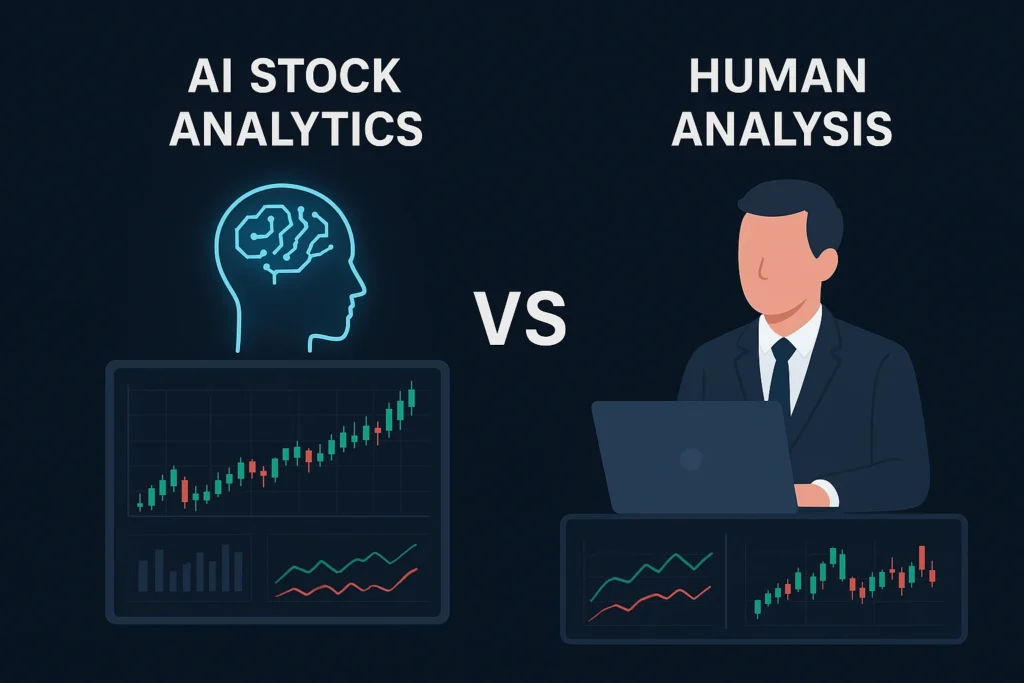
My honest take after testing several of these: AI doesn’t replace judgment. It replaces the exhausting part of judgment — staring at forty charts trying to spot which three are worth a closer look.
New for 2026: SEBI’s Rules Now Cover AI Trading Software in India
This is the part almost no other “best AI stock tools” article is covering yet, and if you’re trading from India, it directly affects which ai stock market software you can legally use.
As of April 1, 2026, SEBI made compliance mandatory for every algorithmic and AI-driven trading strategy operating in India. In practice, that means: every order placed by an AI or algo system now carries an exchange-assigned Algo-ID so it can be traced back to its source, all automated trades must route through a SEBI-compliant broker API, and algo vendors must formally register with stock exchanges rather than operating in the previous unregulated grey zone.
Why this matters for you as a beginner: algorithmic and AI-assisted trading now accounts for over 50% of total market turnover in India, and regulators moved specifically because unregistered providers were promising “guaranteed returns” to retail investors who had no way to verify what the software was actually doing. If a tool or a “signal group” promises guaranteed profits and isn’t operating through a registered, compliant broker API post-April 2026, that’s now a genuine red flag, not just bad marketing.
The practical takeaway: stick to established, exchange-recognized platforms (the ones in the table above), and if you’re using any custom or third-party AI signal service, confirm it’s operating through a SEBI-compliant setup before trusting it with real money.
What I Actually Noticed Testing These Tools
I spent a few weeks with TradingView and Zerodha Streak specifically. The first few days, I genuinely understood almost nothing — the interface alone was overwhelming. Slowly, that changed. I didn’t get spectacularly rich, and that was never really the point.
What I noticed instead was something more useful: I stopped making the panic decisions I would have made without any structure at all. A few times, the AI’s risk alert stopped me from buying into something that dropped hard the next day.
The honest lesson from that stretch: an ai stock market trading software tool isn’t a shortcut to getting rich. It’s a guardrail against getting careless. That’s a smaller promise than most marketing around these tools makes, but it’s the true one.
If you’re starting out, use demo/paper trading mode first. Every serious platform on this list offers one. Don’t put real money in until the tool’s suggestions start making intuitive sense to you, not just numerically correct sense.
How AI Search Is Changing the Way People Research Stocks
Here’s a shift worth naming directly, since it’s changing how people even find information like this article. A growing share of stock research now starts inside an AI assistant, not a search engine — someone asks ChatGPT or Claude “should I look into this stock” before they ever open a screener. Cost-efficient models like DeepSeek have made this kind of casual, exploratory research essentially free, which is a big part of why it’s become so common so fast.
That’s pushing the best ai stock trading software providers to make their data genuinely explainable, not just accurate — because a tool that can say why a stock looks risky, in plain language, is far more useful in this new research pattern than one that only outputs a score.
If you’re evaluating any ai stock analyzer going forward, this is a real differentiator worth checking: can it explain its reasoning in a sentence, or does it just hand you a number and expect you to trust it?
The Future of AI Stock Market Software (2026–2030)
Industry researchers and analysts are pointing toward a few clear directions:
- Sentiment-driven predictions pulling from global news in real time, not just price history
- Conversational trading assistants you can literally ask “why is this stock risky?” and get a real explanation, not just a number
- Mood-aware investing — tools that adjust suggested caution levels based on overall market fear or euphoria
- Fully automated portfolio rebalancing based on your stated risk tolerance
- Strategy testing before real capital is ever at risk, now standard on most serious platforms rather than a premium add-on
Most analysts expect AI to guide the research and preparation side of trading heavily by 2030, while final investment decisions remain a human call — partly by choice, and partly because regulation in most markets still requires a human to be accountable for the trade.
FAQs – AI tools for stock market
Is AI trading legal in India?
Yes. SEBI has not banned AI or algorithmic trading — instead, as of April 1, 2026, it requires all automated trading strategies to operate through a SEBI-compliant broker API with a traceable Algo-ID, specifically to protect retail investors from unregistered providers.
What are the best AI tools for stock market analysis in 2026?
TradingView and Finviz Elite are the strongest starting points for beginners, TrendSpider leads for automated pattern recognition and backtesting, and Zerodha Streak AI is the top no-code option for Indian traders specifically.
Can beginners actually use AI stock trading software?
Yes. Most platforms on this list, including Zerodha Streak and TradingView, require zero coding knowledge and are designed with beginner-friendly interfaces and demo modes.
Do AI tools for stock market prediction guarantee profit?
No, and be skeptical of any tool that claims otherwise. AI can highlight patterns and flag risk, but market outcomes are never guaranteed — this is a decision-support tool, not a certainty machine.
Should I start with a demo account before using real money?
Yes, strongly recommended. Every platform mentioned here offers a demo or paper-trading mode — use it until the tool’s logic feels intuitive to you before risking real capital.
What’s the best free AI stock screener?
Finviz’s free tier remains one of the strongest no-cost options for screening and pattern discovery, while TradingView’s free plan offers solid charting with community-built AI indicators.
Conclusion — Read Before You Invest
2026 is genuinely the year ai tools for stock market use became accessible to actual beginners, not just professional trading desks. These tools don’t make you rich. What they do is make learning the market less intimidating, and that confidence — more than any single winning trade — is what actually keeps people from quitting before they’ve learned anything.
If you’re starting now: test tools on demo mode first, don’t outsource your judgment entirely to any AI, learn the basic terminology at your own pace, and take small steps rather than big risky ones.
The stock market isn’t gambling if you approach it as calculated learning — and AI, used honestly, is a genuinely useful part of that learning curve. And if you’re curious how this same AI-assisted approach applies beyond trading, I’ve covered it from a small-business angle in Best AI Tools for Business Owners Who Want Faster Growth Without Hiring More Staff.
Have questions about any of these tools? Drop a comment — I read and reply to all of them.