
Meta is no longer playing catch-up in artificial intelligence.
It’s preparing for something much bigger.
While the world’s attention remains fixed on ChatGPT updates and Google’s Gemini announcements, Meta is quietly building its most ambitious AI roadmap yet — one that could redefine how billions of people interact with technology by 2026.
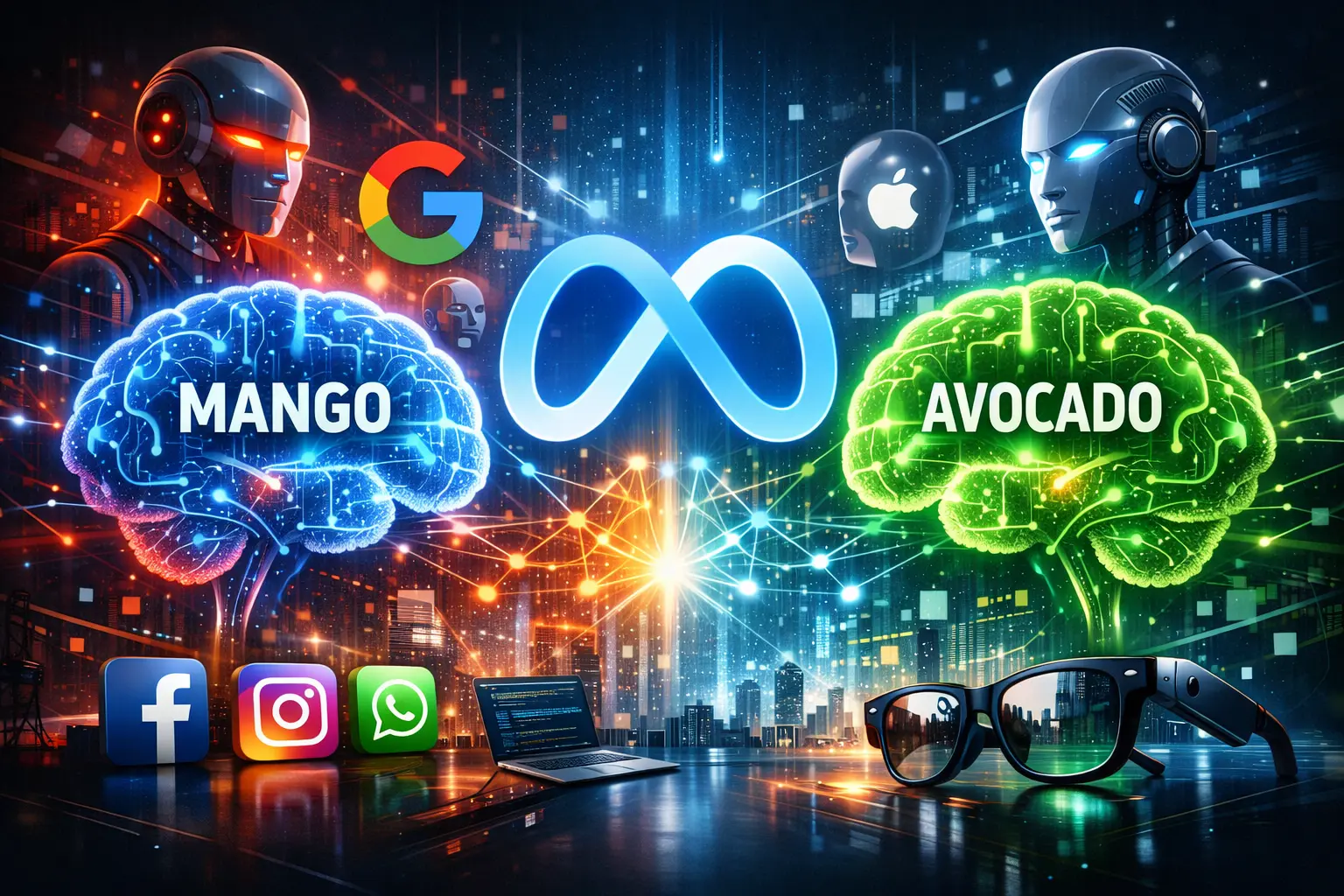
At the heart of Meta 2026 AI plan are two next-generation models with unusual names: Mango and Avocado. These aren’t just internal experiments. They represent Meta’s long-term strategy to challenge OpenAI, Google, and Apple in what many are now calling the AI war of 2026.
Let’s break down what’s really happening — and why this matters far beyond tech headlines.
Table of Contents
What Meta Has Announced So Far (In Simple Terms)
Meta has confirmed that it is working on new AI models expected to roll out gradually through 2026, internally referred to as Mango and Avocado.
While Meta hasn’t revealed full technical details yet, credible reports and executive statements suggest these models will focus on:
- Advanced multimodal AI (text, image, video, and voice)
- Deep integration with Meta’s platforms
- Open-source accessibility for developers
- AI-powered wearables and assistants
Unlike one-off chatbot releases, this is a platform-level AI shift.
And that’s what makes it important.
According to Meta’s official AI research blog, the company is investing heavily in open and multimodal AI systems.
What Are Mango and Avocado AI Models?
Think of Mango and Avocado not as single chatbots, but as AI engines designed for different purposes inside Meta’s ecosystem.
Meta Mango AI Model (Expected Focus)
- Large-scale multimodal intelligence
- Understanding long videos, reels, and live streams
- Smarter content recommendations
- Advanced reasoning for social interactions
Mango is expected to power behind-the-scenes intelligence — the kind that decides what you see, who you interact with, and how content spreads.
Meta Avocado AI Model (Expected Focus)
- Lightweight and efficient
- Optimized for on-device AI
- Designed for wearables and smart glasses
- Real-time voice and visual assistance
Avocado appears built for always-on AI, especially in Meta’s Ray-Ban smart glasses and future wearable devices.
Together, these models show that Meta’s AI models for 2026 aren’t just about chatting — they’re about living inside your daily digital life.
Why Meta Is Making This Move Now
Meta learned a hard lesson in the last AI wave:
Being late means losing control.
OpenAI owns conversational AI.
Google owns AI-powered search.
Apple is quietly dominating on-device intelligence.
Meta, however, owns something even more powerful:
Human attention at scale
With Facebook, Instagram, WhatsApp, and Messenger, Meta sits at the center of global communication. Its AI strategy is simple but bold:
Instead of pulling users toward AI tools, Meta will push AI directly into where users already live.
That’s the real logic behind Meta 2026 AI plan.
The AI War of 2026: Meta vs Everyone
By 2026, the AI battle won’t be about who has the smartest chatbot.
It will be about who controls daily digital behavior.

A Reuters report suggests Meta is positioning its AI roadmap to compete directly with OpenAI and Google in the coming years.
Here’s how the landscape is shaping up:
| Company | AI Strategy | Strength |
|---|---|---|
| Meta | Open + Social AI | Massive user base |
| OpenAI | Closed + API AI | Best reasoning models |
| Search + AI | Data & discovery | |
| Apple | On-device AI | Privacy & hardware |
Meta’s bet is unique. It doesn’t need users to ask questions — it lets AI anticipate needs inside social platforms.
That’s a dangerous advantage.
While tools like ChatGPT dominate headlines, users are increasingly learning how to use Perplexity AI like a pro for research-focused AI tasks.
How Meta’s AI Will Change Everyday User Experience
Most users won’t even realize Mango or Avocado exists — and that’s the point.
Here’s how AI will quietly reshape daily life:
Smarter Social Feeds
- AI-generated summaries of long posts
- Context-aware reels and stories
- Reduced spam and low-quality content
WhatsApp AI Assistants
- Message drafting
- Auto-summaries of group chats
- Real-time translation during conversations
Wearable AI Becomes Useful

With Avocado AI:
- Smart glasses can recognize objects
- Real-time navigation overlays
- Instant answers without pulling out a phone
This isn’t futuristic fantasy — it’s Meta’s real product direction.
Recent data from Statista shows that billions of users interact with AI-powered systems daily through social platforms.
What This Means for Creators, Developers, and Businesses
Meta’s AI push isn’t just consumer-focused. It’s a massive opportunity for professionals.
For Content Creators
- AI-assisted video editing
- Caption and script generation
- Content performance predictions
- Faster content scaling
For Developers
- Open-source AI models
- Lower-cost AI deployment
- Custom AI tools inside Meta apps
Meta’s open strategy could undercut expensive closed APIs.
For developers and non-technical users alike, the rise of AI tools that replace coding shows how quickly software creation is evolving.
For Businesses
- AI-driven ads optimization
- Smarter chatbots on WhatsApp
- Personalized marketing at scale
This could redefine digital advertising by 2026.
The Bigger Picture: Why 2026 Will Be a Turning Point for AI
If 2023–2024 was about AI discovery, and 2025 about AI adoption, then 2026 will be about AI invisibility.
AI won’t feel like a tool anymore.
It will feel like infrastructure.
Meta understands this better than most.
Its AI won’t ask for attention — it will blend into human interaction, quietly shaping behavior, creativity, and commerce.
That’s why the future of AI in 2026 won’t belong to the loudest company — but the most embedded one.
Risks, Privacy Concerns, and Controversies
No honest analysis is complete without the risks.
Meta’s AI expansion raises serious questions:
- How much user data will AI analyze?
- Can misinformation scale faster with AI?
- Will deepfakes become more convincing?
- How will governments regulate social AI?
These challenges could slow Meta’s plans — or force major redesigns.
Trust will matter as much as intelligence.
Should You Care About Meta 2026 AI Plan?
YES, if you are:
- A regular social media user
- A content creator
- A business owner
- A tech professional
- An AI enthusiast
NO, only if:
- You don’t use Meta platforms at all
For everyone else, Meta’s AI roadmap will directly affect how you communicate, consume content, and do business online.
What This Means for the Future of AI
The AI war isn’t about domination anymore.
It’s about integration.

Meta’s Mango and Avocado models signal a future where AI doesn’t live in apps — it lives between people.
And by 2026, that might be the most powerful position in tech.
Meta’s AI roadmap is part of much larger future tech trends shaping the next decade, where AI becomes invisible and embedded into everyday life.
FAQs
What is Meta 2026 AI plan?
Meta’s 2026 AI plan focuses on launching next-generation AI models like Mango and Avocado, designed to power social platforms, wearables, and open-source AI tools.
What are Meta’s Mango and Avocado AI models?
Meta Mango AI is expected to be a large multimodal model, while Meta Avocado AI is likely optimized for lightweight, on-device intelligence and smart wearables.
How is Meta’s AI different from ChatGPT or Google Gemini?
Unlike ChatGPT or Gemini, Meta’s AI is designed to work directly inside social platforms like Instagram, WhatsApp, and Facebook rather than as a standalone chatbot.
Will Meta’s AI be free or paid?
Meta is expected to keep many AI features free within its platforms, while offering premium tools and enterprise AI services for businesses and developers.
How will Meta AI affect WhatsApp and Instagram users?
Meta AI could bring chat summaries, AI replies, smarter feeds, and real-time assistance directly inside WhatsApp and Instagram by 2026.
Is Meta using user data to train its AI models?
Meta has stated it follows regional privacy laws, but AI training using public data remains a major concern and topic of regulatory scrutiny worldwide.
Can developers use Meta’s AI models?
Yes, Meta is known for open-sourcing AI models, which may allow developers to build applications using Meta’s 2026 AI technology.
Will Meta AI power smart glasses?
Yes, Meta Avocado AI is expected to play a major role in powering AI-enabled smart glasses and wearable assistants.
Final Thoughts
Meta 2026 AI plan is not hype — it’s strategy.
By focusing on open models, wearables, and social intelligence, Meta is building AI where it matters most: inside human connection.
Whether this vision succeeds or backfires will define the next decade of technology.
One thing is certain:
The AI war ahead won’t be fought on chat screens — it will be fought in everyday life.
1 thought on “Meta 2026 AI Plan Explained: Mango, Avocado & AI War”