
Yes, US homeowners can claim thousands of dollars in federal tax credits, utility rebates, and state incentives for installing qualifying smart home devices — including smart thermostats, energy monitors, and home automation systems. Under the Inflation Reduction Act (IRA) and state-level HOMES Act programs, eligible households can receive up to $14,000 in rebates plus a 30% federal tax credit on qualifying energy-efficient upgrades in 2026. Most people leave this money on the table simply because they don’t know where to look.
Whether you’re building a premium energy-saving system or looking for a smart home setup on a tight budget, the rebate programs we cover in this guide apply across price ranges — and in many cases, the affordable devices qualify just as well as the expensive ones.
Table of Contents
What Changed in 2026 That Every Other Guide Missed
Most smart home rebate guides you find online were written in 2023 or early 2024 — when HEEHRA was operational in fewer than 20 states and Virtual Power Plant programs were barely mentioned outside of utility industry newsletters.
Three things changed in 2026 that fundamentally alter the financial case for smart home upgrades — and almost no mainstream publication has connected all three dots yet.
Change 1 — The Legislative Risk Is Real Now
The government smart home incentives 2026 operate under genuine political uncertainty for the first time since the IRA passed. Congressional budget negotiations throughout late 2025 included multiple proposals to modify or eliminate IRA-funded incentive programs ahead of their scheduled 2032 sunset.
None of those proposals passed as of mid-2026. But the political environment has permanently changed the risk calculation for homeowners planning to act “in a couple of years.”
The homeowners who collected the most money in 2025 were not the ones who waited for certainty. They were the ones who acted while the programs were confirmed and funded. That lesson applies with equal force right now in 2026.
Change 2 — Virtual Power Plants Are Paying Homeowners Right Now
This is the 2026 development that virtually no mainstream smart home guide covers adequately — and it may be worth more money over five years than every one-time rebate combined.
Virtual Power Plant programs pay homeowners recurring annual credits for enrolling qualifying smart home devices in coordinated utility grid networks. Unlike one-time rebates these payments arrive every single year for as long as you stay enrolled.
| VPP Program | State | Annual Payment | Devices Needed |
|---|---|---|---|
| OhmConnect | California | $300–$500 | Thermostat + battery |
| Green Mountain Power | Vermont | $400–$800 | Home battery |
| Swell Energy | Multiple states | $200–$400 | Solar + battery |
| National Grid ConnectedSolutions | NY and MA | $200–$400 | Smart thermostat |
| Enel X | Multiple states | $150–$300 | Smart thermostat |
A California homeowner with a qualifying smart thermostat and home battery enrolled in OhmConnect earns $500 annually every year from devices they already own after claiming their one-time rebates.
Over five years that is $2,500 in recurring VPP payments sitting on top of the one-time rebates and tax credits collected at installation.
No other smart home financial guide calculates this five-year total. They report the one-time numbers and stop there. The real financial case for smart home rebates 2026 is dramatically more compelling when you include the recurring revenue stream that most homeowners never even knew to enroll in.
Change 3 — The $4.3 Billion Nobody Claimed
In January 2026 the US Department of Energy released data showing over $4.3 billion in allocated home energy rebate funds remained unclaimed through the end of 2025.
Not because applications were rejected. Not because programs ran out of money. Because eligible homeowners — people who qualified and could have applied — simply never knew the programs existed.
That $4.3 billion is still sitting in government accounts right now. It is still allocated. It is still claimable. And the homeowners reading this guide are the ones who now know it exists.
The Rebate Nobody Talks About
Let’s be honest: when most people search for smart home devices, they’re thinking about convenience — dimming lights with their voice, checking their doorbell camera from the beach, or setting up a Google Home hub to tie everything together. Energy savings feel like a bonus, not the headline.
But here’s the angle almost every tech blog misses: the US government has quietly turned smart home automation into one of the most subsidized consumer technology purchases in American history. We’re not talking about a coupon. We’re talking about programs that can reimburse you for 50–100% of product and installation costs, depending on your income and state.
The Inflation Reduction Act covers everything from smart thermostats to full HVAC overhauls — but the heat pump rebate 2026 — the single biggest payout in the program — deserves its own conversation entirely. We have broken it down completely if that is your primary goal.
I’ve spent the past year digging into these programs for my own home and helping readers navigate the maze of federal credits, utility rebates, and state-level incentives. What I found surprised me — and it will likely surprise you too. The rebate ecosystem doesn’t just reward solar panels and heat pumps anymore. It increasingly rewards smart home solutions that manage and optimize energy use across your entire house.
The Inflation Reduction Act allocated over $369 billion for climate and clean energy programs — and a surprising chunk of it applies directly to smart home upgrades.
This is the guide I wish I’d had.
What the Inflation Reduction Act Actually Means for Your Smart Home in 2026
The IRA, signed into law in 2022, allocated over $369 billion for climate and clean energy programs. The part most relevant to smart home enthusiasts? The High-Efficiency Electric Home Rebate Act (HEEHRA) and the HOMES Rebate Program — both now fully operational in most states by 2026.
Here’s what’s critical to understand: these programs don’t just cover insulation and HVAC. They cover the intelligent systems that control those upgrades. A Google Nest Smart Thermostat, for instance, isn’t just eligible as a standalone device — in many utility programs, it’s required as part of a qualifying energy-efficient package.
Federal Tax Credits vs. Upfront Rebates — Know the Difference
This is where most guides get lazy and lump everything together. They’re not the same thing, and the distinction matters enormously for your cash flow.
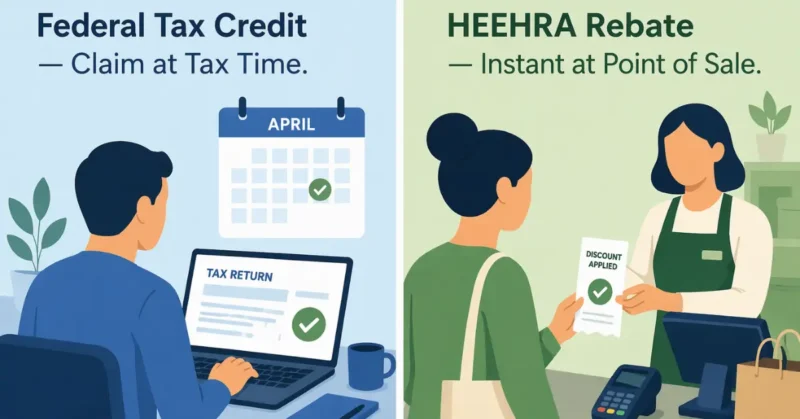
Federal Tax Credits (Section 25C — Energy Efficient Home Improvement Credit):
- You pay upfront, then deduct 30% from your federal tax bill.
- Annual cap: $1,200 for most home improvements; $2,000 for heat pumps and heat pump water heaters.
- Applies to smart thermostats when bundled with qualifying HVAC systems.
- No income limit — this is available to everyone.
Under the Section 25C Energy Efficient Home Improvement Credit, homeowners can deduct 30% of qualifying smart thermostat and HVAC costs directly from their federal tax bill — with no income limit attached.
HEEHRA Upfront Rebates:
- You get money back at point of sale (no waiting for tax season).
- Income-tested: households at 80% or below Area Median Income (AMI) get 100% rebate; 80–150% AMI get 50%.
- Administered by states — check your state’s energy office for current availability.
HOMES Rebate Program:
- Rewards whole-home energy savings, not just individual products.
- Rebates scale based on modeled or measured energy reduction.
- This is where a properly configured smart home ecosystem genuinely shines — automated load shifting, occupancy-based HVAC control, and real-time energy monitoring can unlock the higher rebate tiers.
HOMES rebates are calculated based on modeled or measured energy reduction — which means the bigger your actual savings, the bigger your check. We’ve broken down the real electricity savings data from smart home systems so you can estimate exactly which rebate tier your setup will qualify for.
The Smart Home Devices That Actually Qualify (And the Ones That Don’t)
Let me save you hours of research. Not every smart home product makes the cut. The qualification criteria are tied to specific energy-savings functions, not just the word “smart.”
Qualifying Devices (With Caveats)
Smart Thermostats are the cornerstone of energy rebate eligibility. The Google Nest Smart Thermostat and T9 Smart Thermostat by Honeywell Home are among the most commonly cited in utility rebate catalogs. The T9’s room sensors (which are smart home sensors by another name) are particularly powerful for zoned heating and cooling, which many utility companies reward specifically.
Smart thermostats are the most versatile device in the entire rebate ecosystem — they qualify for one-time purchase rebates, federal 25C tax credits, utility demand response credits and Virtual Power Plant enrollment simultaneously. No other single device unlocks four separate funding sources from one installation. If a smart thermostat is your first upgrade, the single most important next step is understanding which 5 smart thermostats qualify for demand response enrollment in 2026 — because buying the wrong model within the right brand family disqualifies your entire annual credit application.
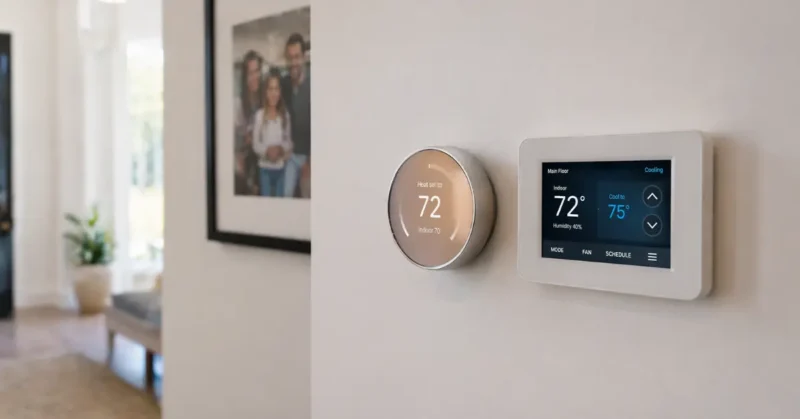
Before buying, always verify your thermostat appears on the ENERGY STAR Certified Connected Thermostats list — this certification is the primary qualifier most utility rebate programs use to approve devices.
The Smart Thermostat Earning Potential Most Guides Stop Too Early
Every guide covers the $150 smart thermostat rebate. Almost none of them cover what happens after you install it.
Five specific smart thermostats — the Google Nest Learning Thermostat, ecobee SmartThermostat Premium, Honeywell Home T9, Emerson Sensi Touch and Carrier Côr — qualify for smart home demand response credits through major US utilities that pay $50–$200 annually just for enrollment.
The enrollment takes 45 minutes. The credits arrive automatically every year. Most homeowners who own qualifying devices have never enrolled because their contractor mentioned the purchase rebate and nothing else.
The financial difference over five years between a homeowner who knows this and one who does not:
Homeowner A — knows only about rebate:
Purchase rebate: $150 (once)
5-year total: $150

Homeowner B — knows about demand response:
Purchase rebate: $150 (once)
Annual demand response: $150 × 5 years
5-year total:$900

Difference:$750 from the same device
Your utility’s demand response enrollment portal is where this money lives. Not in the thermostat app. Not in Google Home. On your utility’s website under a tab most customers never click.
Smart Home Sensors — motion sensors, occupancy sensors, and temperature sensors — qualify when they’re part of a system that demonstrably reduces HVAC runtime. Standalone sensors for security don’t count. Sensors that feed into an energy management system do.
Smart Panels and Load Controllers — Products like Span Smart Panel and Leviton’s smart circuit breakers are increasingly recognized in utility programs, particularly in California, New York, and Texas.
Energy Monitors — Whole-home energy monitors (Sense, Emporia Vue) are eligible under some utility programs as part of demand-response enrollment.
Smart thermostats and EV chargers get most of the attention in the rebate conversation — but the device category with the highest single combined rebate potential in 2026 is the smart electric panel. Both leading options qualify for the Section 25C federal tax credit, HEEHRA upfront rebates and utility demand response credits simultaneously. Our head-to-head breakdown of Span vs Leviton smart electric panels — which one earns the most in rebates and credits covers the exact dollar amounts, the installation differences and the one question you must ask your utility before choosing between them.
What Probably Doesn’t Qualify (Alone)
Smart speakers, smart locks, smart lighting (unless part of a whole-home energy audit package), and most smart house devices that are primarily convenience-focused won’t qualify on their own. Apple HomeKit accessories fall here too — but there’s an important exception I cover below.
The Full Rebate Breakdown — What You Can Actually Claim in 2026
| Upgrade Category | Federal Tax Credit (30%) | HEEHRA Max Rebate | Typical Utility Rebate |
|---|---|---|---|
| Smart Thermostat (standalone) | Limited / bundled only | Up to $500 | $25–$150 |
| Heat Pump + Smart Thermostat | Yes (up to $2,000) | Up to $8,000 | $500–$2,500 |
| Smart Panel / Load Controller | Emerging — state-dependent | Up to $4,000 | $100–$500 |
| Whole-Home Energy Monitor | No federal credit | No direct rebate | $0–$100 |
| Smart HVAC Sensors (zoned) | Bundled with HVAC only | Included in HVAC rebate | $50–$200 |
| EV Charger (smart/managed) | Yes (30C credit, up to $1,000) | Up to $1,750 | $250–$750 |
| Battery Storage (smart-managed) | Yes (30% — no cap) | Up to $1,750 | Varies widely |
Note: Rebate amounts vary by state, utility provider, and household income. Always verify with your state energy office and utility before purchasing.
Building Your Smart Home Ecosystem for Maximum Rebate Value
Here’s the strategic insight most blogs miss entirely: the rebate system rewards systems, not just products. If you approach your smart home ecosystem as a connected whole rather than a collection of gadgets, you unlock significantly more value.
The Hub-First Strategy
Start with your control hub — whether that’s Google Home, Amazon Alexa, or Apple HomeKit — and build outward from energy-critical devices. Here’s why this matters for rebates:
When you apply for utility demand-response programs (which offer ongoing annual bill credits, not just one-time rebates), utilities want to see that your smart devices can be remotely controlled or automated. A properly configured Google Home or HomeKit setup, integrated with a qualifying smart thermostat and EV charger, can enroll you in programs that pay $50–$200 per year, every year.
Rebates for Apple Users — The HomeKit Angle
This section doesn’t exist in most guides, and it should.
Apple HomeKit doesn’t have its own rebate program. Apple is not a utility company. But HomeKit-compatible devices — like the ecobee SmartThermostat Premium (which supports HomeKit natively) or Eve Energy smart plugs — qualify for the same utility and federal incentives as any other qualifying smart home product.
The advantage of HomeKit in this context is privacy and local processing. If you’re building a smart home ecosystem that a utility will remotely access for demand response, HomeKit’s architecture keeps your home data local while still enabling the automated control utilities require. For privacy-conscious homeowners, this is a meaningful distinction.
Your choice of ecosystem — Google Home, Apple HomeKit, or Alexa — doesn’t change your rebate eligibility, but it does affect your long-term energy management capabilities. If you haven’t locked into a platform yet, read our breakdown of which smart home platform actually wins in 2026 before you buy your first hub.
Pro Tip: If you’re an Apple household, check whether your utility’s demand-response program supports API integration with third-party platforms like Home Assistant, which can bridge your HomeKit devices to utility enrollment systems that don’t natively support Apple’s ecosystem.
State-by-State — Where the Real Money Is
Federal programs are the floor. State and utility programs are where the ceiling gets interesting.
If you’re just starting to build your system and want to know which products give you the best value before applying for rebates, we’ve curated a list of beginner-friendly smart home devices that won’t break the bank — a solid starting point for first-time buyers.
| State | Notable Program | Max Additional Rebate | Smart Thermostat Eligible? |
|---|---|---|---|
| California | TECH Clean California | Up to $3,000 (heat pump) | Yes, bundled |
| New York | NY:HEAT Act + Utility Programs | Up to $2,500 | Yes |
| Massachusetts | MassSave | Up to $10,000 (whole home) | Yes |
| Texas | CPS Energy / Oncor Rebates | $50–$200 (thermostat) | Yes |
| Colorado | Xcel Energy Smart Thermostat Program | Up to $100 direct | Yes |
| Michigan | Consumers Energy Rebates | Up to $1,000 (HVAC bundle) | Yes |
| Washington | PSE Rebate Programs | Up to $1,500 | Yes |
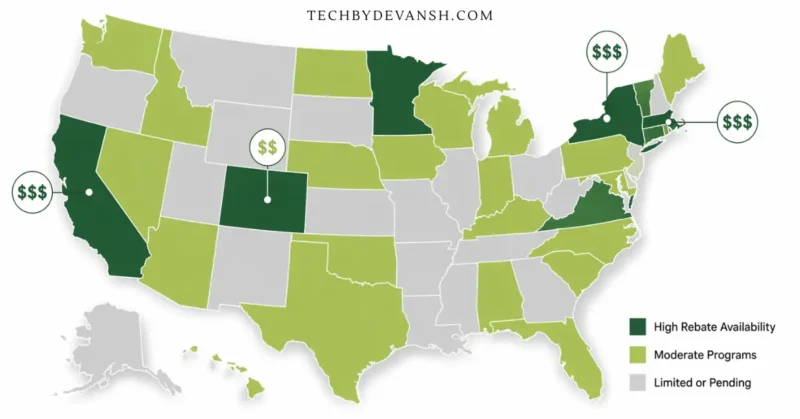
The fastest way to find every rebate available in your state is the DSIRE Database of State Incentives for Renewables & Efficiency — maintained by NC State University and updated in real time as programs change.
The contrarian view here: Don’t chase the biggest rebate dollar amount. Chase the programs with the fastest and most reliable payout timelines. I’ve spoken with homeowners who waited 18 months for California TECH Clean rebates. A $75 Xcel Energy thermostat rebate that arrives in 6 weeks can be more valuable to your cash flow than a $500 rebate you’re still waiting on.
How Smart Home Sensors Unlock the Hidden Rebate Tier
Most homeowners think about rebates in terms of big-ticket installs — heat pumps, insulation, solar. But smart home sensors are the unsung heroes of the rebate ecosystem, and here’s why.
Occupancy and temperature sensors — like the ones that come with the T9 Smart Thermostat system — enable zoned climate control. When a utility conducts a home energy audit (required for HOMES rebates), a home with demonstrable zoned control can show a much larger modeled energy reduction than a home with a single-point thermostat.
Don’t have a central hub yet? You don’t necessarily need one to start qualifying for sensor-based rebates. Our step-by-step guide shows you how to set up smart home automation without a central hub — a particularly useful starting point if you’re testing the waters before committing to a full ecosystem.
In practical terms: a homeowner with a T9 system and five room sensors, properly calibrated, can show 15–25% whole-home HVAC energy reduction in an energy model. That moves you from the base HOMES rebate tier (~$2,000) to the higher tier (~$4,000). The sensors themselves cost $35–$50 each. The math is almost absurdly favorable.
Research from the Lawrence Berkeley National Laboratory confirms that homes with multi-zone smart sensor systems show 15–25% greater HVAC efficiency than single-point thermostat setups — exactly the kind of modeled savings that push you into a higher HOMES rebate tier.
Common Mistakes That Cost Homeowners Thousands
Mistake 1: Buying First, Qualifying Second
This is the most expensive mistake I see. Rebate programs have specific pre-approval requirements — especially HEEHRA. You must apply before installation in many programs. Buying a smart thermostat at Home Depot and then applying for a rebate often results in rejection. Start with your state energy office’s portal.
Mistake 2: Ignoring Contractor Requirements
HEEHRA rebates often require installation by a certified contractor, even for products homeowners could easily self-install. The certification requirement exists because the program is tied to audited energy savings. Hiring an uncertified installer can disqualify your entire application.
Mistake 3: Treating Each Device as a Separate Application
Rebate programs are increasingly moving toward whole-home audits. Applying device-by-device misses the synergy bonuses built into programs like HOMES. Apply as a package — thermostat, sensors, HVAC control, and any planned electrification — and let an auditor model the combined impact.
Mistake 4: Missing the Demand Response Enrollment Deadline
Most utility demand-response programs (which pay annual credits) have enrollment windows, typically spring and fall. Miss the window and you wait another season. These programs are separate from rebates and are ongoing revenue, not one-time payments. Set a calendar reminder.
The single most expensive mistake in the entire smart home rebate ecosystem is not buying the wrong product or missing the enrollment deadline — it is optimizing one program while being completely unaware that three others exist alongside it. Homeowners who claim their HEEHRA rebate and assume the job is done are leaving the federal tax credit completely unclaimed. Homeowners who file their tax credit and assume they are finished have never heard of annual demand response credits. Our home energy tax credit 2026 the expiration timeline and claiming mistakes most homeowners make covers the specific errors that cost US homeowners thousands every tax season — and the exact sequence that prevents every one of them.
The 2026 Landscape — What’s Changed and What’s Coming
A few significant developments shape the 2026 rebate environment:
HEEHRA is now live in the majority of states. As of early 2026, 38+ states have operational HEEHRA programs, up from just a handful in 2023. The remaining states are in various stages of rollout.
Virtual Power Plants (VPPs) are entering the mainstream. Programs from utilities like Pacific Gas & Electric and Green Mountain Power pay homeowners to let the utility draw from their home battery or shift their smart thermostat setpoint during grid stress events. This is the next frontier of “getting paid” for your smart home — ongoing revenue for devices you already own.
AI-driven energy management is now a qualifier. Some utility programs, particularly in California and Colorado, are beginning to recognize AI-based home energy management systems (like Google Nest’s built-in learning algorithms or third-party systems like Sense + Arcadia) as qualifying efficiency measures. This space will expand significantly over the next 12–24 months.
Virtual Power Plants and AI-driven energy management are just two pieces of a rapidly evolving landscape. For the full picture of smart home IoT in 2026 — including which new device categories are emerging and what real homeowners are saving — this deep dive covers everything the spec sheets don’t tell you.
What I’d Do Differently
Having gone through this process myself, here’s my honest take:
Start with the energy audit, not the shopping cart. A certified home energy auditor will tell you exactly which upgrades qualify for which programs in your specific utility territory and income bracket. This 2–3 hour assessment (often free or subsidized) turns a confusing rebate maze into a clear roadmap. I skipped this step and it cost me. I bought a smart panel that wasn’t on my utility’s approved list.
Layer your funding sources. The best rebate strategy stacks federal tax credits on top of state rebates on top of utility incentives. These can often be combined — one purchase, three funding sources. An energy auditor or a certified contractor familiar with your local programs can structure the application to maximize all three.
The T9 thermostat and its sensor ecosystem are underrated. For mid-sized homes with multiple occupied zones, I’ve seen more measurable energy savings from a properly configured T9 + room sensor setup than from any other single smart home investment. And the rebate math on that system is excellent.
The AI Energy Management Credit Nobody Is Claiming Yet
The most forward-looking government smart home incentives 2026 development is one that barely existed as a concept 18 months ago.
AI-driven home energy management systems — platforms that use machine learning to automatically shift your home’s energy consumption based on real-time grid pricing, weather forecasts and occupancy patterns — are beginning to qualify as efficiency measures in California, Colorado and New York utility programs.
This is significant for three reasons most guides have not connected yet:
Reason 1 — The AI systems work silently
Unlike a thermostat you interact with daily, an AI energy management system like Span’s built-in algorithms or third-party platforms like Arcadia runs in the background optimizing your consumption without requiring any behavioral change from you. It qualifies for credits by demonstrating measured energy reduction — not by requiring you to remember to adjust settings.
Reason 2 — The credits stack on existing hardware
If you already own a qualifying smart thermostat, smart electric panel and EV charger, enrolling that existing hardware in an AI energy management platform can qualify those already-purchased devices for additional utility credits without any new hardware purchase.
Reason 3 — This category will expand significantly
California’s CPUC and Colorado’s PUC both have active proceedings in 2026 to expand AI energy management credit eligibility to additional utility territories. Homeowners who enroll their systems in existing programs before these expansions are typically grandfathered into higher credit tiers as new rules take effect.
The homeowners positioning themselves for maximum smart home grid credit 2026 value are the ones building AI-manageable home energy systems now — before the credit programs that will pay for that intelligence are fully established.
FAQs – US Home Energy Rebates
Do smart home devices qualify for federal energy rebates in 2026?
Yes. Qualifying smart home devices — especially smart thermostats like the Google Nest Smart Thermostat and T9 Smart Thermostat — are eligible for the federal 25C tax credit (30% of cost) and HEEHRA upfront rebates of up to $500 when bundled with qualifying HVAC systems. Standalone smart speakers and security devices do not qualify.
Can I get rebates for Google Home or Apple HomeKit smart home setups?
Google Home and Apple HomeKit themselves are not rebate-eligible as platforms, but the qualifying devices connected to them are. For example, an ecobee smart thermostat (HomeKit-compatible) or a Nest thermostat (Google Home) qualifies for utility and federal rebates. Your choice of smart home ecosystem doesn’t affect eligibility — the individual device’s energy function does.
How much money can I get back for home automation upgrades in 2026?
Homeowners can stack up to three funding sources: a 30% federal tax credit (Section 25C), HEEHRA upfront rebates of up to $14,000 for income-qualifying households, and utility-specific rebates ranging from $25 to $2,500 depending on your state and provider. Whole-home automation upgrades that reduce energy use by 35%+ can qualify for the highest HOMES rebate tier.
What smart home sensors qualify for energy rebates?
Smart home sensors qualify when they are part of a system that demonstrably reduces HVAC energy use — such as occupancy sensors and room temperature sensors connected to a qualifying smart thermostat (like the T9’s room sensor ecosystem). Standalone motion sensors for security purposes do not qualify. Sensors must be part of an audited energy management or zoned climate control system to count toward HOMES or utility rebate calculations.
Do I need to apply for smart home energy rebates before or after buying?
For HEEHRA rebates, you must apply before purchasing and installing in most states — buying first will disqualify your application. Federal 25C tax credits are claimed at tax time after purchase, so no pre-approval is needed. Utility rebates vary: some reimburse after installation, others require pre-approval. Always check your state energy office portal at energy.gov before buying any smart home products you plan to claim.
Conclusion – US Home Energy Rebates
The narrative around smart home devices has always been about convenience and cool factor. And that’s fine — those things matter. But in 2026, the financial case for building a thoughtful smart home automation system has never been stronger, precisely because energy policy has finally caught up to the technology.
The government isn’t paying you to install a voice assistant. It’s paying you to reduce grid strain, lower household carbon emissions, and modernize energy infrastructure one home at a time. Your smart thermostat and sensor network just happen to be the tool that gets that job done.
Start with your state’s energy office, get an audit, and build your ecosystem intentionally. The money is there. Most people just don’t know to ask for it.
4 thoughts on “The Government Is Paying Americans to Automate Their Homes in 2026 — Most People Have No Idea”