

If you’ve completed BCA or are still studying, you’ve probably asked yourself at least once:
“Is DevOps a good career after BCA?”
The IT world is moving towards cloud, automation, and faster releases. Traditional roles alone are not enough now. Many BCA students want a career that is skill‑based, future‑proof, and pays well. DevOps fits that requirement very well.
The honest answer: yes, DevOps can be an excellent career after BCA—if you follow the right learning path and build real skills.
For full details of DevOps roles, salaries and future in India, read this complete DevOps career guide.
Table of Contents
What Is DevOps? (Simple Explanation for BCA Students)
DevOps is a way of working where development (Dev) and operations (Ops) teams work together to build, test, deploy, and maintain applications quickly and reliably.
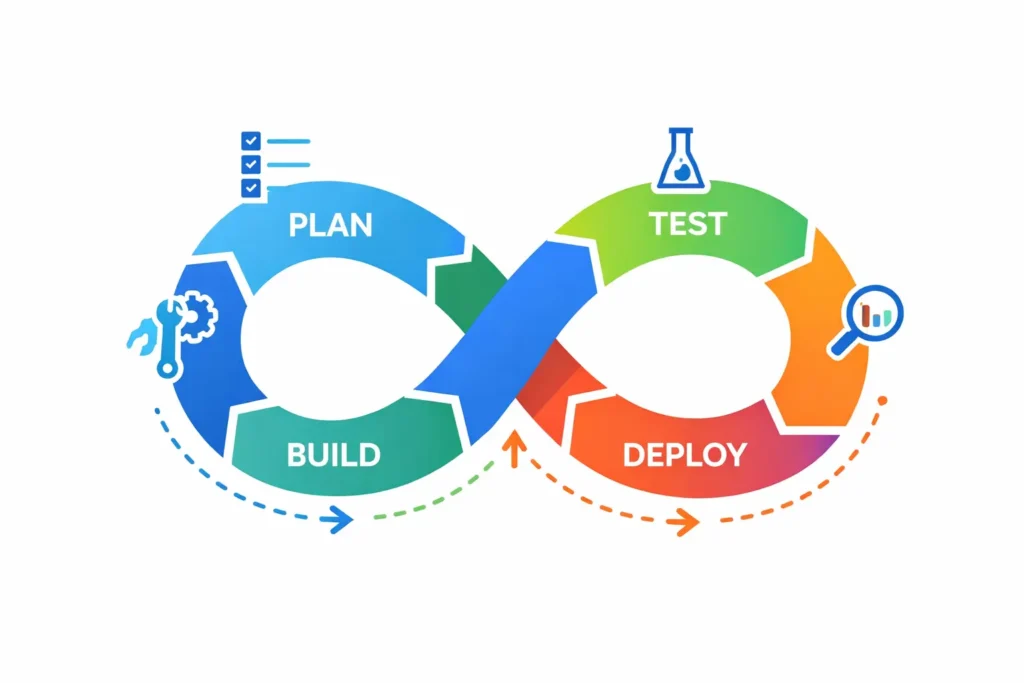
Instead of doing everything manually, DevOps focuses on:
- Automation
- Cloud platforms
- Continuous integration and delivery (CI/CD)
- Containers
- Monitoring and reliability
In simple words: DevOps helps companies ship software faster, with fewer errors and less chaos.
Can BCA Students Learn DevOps?
Yes. In fact, BCA students are a very good fit for DevOps.
Your BCA course already gives you basics like:
- Computer fundamentals
- Operating systems
- Networking concepts
- Programming logic
- Databases
DevOps does not demand advanced algorithms or heavy competitive‑programming skills. It is more about tools, workflows, and solving real problems in production systems.
If you are comfortable with Linux, scripting, and basic cloud concepts, you can definitely learn DevOps.
How to Use Your BCA Semesters Wisely for DevOps
If you are still in BCA, you don’t have to wait until graduation to start with DevOps. You can slowly build the right skills semester by semester so that, by the time you finish BCA, you are already job‑ready.
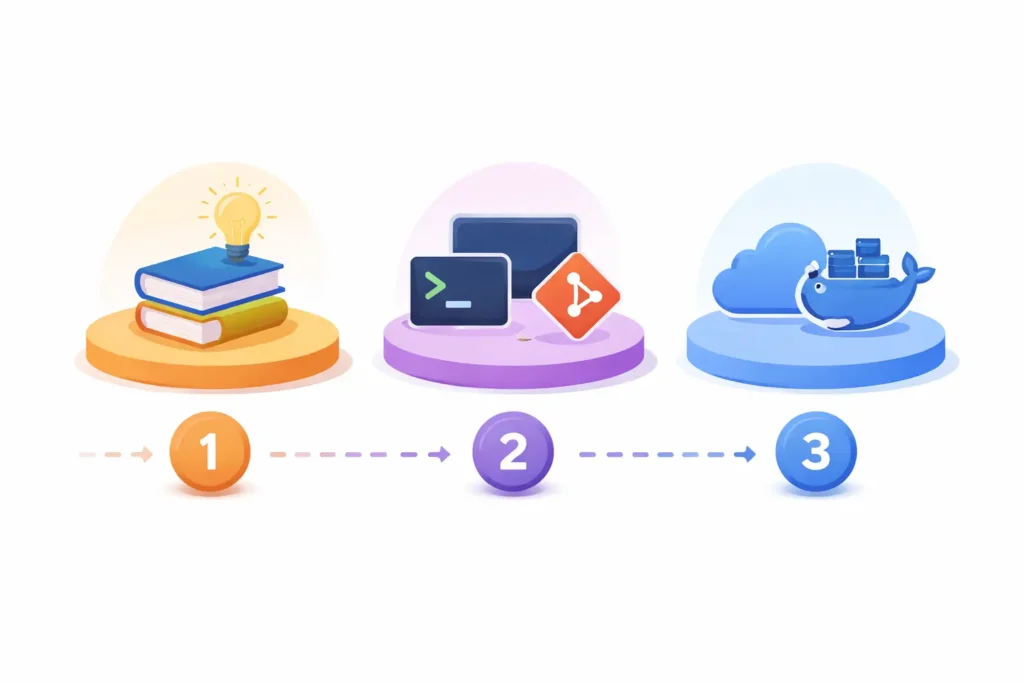
1st year – Build strong basics
In the first year, your goal should be to understand how computers and the internet really work.
- Pay attention to computer fundamentals, OS, and networking subjects.
- Parallel to college, start learning basic Linux commands and simple Git usage.
- Try to do at least one tiny project, like hosting a simple website on Linux, just to remove fear of terminals and servers.
If your basics are strong here, learning DevOps tools later becomes much easier.
2nd year – Start touching DevOps skills
In the second year, you can start moving closer to real DevOps topics.
- Learn shell scripting and basic Python for automation.
- Practice Git and GitHub properly: branches, pull requests, resolving conflicts.
- Watch beginner content on CI/CD and try to automate a small college project build using GitHub Actions or Jenkins.
At this stage, you’re not expected to be an expert; you just need enough familiarity to understand what happens in a real pipeline.
3rd year – Go deep into cloud, containers, and projects
In the final year, focus on tools that companies actually use.
- Learn Docker and understand images, containers, and volumes.
- Explore one cloud provider (AWS is a good starting point) and deploy at least one small app.
- For your final‑year project, try to include a CI/CD pipeline, containerization, or cloud deployment so you can show real DevOps work on your resume.
If you plan your BCA like this, you don’t just graduate with a degree—you graduate with a DevOps‑ready portfolio.
Why DevOps Is a Strong Career Option After BCA
Here is why choosing DevOps after BCA makes sense in 2026.
1. High Demand in Indian IT
Most companies now rely on:
- Cloud infrastructure
- Automated pipelines
- Microservices and APIs
Because of this, DevOps engineers are required in almost every medium and large company, from startups to big MNCs.
2. Faster Growth Than Many Traditional Roles
Compared to roles like:
- Manual tester
- Basic IT support
- Generic junior developer
DevOps often offers:
- Quicker promotions
- Better salary jumps
- Exposure to modern tools and architectures
3. Skills Matter More Than Degrees
In DevOps, what you can do matters more than which degree you hold.
- Skills > certificates
- Projects > theory
- Hands‑on work > marks
Many good DevOps engineers do not have an MCA or MTech. They built skills through practice, projects, and real work.
DevOps After BCA: Salary in India (2026)

Here is a realistic salary for BCA graduates who move into DevOps:
- Freshers (0–1 year): ₹4 – ₹7 LPA
- 2–4 years experience: ₹8 – ₹15 LPA
- Senior level (5+ years): ₹18 – ₹30+ LPA
- Remote global roles: can reach ₹30–50 LPA equivalent once you have strong experience and work with foreign companies
Many BCA graduates eventually work remotely for US or European companies after building a few years of solid DevOps experience.
DevOps Roadmap After BCA (Step‑by‑Step)
Here is a simple roadmap designed for BCA students. You don’t need to master everything at once—move step by step.
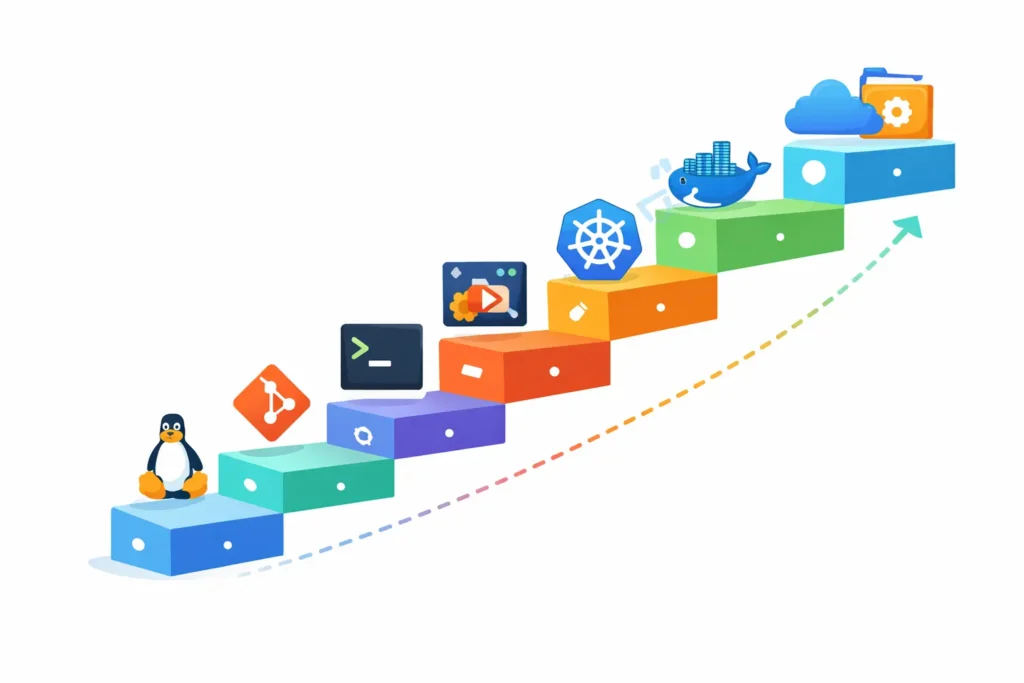
1. Linux & Git
- Basic Linux commands
- Git and GitHub for version control
2. Scripting
- Shell scripting
- Basic Python (optional but very useful)
If you want a structured starting point, check these Best Free DevOps Courses & Certifications (2026) to begin learning without paying.
3. CI/CD
- Jenkins or GitHub Actions
- Automating builds, tests, and deployments
4. Containers
- Docker basics
- Images, containers, volumes
5. Kubernetes
- Pods, services, deployments
- How scaling and rolling updates work
6. Cloud Platform
- Start with AWS (very popular in India)
- Later explore Azure or GCP if needed
7. Projects and Internships
- Build small DevOps pipelines for sample apps
- Put everything on GitHub
- Apply for internships, trainee roles, or freelance projects
If you follow this roadmap consistently, you can become job‑ready within a few months.
DevOps Jobs After BCA: Possible Roles
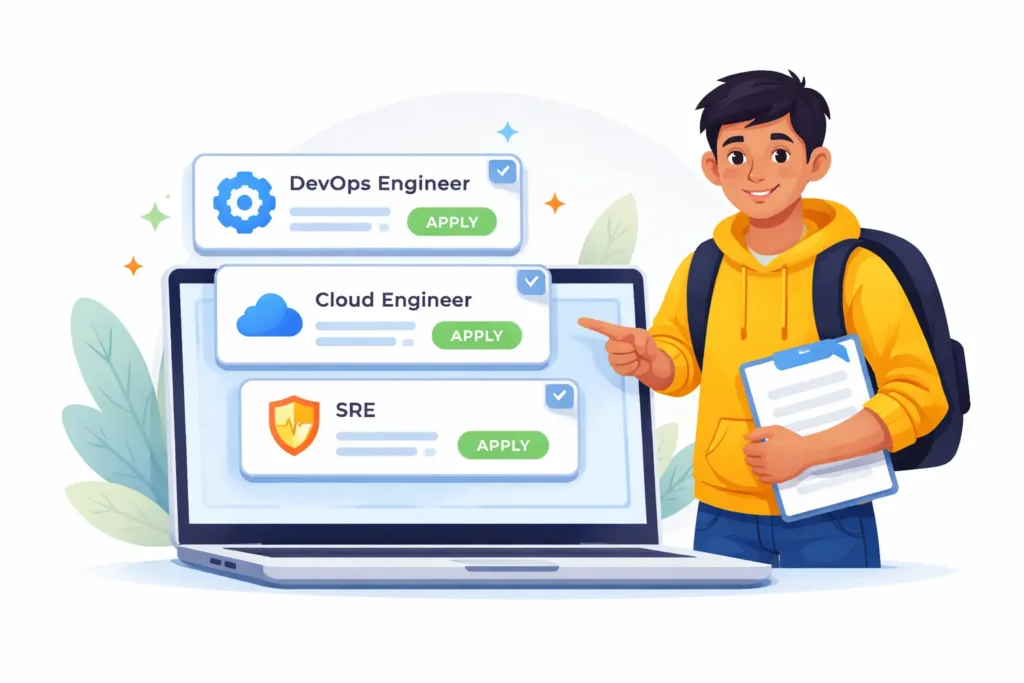
Once you learn the right skills, you can apply for roles like:
- Junior DevOps Engineer
- Cloud Support Engineer
- CI/CD Engineer
- Junior Site Reliability Engineer (SRE)
- Entry‑level Platform Engineer
Many companies are happy to hire freshers or interns if they show strong practical skills and a good portfolio.
DevOps vs MCA After BCA: What Should You Choose?
| Factor | DevOps | MCA |
|---|---|---|
| Time required | 6–12 months | 2–3 years |
| Cost | Low | High |
| Job readiness | Fast | Slow |
| Salary growth | High | Medium |
| Skill focus | Practical | Theory-heavy |
You can also quickly compare current DevOps engineer salaries in India on LinkedIn job listings to see real‑time ranges before applying.
If your main goal is getting into IT quickly with good growth, moving into DevOps after BCA is usually a smarter, faster route. If you love academics or want to go into teaching or research, then MCA can still make sense.
Is DevOps Hard for BCA Students?
DevOps is not “hard” in the way advanced math or complex algorithms are, but it does require consistency.
You will spend more time on:
- Understanding tools and platforms
- Automating manual work
- Debugging real issues
You will not spend your whole day writing complex code. If you can practice a little every day, you can become comfortable with DevOps within 6–12 months.
Companies Hiring DevOps Engineers in India
DevOps is now a core function in many sectors, not just a niche role.
You will find DevOps positions in:
- IT and cloud companies: TCS, Infosys, Wipro, Accenture, Cognizant
- Product and e‑commerce companies: Amazon, Flipkart, Paytm, Swiggy, Zomato
- Banks and fintech: HDFC, ICICI, SBI, and other financial companies
- Many SaaS and startup companies working on global products
Future Scope of DevOps After BCA
DevOps sits at the center of many fast‑growing areas:
- Cloud computing
- AI and automation
- Cybersecurity
- IoT and connected systems
Because of this, DevOps skills will stay relevant for a long time. Even if job titles change (Platform Engineer, Reliability Engineer, etc.), the core DevOps mindset and skills will still be needed.
FAQs – DevOps Career After BCA
Is DevOps a good career after BCA?
Yes. There is strong demand, good salary growth, and plenty of opportunities if you build the right skills.
Can I learn DevOps without doing MCA?
Absolutely. MCA is not compulsory for DevOps roles. A BCA + strong skills + projects is enough to start.
How long will it take to learn DevOps after BCA?
Expect around 6–12 months of steady practice to reach a decent fresher level.
Does DevOps require coding?
You should know basic scripting (shell, Python), but you do not need to be a hardcore programmer.
Can freshers get DevOps jobs after BCA?
Yes. Many companies hire freshers and train them, as long as they can show practical knowledge and some projects.
Final Verdict: Should You Choose DevOps After BCA?
If you are looking for:
- A good‑paying IT career
- Fast entry into the industry
- Strong future scope
- A chance to work with global teams and modern tools
then DevOps is a great choice after BCA.
Before deciding, you can also read our complete guide on whether DevOps is a good career in India to understand the bigger picture.
Take it step by step: learn the basics, practice daily, build projects, and keep improving your portfolio. Your DevOps career can genuinely start within the next few months if you stay consistent.
2 thoughts on “Is DevOps a Good Career After BCA in India? (2026 Guide)”