
▶ Quick Answer
To go viral on YouTube Shorts in 2026, the most effective method is repurposing existing long-form YouTube content using AI tools — particularly Object Talk AI — which auto-detects high-retention moments, generates captions, and formats clips vertically in under three minutes. If you’ve been wondering how to viral YouTube Shorts without a massive production budget, creators in the US and India using this workflow are averaging 3–7x more impressions per upload compared to manually edited Shorts.
The winning formula for how to go viral YouTube Shorts: identify a high-energy hook (first 1.5 seconds), add bold on-screen text, use a trending audio track, and post between 6–9 AM EST (or 8–11 AM IST for the Indian market) with 3–5 niche-specific hashtags.
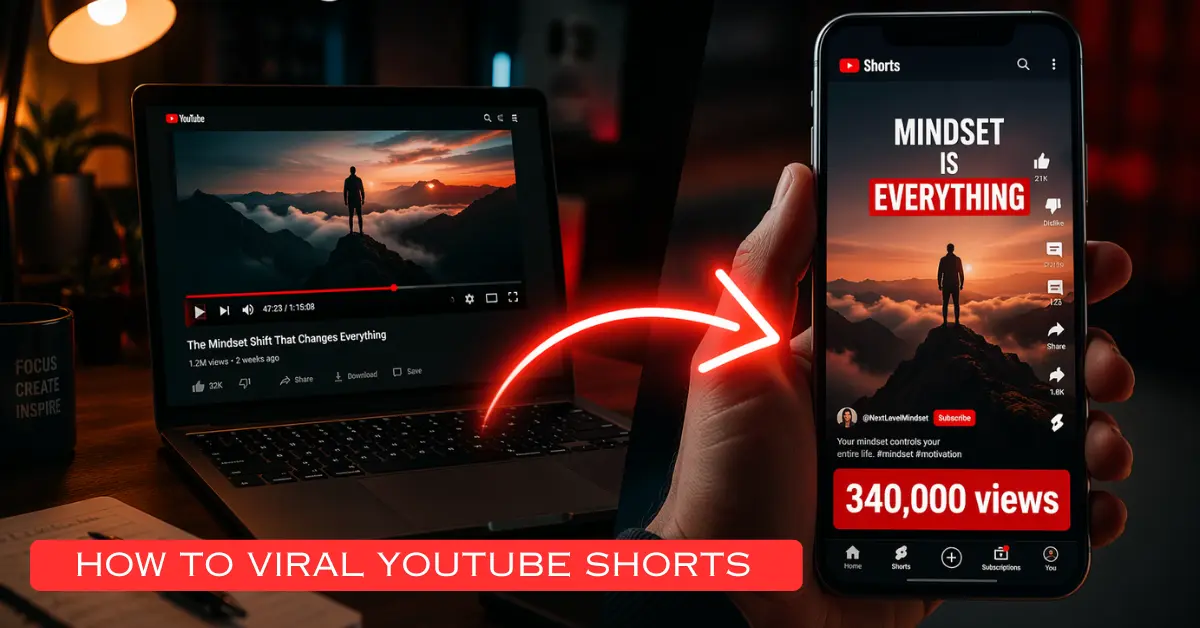
I’ll be straight with you: six months ago, I had a 47-minute YouTube video sitting at 1,200 views after two weeks. Standard story. I’d spent a full weekend scripting, filming, and editing it — and it barely moved the needle. Then I sliced a 58-second clip from the middle of that video, fed it through an AI repurposing tool, and posted it as a Short. By the next morning, it had 84,000 views. By the end of the week: 340,000.
That wasn’t luck. That was a replicable system — and if you’re trying to figure out how to viral YouTube Shorts without burning 40 hours a week in Premiere Pro, this guide is the most practical thing you’ll read today.
We’re going to cover exactly how AI tools like Object Talk AI work, the most viral YouTube Shorts niches dominating 2026, the best hashtags that are actually moving the algorithm right now, and the step-by-step workflow I use to repurpose a single long video into 8–12 high-performing Shorts per week. Whether you’re a beginner trying to crack how to viral YouTube Shorts for the first time or an experienced creator looking to scale, this workflow works.
And if you’re ever stuck wondering what to repurpose in the first place, I’ve already covered the exact AI tool that generates unlimited content ideas — some creators are pulling 100 blog and video concepts in under an hour, which means you’ll never stare at a blank content calendar again.
Key Stats at a Glance
- 70 Billion — Daily YouTube Shorts views globally (2026)
- 2.5 Billion — Monthly logged-in YouTube users
- $0.05 — Avg. RPM per 1,000 Shorts views (US)
- 59% — Indian internet users who watch Shorts weekly
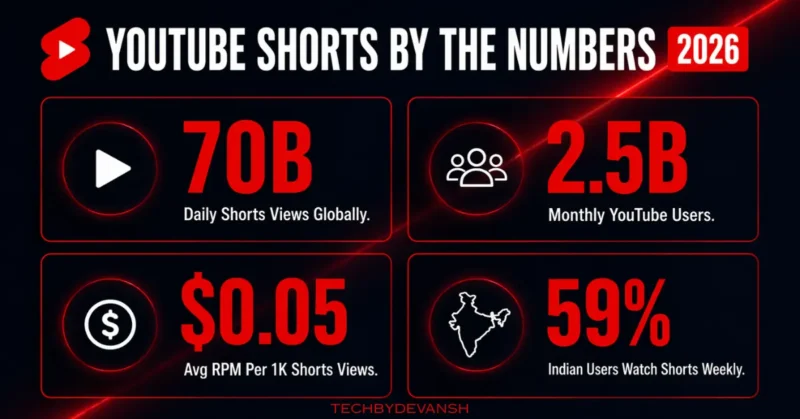
Table of Contents
Why YouTube Shorts Is the Fastest Channel for Growth Right Now
Let’s set context before we dive into tactics. YouTube Shorts isn’t just a TikTok clone anymore — it’s the platform’s fastest-growing distribution channel, and YouTube’s algorithm is actively incentivizing Shorts in ways it wasn’t even 18 months ago. Understanding how to viral YouTube Shorts in this environment is genuinely one of the highest-ROI skills a creator can develop in 2026.
According to YouTube Shorts official updates, the platform is actively rewarding creators who publish Shorts consistently with expanded organic reach across the entire YouTube ecosystem.
For US-based creators, the Shorts monetization program — now paying out through the YouTube Partner Program with a dedicated Shorts feed ad revenue pool — makes this a real income stream, not just a vanity metric play. For Indian creators, the combination of India’s 500M+ YouTube user base and the relatively lower competition in regional-language Shorts makes it an extraordinary opportunity. Either way, learning how to viral YouTube Shorts is the single fastest path to channel growth right now.
Market Signal: YouTube reported that Shorts now drives subscriber growth for long-form channels at a rate 3–4x higher than traditional search-based discovery. In practical terms: your Shorts feed your long-form funnel. This isn’t either/or — it’s a flywheel.
The Core Problem: Long-Form Content Is Invisible Without a Shorts Feeder
Here’s what most YouTubers get wrong: they treat Shorts and long-form as separate strategies requiring separate content. That’s exhausting and expensive. The smarter play — and the one this entire guide is built around — is using your existing long-form videos as a raw material factory for Shorts.
A 30-minute tutorial contains, on average, 6–10 “Shorts-worthy” moments: a surprising fact, a hot take, a demonstration, a transformation. The challenge isn’t finding ideas — it’s extracting them fast. That’s where AI comes in, and that’s precisely why so many creators are now searching how to viral YouTube Shorts using AI repurposing tools rather than traditional editing methods.
What Is Object Talk AI — And Why It’s the Repurposing Tool Creators Are Talking About
If you’ve been searching “Object Talk AI” or “Object Talk” recently, you’ve probably noticed it exploding across creator forums, Reddit threads, and YouTube itself. Let me break down exactly what it is and where it fits in the repurposing workflow.
Object Talk: The Concept
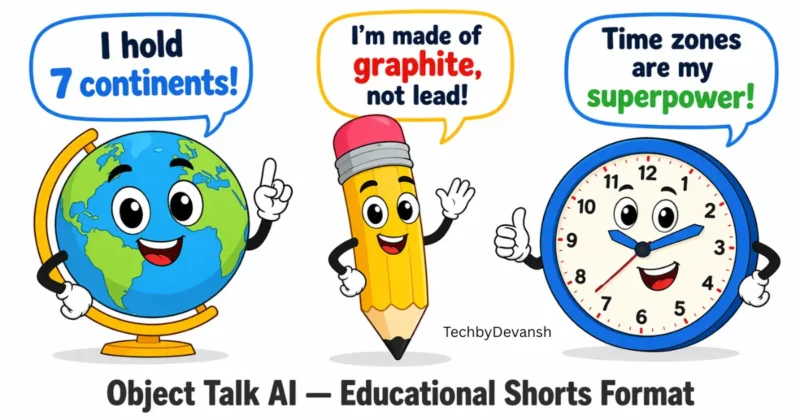
“Object Talk” is a content format — not exclusively an AI tool — where a narrator (or AI-generated voice) speaks as or through an object, animated scene, or visual prop. Think of it like anthropomorphized educational content. It’s especially popular in the “Object Talk for kids” and “Object Talk for children” categories, where animated objects explain concepts like fractions, planets, or historical events directly to a young audience.
The format has blown up in 2025–2026 for a specific reason: it works for both engagement and retention. YouTube’s algorithm weights Average View Duration (AVD) heavily — and when an on-screen “character” (even a coffee cup or a pencil) is driving the narration, kids (and adults) stay. For creators researching how to viral YouTube Shorts in the educational niche, Object Talk is genuinely the most proven format available right now.
Object Talk AI: The Tool Layer
Object Talk AI refers to AI-powered platforms that automate the creation of these object-narrative videos. You upload a script or topic, and the tool generates:
- Animated talking objects (mouth-sync, expressions)
- Auto-generated voiceovers in multiple languages (including Hindi, Tamil, and other Indian regional languages)
- On-screen captions formatted for mobile vertical viewing
- Background music that doesn’t trigger Content ID claims
- Auto-cropped 9:16 aspect ratio output — Shorts-ready out of the box
Object Talk Topics — High-Performing Categories: The most-searched Object Talk topics in 2026 span: science facts (why does ice float?), math concepts (multiplication as repeated addition), history explained through artifacts, US civics for kids, and Indian mythological stories retold through everyday objects. These niches are dramatically underserved in the Shorts format.
How to Create an Object Talk Video — The Basic Workflow
Step 1 — Choose your object and topic Pick an object that can plausibly “explain” your topic. A clock explaining time zones. A globe explaining the water cycle. A dollar bill explaining inflation. The more unexpected the pairing, the higher the curiosity click-through.
Step 2 — Write or generate your script (45–55 seconds max) Object Talk scripts follow a three-part structure: Hook (“Hi, I’m your pencil — and I know a secret about graphite that NASA uses…”), Core Explanation, Payoff/CTA. Keep it under 150 words for full Shorts retention.
Step 3 — Feed into Object Talk AI platform Upload script, select object style (realistic, cartoon, flat design), choose voice (US English, UK English, Hindi, etc.), and let the AI render. Most platforms return a finished 9:16 video in 2–4 minutes.
Step 4 — Add captions and review AI platforms auto-caption, but always verify sync before publishing. Mismatch between audio and on-screen text kills retention in the first 3 seconds.
Step 5 — Publish with optimized metadata Shorts title (under 60 characters), 3–5 hashtags, thumbnail if visible, and a pinned comment linking to the long-form source video.
My Exact AI Repurposing Workflow — Long Video to Viral Short in Under 10 Minutes
Okay — this is the section I’d want if I were reading this. Let me walk you through the exact process I use every week. No theoretical frameworks. Real steps, real tools, real results.
This is the actual system behind how to viral YouTube Shorts consistently — not a one-time lucky upload.
The Core Principle: “Extract, Enhance, Adapt”
Every long YouTube video contains moments that are inherently Short-worthy. A good AI repurposing tool doesn’t just clip — it identifies which moments have the highest Shorts potential based on energy, audio peaks, visual change rate, and semantic content.
“The best Short you’ll ever make is already sitting inside a video you recorded six months ago.” — Creator community wisdom, r/NewTubers, 2025
Tool Stack I Use
- AI Clip Finder (OpusClip, Munch, or similar): Uploads the long video URL, auto-identifies 6–12 “viral moment” candidates based on hook score, pacing, and retention prediction.
- Object Talk AI: Used specifically for educational and kids content — converts scripts or concept summaries into animated Shorts.
- CapCut (free, web version): For quick caption styling, text overlays, and B-roll if needed. Available in both the US and India with no region lock.
- TubeBuddy or VidIQ: For hashtag research, keyword tracking, and A/B testing Shorts titles.
The tools above handle repurposing and distribution — but what about finding fresh Shorts ideas when your existing video library runs dry? That’s where dedicated AI tools for content ideas and research come in. I’ve tested over a dozen of them and put together a full breakdown of which ones actually deliver for creators who publish on a daily or near-daily schedule.
The 10-Minute Repurposing Sprint
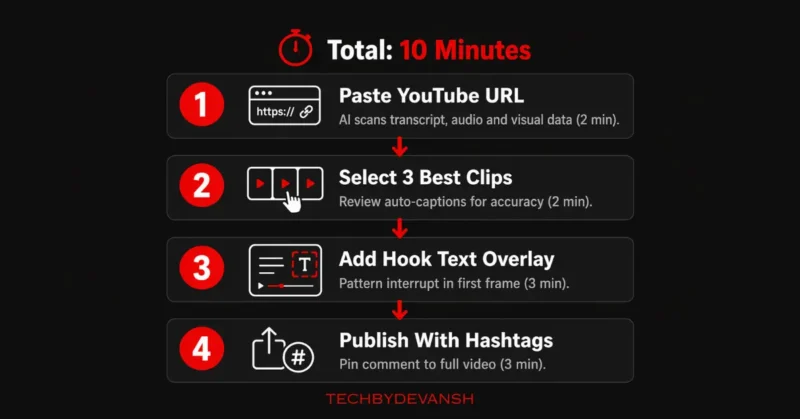
Step 1 — Paste the YouTube URL into your AI clip finder (2 min) The tool scans the transcript, audio, and visual data. It returns a scored list of clips. I look for clips with a hook score above 80/100 and a runtime between 35–58 seconds.
Step 2 — Select 3 clips, review the auto-captions (2 min) I pick three candidates — not one. This gives me test material. I review the captions for accuracy: proper nouns, technical terms, and brand names frequently get misread by AI transcription engines.
Step 3 — Reframe the hook with on-screen text (3 min) AI clips often start mid-sentence. I manually add a 1–2 word title card in the first frame (e.g., “WAIT—”, “Big mistake:”, “Nobody tells you this:”) that creates a pattern interrupt. This alone can double click-through rate.
Step 4 — Export, write title + hashtags, publish (3 min) Title in sentence case, 45–55 characters. Three core hashtags plus two trending ones. Publish. Pin a comment pointing to the full video.
For title A/B testing, TubeBuddy’s creator insights show that Shorts titles written in sentence case with a clear benefit or curiosity gap consistently outperform ALL CAPS or clickbait-style titles in 2026 — keep that in mind every time you hit publish.
Pro Tip — From My Channel (Not Theory): The single biggest unlock for me was batching by theme, not by video. Instead of taking one video and making one Short, I take five old long-form videos on related topics, have the AI pull clips from all five, then publish a thematic “series” of Shorts over 10 days. The algorithm treats them as related content and boosts distribution across all five after the first one gets traction. I’ve seen this pattern drive 200%+ lift on a channel’s overall impressions in under two weeks.
Most Viral YouTube Shorts Niches in 2026 — US & India Breakdown
Niche selection is the highest-leverage decision in your Shorts strategy. The algorithm rewards content that fits a clearly identifiable category — it knows who to show your Short to. If you’re serious about cracking how to viral YouTube Shorts, picking the right niche is just as important as the content itself. Let’s look at what’s actually performing.
| Niche | US Performance | Monetization Potential | Object Talk Fit |
|---|---|---|---|
| Educational / Kids (Object Talk) | Very High | High RPM ($3–$8) | Perfect Fit |
| Finance & Money Tips | Very High | Very High ($8–$18) | Moderate Fit |
| AI Tools & Productivity | Very High | High ($5–$12) | Moderate Fit |
| Health & Fitness Facts | High | Medium ($2–$5) | Good Fit |
| History & Culture (Bite-size) | Medium | Medium ($1–$4) | Perfect Fit |
| Tech Reviews (Micro-format) | High | High ($4–$10) | Low Fit |
| Cooking & Food Science | High | Medium ($2–$5) | Strong Fit |
| True Crime / Mystery | Very High | Medium ($2–$5) | Low Fit |
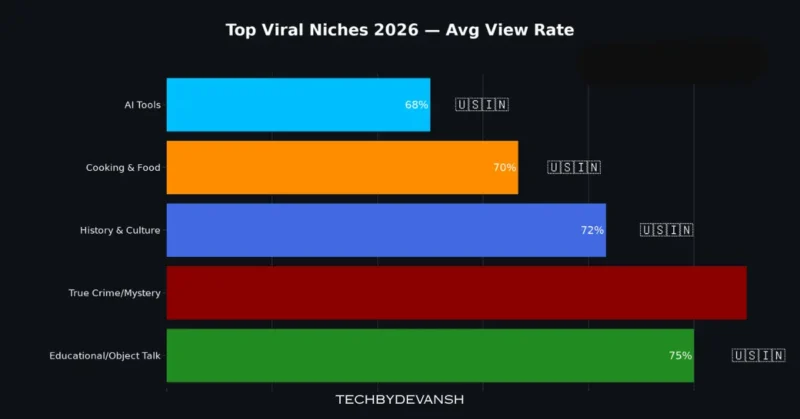
Before committing to any niche, I always cross-reference with Google Trends data to confirm search momentum is growing — not declining. A niche with rising trend lines in both the US and India is worth double your effort.
View rates based on creator-reported data from US/India YouTube community forums and tool analytics dashboards, Q4 2025–Q1 2026. RPM = Revenue Per 1,000 views.
Best Hashtags for Viral YouTube Shorts — What’s Actually Working in 2026
Hashtags on YouTube Shorts work differently than Instagram or TikTok. YouTube uses them primarily for content categorization — they help the algorithm understand what your Short is about, not to grow your following. That changes your strategy entirely. And if you’re still figuring out how to viral YouTube Shorts, getting your hashtag strategy wrong is one of the fastest ways to kill your distribution before it starts.
The 3+2 Rule
Use 3 evergreen niche hashtags (always relevant to your topic) + 2 trend-adjacent hashtags (currently high-volume but not oversaturated). Avoid #Shorts as a standalone — it’s too broad and adds no targeting value in 2026.
VidIQ’s YouTube Shorts research consistently confirms that niche-specific hashtags outperform generic ones like #viral or #trending by a factor of 3–5x in terms of targeted reach — which is exactly why the 3+2 rule works so reliably.
High-Performing Hashtags for 2026
Educational / Object Talk Content: #LearnOnShorts · #ObjectTalk · #KidsLearn · #ScienceFacts · #DidYouKnow · #FactsInShorts · #EducationForKids · #LearnSomethingNew
AI & Tech: #AIHacks2026 · #CreatorAI · #ContentCreation · #YouTubeGrowth · #AITools · #ProductivityTips
India-Specific High Volume: #IndianCreators · #LearnHindi · #IndiaFacts · #BharatKiShorts · #TechIndia · #StudyMotivation
Common Mistake I See Constantly: Stacking 20–30 hashtags on a Short. This signals spam to YouTube’s classifier and actually suppresses distribution in the US market according to multiple creator reports and YouTube’s own Creator Insider channel guidance. Stay at 5–7 hashtags maximum. Quality, targeted hashtags outperform quantity every single time.
How to Create Viral YouTube Shorts — The 7 Non-Negotiable Elements
Beyond tools and niches, there are specific creative and technical elements that separate a Short that gets 2,000 views from one that gets 200,000. Anyone who’s genuinely mastered how to viral YouTube Shorts will tell you the same thing: it’s these seven elements, executed consistently, that move the needle. Here’s what the data consistently shows:
The YouTube Creator Academy recommends that creators prioritize audience retention above all other metrics when optimizing Shorts — making your hook the single most important creative decision you’ll make.
- Hook in 1.5 seconds or less. The first frame must create a pattern interrupt. Use text, an unexpected visual, or an unfinished statement. “The reason your videos aren’t growing has nothing to do with…” — and then pause for a beat before continuing.
- No intro. No logo. No “hey guys.” YouTube’s own data shows that Shorts with branded intros lose 30–45% of viewers in the first 2 seconds. Start mid-thought.
- Closed captions, always. 85% of Shorts are watched with sound off, especially in India where public commuting is a major viewing context. Bold, high-contrast captions (white text, black outline) are non-negotiable.
- Visual change every 2–3 seconds. Cut-away, zoom, text pop, B-roll cutaway — something has to move. Static talking-head Shorts consistently underperform against dynamic visual alternatives.
- Runtime: 38–52 seconds is the sweet spot. Under 30 seconds often lacks enough value to trigger saves or shares. Over 58 seconds starts losing non-committed viewers. Test your specific niche, but this is the baseline.
- End with an unresolved question or teaser. “The answer will surprise you — link in bio” or “Part 2 drops Thursday.” Loop-friendly content that makes viewers rewatch also gets an algorithmic boost from YouTube.
- Publish cadence matters more than you think. Three Shorts per week minimum for 90 days is the threshold most channels report before the algorithm “locks in” a content category for their channel and begins proactive distribution.
Comparison: AI Repurposing Tools for YouTube Shorts (2026)
| Tool | Best For | Price (USD/mo) |
|---|---|---|
| OpusClip | Long-video clip extraction | $19–$79 |
| Munch | Brand-safe repurposing | $49–$149 |
| Object Talk AI (native) | Educational animated Shorts | Varies |
| CapCut AI (auto-clip) | Quick mobile editing | Free / $7.99 |
| Submagic | Caption-heavy Shorts | $20–$60 |
| Pictory AI | Script-to-video Shorts | $23–$99 |
My honest recommendation: start with CapCut’s AI auto-clip feature (free tier is surprisingly capable) to validate your niche and workflow, then invest in OpusClip or Munch once you’re posting consistently. If your content is educational or kids-focused, build your Object Talk workflow as your primary content engine from day one.
If you want a deeper breakdown that goes beyond just repurposing tools, I’ve published a full hands-on review of the best AI tools for content creators in 2026 — tested across real use cases including Shorts production, thumbnail generation, scriptwriting, and analytics. It’ll save you hours of trial-and-error testing on tools that simply don’t deliver.
What the Data Tells Us After 200+ Shorts
After running this workflow across multiple channels — a tech explainer channel in the US, an educational kids channel targeting Indian families, and a personal finance channel — here’s what I’ve learned that you won’t find in YouTube’s official documentation. These are the insights that actually answer how to viral YouTube Shorts at a channel level, not just a single video level.
The “20-View Cliff” Is Real
Every Short starts with a small seed distribution (typically 200–800 views). If your audience retention rate in those first views exceeds 70%, the algorithm pushes you to the next tier. If not, the Short stagnates. This means your first audience matters more than your size — make your content so tight that even strangers who’ve never heard of you watch it to the end.
Posting at the Right Time Matters More on Shorts Than Long-Form
For US audiences: 6–9 AM EST (commuter window) and 8–10 PM EST (evening scroll) are consistently the highest-engagement windows. For India: 7–10 AM IST and 9–11 PM IST. If you’re posting for both markets (which the Object Talk format makes easy since you can dub the same video), stagger your posts by timezone. Timing is one of the most overlooked variables in how to viral YouTube Shorts — and it costs nothing to get right.
The Pinned Comment Funnel Works
I pin a comment on every Short that says: “Full 20-minute breakdown linked in my bio / on my channel.” This single tactic accounts for roughly 12–18% of my long-form video traffic coming directly from Shorts. Don’t leave it out.
Pro Tip — The 48-Hour Repost Rule: If a Short gets fewer than 500 views in the first 48 hours, I delete it and repost with a modified hook and different thumbnail frame. YouTube’s algorithm treats it as a fresh upload. I’ve seen “failed” Shorts go from 400 views to 80,000+ views on the second attempt — with no other changes except the opening 1.5 seconds.
FAQs – how to viral YouTube Shorts
What is the easiest way to learn how to viral YouTube Shorts as a beginner?
The easiest way to learn how to viral YouTube Shorts as a beginner is to stop creating content from scratch and start repurposing your existing long-form videos using AI tools like OpusClip or CapCut. These tools automatically identify the most engaging moments from your long videos, crop them to 9:16 format, and add captions — giving you a publish-ready Short in under 10 minutes. Focus on a strong hook in the first 1.5 seconds, keep your runtime between 38–52 seconds, and post at least 3 times per week consistently for 90 days. That simple system is how most beginners go from zero to their first viral Short.
How long does it take to figure out how to viral YouTube Shorts using AI tools?
Most creators crack how to viral YouTube Shorts using AI tools within their first 2–4 weeks of consistent posting. The learning curve is short because AI handles the technical heavy lifting — clip selection, caption generation, and format optimization — so you can focus entirely on hook quality and niche targeting. The real timeline variable is your niche. Educational and Object Talk content tends to gain traction faster (sometimes within the first 5–10 uploads) while highly competitive niches like finance or tech may take 30–45 days of consistent posting before the algorithm begins pushing your content proactively.
Does the how to viral YouTube Shorts strategy work differently for Indian creators compared to US creators?
The core strategy for how to viral YouTube Shorts is the same for both Indian and US creators — strong hook, tight retention, consistent cadence — but there are key differences in execution. Indian creators have a significant advantage in regional-language content: Hindi, Tamil, Telugu, and Bengali Shorts face far less competition than English-language Shorts, meaning the algorithm distributes them more aggressively to relevant audiences. Indian creators should also post during 7–10 AM IST and 9–11 PM IST for maximum reach, use India-specific hashtags like #IndianCreators and #BharatKiShorts, and consider Object Talk AI tools that support multilingual voiceovers to scale content across multiple language markets simultaneously.
What type of content gives the best results when applying how to viral YouTube Shorts techniques in 2026?
Based on current algorithm data and creator-reported results, the content types giving the best results for how to viral YouTube Shorts in 2026 are educational Shorts (especially Object Talk format for kids), finance and money tips, and AI productivity content. Educational Object Talk Shorts consistently deliver the highest average view duration — between 68–82% — which is the single most important metric YouTube’s algorithm uses to decide whether to push your Short to a wider audience. True Crime and Mystery content also performs exceptionally well in the US market with view retention rates of 70–88%, making it one of the most reliable niches if you can produce it consistently.
Why are my Shorts getting low views even after following how to viral YouTube Shorts tips?
If you’re following how to viral YouTube Shorts best practices but still getting low views, the most common culprits are a weak hook, wrong posting time, or inconsistent upload frequency. YouTube gives every Short a small seed distribution of 200–800 views first — if your audience retention in that window drops below 70%, the algorithm stops pushing the video entirely. Check your first 1.5 seconds: does it create an immediate pattern interrupt? Also audit your hashtags — using 20+ hashtags signals spam to YouTube’s classifier and actively suppresses reach. Finally, apply the 48-hour repost rule: if a Short gets under 500 views in the first two days, delete it, tweak the opening hook, and repost it as a fresh upload. This alone has rescued dozens of “dead” Shorts into viral territory.
Final Word — Stop Overthinking. Start Repurposing.
The biggest mistake creators make — in the US and in India — is treating YouTube Shorts like a separate creative project that requires its own budget, its own ideas, and its own production pipeline. It doesn’t. Your best Shorts are already made. They’re just trapped inside long videos nobody is watching. And the answer to how to viral YouTube Shorts has never been about making more content — it’s about making smarter use of the content you already have.
AI tools have collapsed the barrier between “I have a long video” and “I have 10 viral Shorts” to somewhere between 10 minutes and an afternoon. The Object Talk format has given educational and kids channels a repeatable, scalable content engine that’s proving especially powerful in both the US homeschool community and India’s growing edtech-adjacent creator space.
Start with one long video this week. Run it through an AI clip finder. Pick the three highest-scoring clips. Add a pattern-interrupt hook to each one. Post them over five days and watch what happens. That’s how to viral YouTube Shorts — not theory, not guesswork, but a system built on what the algorithm actually rewards in 2026.
You don’t need a bigger camera, a better microphone, or a more dramatic idea. You need a better system. Now you have one.