
Hey everyone — Devansh here from TechByDevansh.
In 2025, I wrote about AI in DevOps automation and how it was starting to change the game. Well, 2026 is here, and the game hasn’t just changed — it’s evolved in ways that felt like sci-fi just a few years back.
If you’re in tech, you already know AI DevOps 2026 is no longer just about CI/CD pipelines and scripted automation. It’s becoming intelligent, predictive, and almost intuitive.
And no, this isn’t hype.
A recent 2026 Gartner report confirmed that over 60% of DevOps teams now use AI-driven tools to enhance deployment accuracy and system reliability.
Let’s get real:
AI DevOps 2026 isn’t just “faster.” It’s smarter. It anticipates failures, writes cleaner code, and even decides the safest time to deploy — all without human intervention.
Curious how?
Let’s dive into what’s new, what’s working, and how you can ride this wave — whether you’re just starting out or you’re a seasoned engineer.
Table of Contents
What’s New in AI DevOps 2026?
We’re moving beyond basic automation into what experts are calling “Cognitive DevOps” — where systems don’t just execute, but understand.
1. AI-Powered Predictive Deployment
Tools like Harness.io and Spinnaker now use machine learning to analyze past deployments and predict risks in real time.
Imagine your pipeline rolling back a release before users notice a glitch — that’s 2026 DevOps.
2. Self-Healing Infrastructure
Cloud platforms (AWS, Azure, GCP) now embed AIOps capabilities that detect anomalies and apply fixes automatically.
No more 3 a.m. pages for memory leaks — the system heals itself.
3. Natural Language CI/CD
New tools let you configure pipelines using plain English.
Instead of YAML, you can type:
“Deploy feature X to staging if all tests pass and latency is under 100ms.”
The AI translates that into workflow.
How AI Boosts Every DevOps Stage (2026 Update)
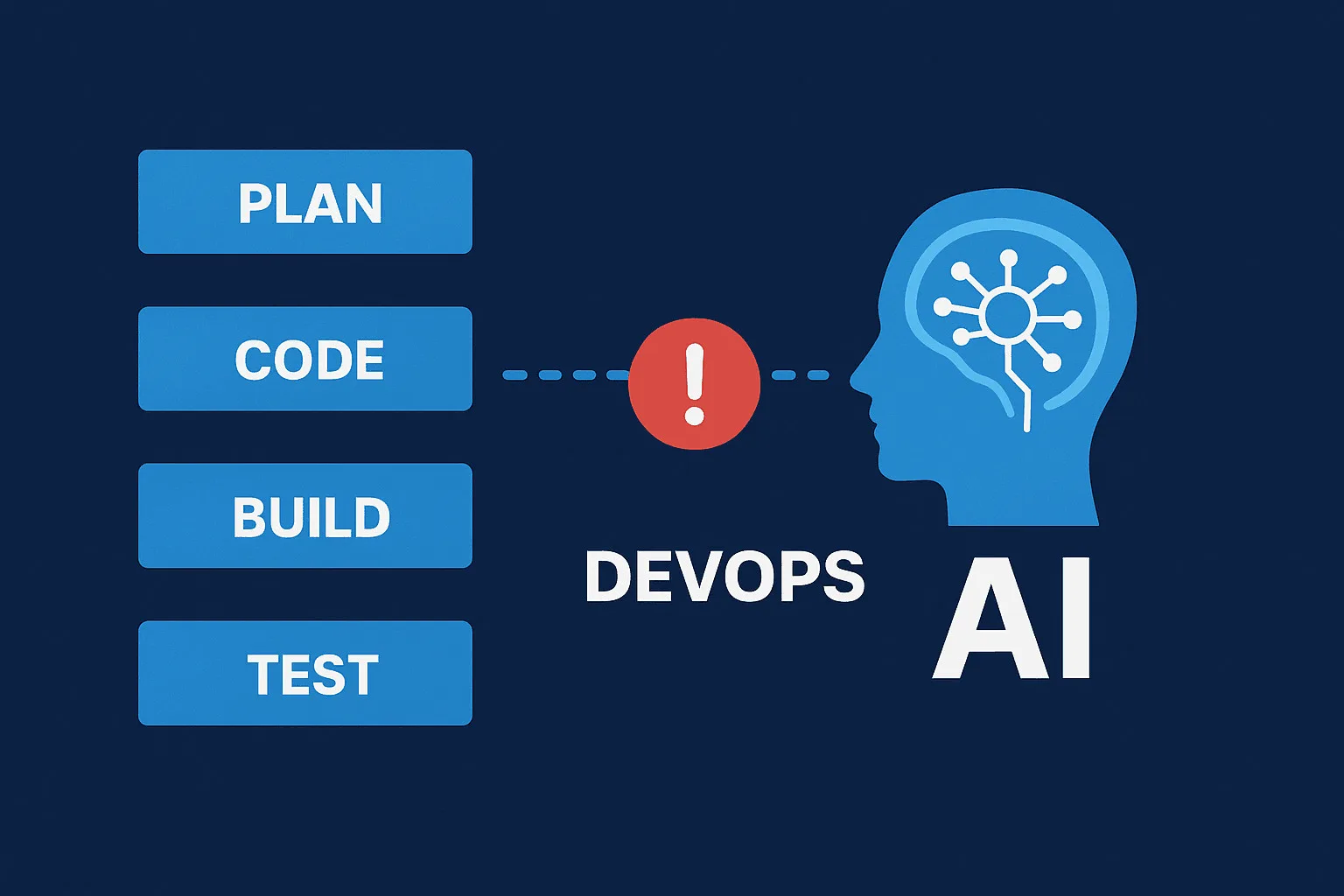
| Stage | Then (2025) | Now (2026) |
|---|---|---|
| Planning | AI sprint estimates | AI-driven resource forecasting |
| Coding | Code suggestions | Full-function autocomplete |
| Testing | Automated test generation | Self-learning test suites |
| Deployment | Risk detection | Autonomous decision-making |
| Monitoring | Anomaly detection | Predictive outage prevention |
| Security | Vulnerability scans | Real-time threat response |
Getting Started with AI in DevOps (No PhD Required)
You don’t need to build neural networks from scratch. Start here:
- Pick an AI-Augmented Toolstack
- Code: GitHub Copilot or Amazon CodeWhisperer
- Deploy: Harness or Jenkins AI plugins
- Monitor: Dynatrace Davis or New Relic AI
- Secure: Snyk Code AI or Wiz AI-driven scans
- Focus on Data Quality
AI is only as good as your pipeline data. Start logging everything — builds, tests, deployments, incidents. - Learn Basics of MLOps
Platforms like Databricks and MLflow are making it easier. You don’t need to be a data scientist, but knowing how models are deployed helps. - Experiment in Sandboxes
Use GitHub Codespaces or GitLab Duo to try AI DevOps tools risk-free.
The 2026 DevOps Engineer: What’s Changed?
The role is shifting from “pipeline builder” to “AI orchestrator.”
The most in-demand skills now include:
- Understanding of ML pipelines
- Data literacy (reading AI insights)
- Security automation (DevSecOps + AI)
- System design for AI reliability
AI isn’t replacing engineers — it’s elevating the role.
The engineers who thrive will be those who partner with AI, not just use it.
Real-World Impact: Who’s Doing It Well?
- Netflix — Uses AI for predictive auto-scaling during global streaming events.
- Stripe — Employs AI-driven security scanning in every commit.
- Airbnb — Runs AI-powered canary deployments to reduce rollout risks.
- Even mid-sized startups now use AI-augmented DevOps to compete with giants.
Your 2026 Action Plan
- Audit Your Current Tools — Where can you add AI? Start with monitoring or testing.
- Train Your Team — LinkedIn Learning and Coursera now have nano-courses on AI for DevOps.
- Think Data-First — Clean, structured pipeline data is your AI fuel.
- Start Small, Think Big — Pilot one AI tool for one workflow. Scale from there.
Final Thoughts
The fusion of AI and DevOps in 2026 isn’t a trend — it’s the new standard.
We’re building systems that think alongside us, reduce grunt work, and prevent problems before they happen.
This shift means more creativity, more innovation, and yes — more reliable software for everyone.
What do you think?
Is your team already using AI in DevOps?
Hit reply or drop a comment — I’d love to hear what you’re experimenting with.
If you’re new to this, I also put together a guide on 5 Free AI Tools for DevOps You Probably Haven’t Tried (2026 Edition).
Liked this post?
Share it with your team or that friend who’s still managing servers manually.
For more on AI, DevOps, and cloud innovation, stay tuned to TechByDevansh.
👉 Follow our journey on Instagram: @techbydevansh
📬 Subscribe for weekly insights straight to your inbox.
1 thought on “How AI Is Rewriting DevOps in 2026: From Automation to Intelligence”