
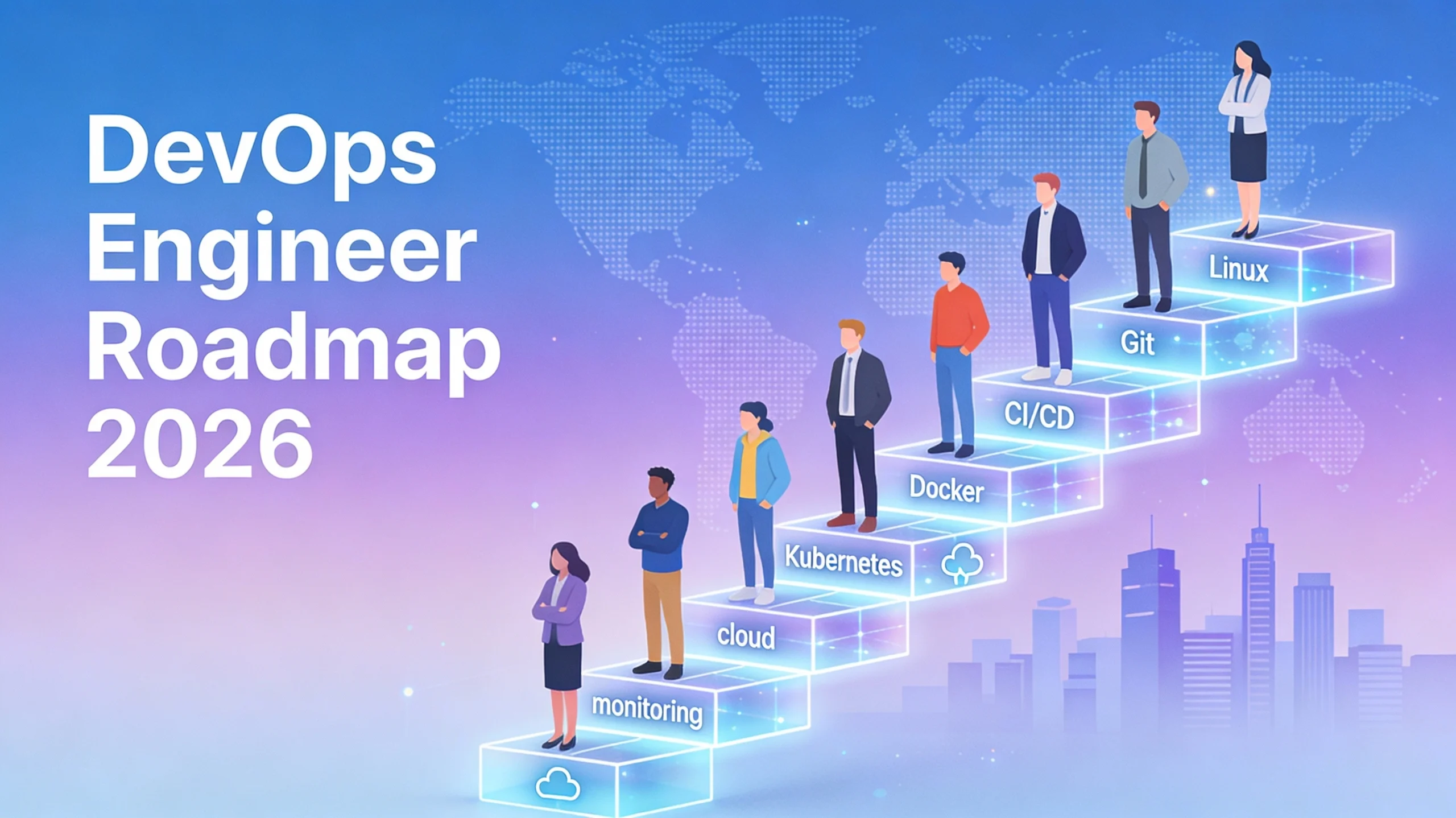
Introduction: Why DevOps engineer roadmap 2026 matters
The demand for skilled DevOps engineers continues to grow as companies move to cloud‑native, microservices, and continuous delivery.
A clear DevOps roadmap for beginners helps you avoid random tutorials and focus only on the skills that actually matter for jobs in 2026.
If you’re still deciding whether DevOps is the right career, especially after a BCA degree, read my detailed guide Is DevOps a Good Career After BCA? (2026 Guide) before you start this roadmap
In this DevOps engineer roadmap 2026, you will see exactly what to learn, in what order, and how to build a portfolio that works for a global audience.
Table of Contents
DevOps engineer in 2026: What the role really is
A DevOps engineer in 2026 is not just a “server person” or a “deployment guy”.
The modern DevOps engineer connects development, operations, security, and even finance to deliver software quickly, safely, and cost‑effectively.
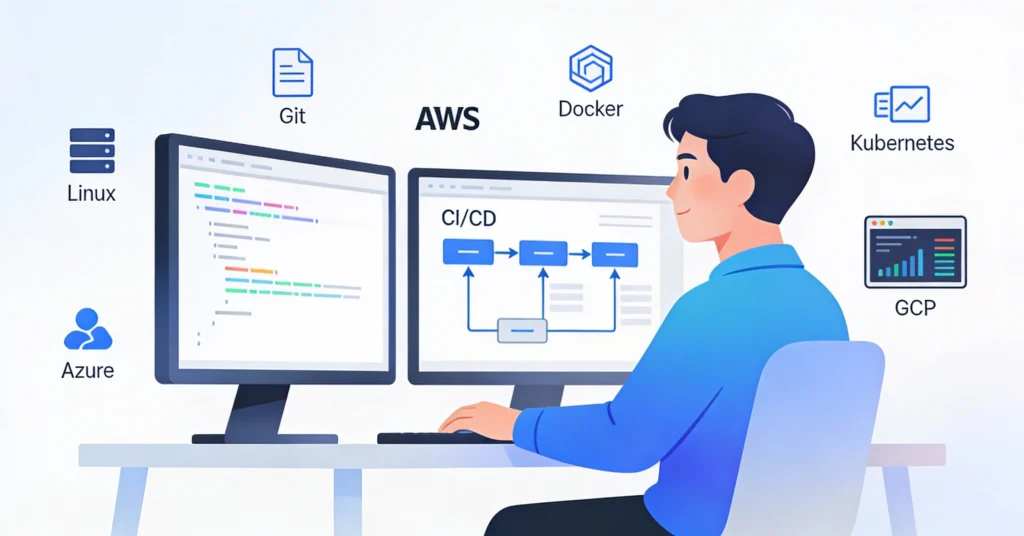
Typical responsibilities include:
- Designing and maintaining CI/CD pipelines
- Managing infrastructure with code and automation
- Working with containers and Kubernetes
- Monitoring systems and responding to incidents
- Collaborating with developers, testers, SREs, and security teams
When people search for a DevOps career path, they want a role where they can impact speed, stability, and business value at the same time, and that is exactly what this roadmap leads to.
For a detailed look at salaries and job reality, see my guide Is DevOps a Good Career in India?
DevOps engineer roadmap 2026 overview table
Use this roadmap table as your quick reference for the whole year.
You can print it, keep it on your desk, and tick off each phase as you progress through your DevOps roadmap step by step.
| Phase | Focus area | Key topics & tools | Goal / Outcome |
|---|---|---|---|
| 1 | Fundamentals | Linux, Git, command line, basic networking, one programming language | You can work confidently in a terminal and manage code with Git. |
| 2 | Scripting & automation | Bash, PowerShell (optional), Python scripting, task automation | You can automate repetitive tasks instead of doing them manually. |
| 3 | CI/CD foundations | GitHub Actions, GitLab CI, Jenkins, pipelines, tests | You can build basic CI/CD pipelines for apps you or your friends create. |
| 4 | Containers & orchestration | Docker, Docker Compose, Kubernetes, Helm | You can package apps into containers and run them on Kubernetes. |
| 5 | Cloud platforms | AWS / Azure / GCP core services, IAM, VPC/networking, storage, databases | You can deploy and operate apps on at least one major cloud. |
| 6 | Observability & reliability | Logging, metrics, tracing, Prometheus, Grafana, alerts, SLOs | You can monitor systems and troubleshoot issues using data. |
| 7 | Security & cost | Secrets management, least privilege, updates, cloud cost basics | You can keep systems secure and avoid wasting money in the cloud. |
| 8 | Projects & portfolio | Real projects, open source, case studies, blogs, LinkedIn | You have a public portfolio that proves you are job‑ready. |
This structure keeps the DevOps engineer roadmap 2026 realistic: you can cover these phases in 6–12 months depending on how much time you have.
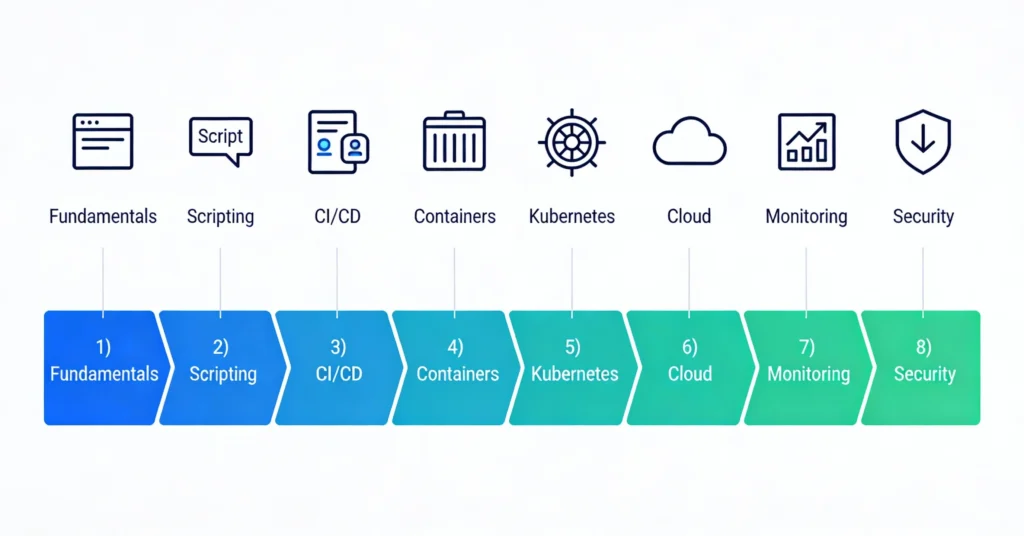
If you prefer a visual mind‑map style overview, the community‑maintained DevOps roadmap on roadmap.sh is a great companion to this guide.
Phase 1: Master the fundamentals
Every DevOps roadmap for beginners starts with fundamentals.
Without Linux, Git, and basic networking, advanced tools will only confuse you.
Focus on:
- Linux: file system, permissions, users, processes, systemd, logs, SSH, and package managers like apt or yum.
- Git: clone, commit, branch, merge, rebase, pull requests, and resolving conflicts using GitHub or GitLab.
- Programming: pick one language—Python, Java, Go, or JavaScript—and learn variables, functions, error handling, APIs, and simple scripts.
When you can use the terminal all day, push code with Git, and write small tools, you are ready for the true DevOps engineer skills 2026.
Phase 2: Networking, OS concepts, and scripting
To become a DevOps engineer, you must understand how systems talk and how servers behave.
Key topics for this phase:
- Networking: TCP/IP, ports, DNS, HTTP/HTTPS, load balancers, reverse proxies, and Firewalls.
- OS & processes: CPU, memory, disk I/O, processes, threads, file descriptors, and how to read system logs.
- Scripting & automation: Bash or PowerShell, plus Python scripting to automate backups, log rotation, deployments, and user management.
This phase turns basic knowledge into practical DevOps engineer skills so you can diagnose issues instead of guessing.
Phase 3: CI/CD foundations – the heart of DevOps
CI/CD is one of the most important parts of any DevOps engineer roadmap 2026.
Companies want faster releases with fewer bugs, and CI/CD pipelines make that possible.
What to learn:
- Continuous Integration: building and testing code automatically on every push.
- Continuous Delivery/Deployment: automatically shipping changes to staging or production using approvals and rollbacks.
- Popular tools: GitHub Actions, GitLab CI, Jenkins, CircleCI, or Azure DevOps pipelines.
Practice tasks:
- Create a small application (even a simple API) and set up a pipeline that runs tests, builds artifacts, and deploys to a test server.
- Add notifications to Slack or email when builds fail so you behave like a real DevOps engineer, not just a script writer.
With this, you will have real examples of DevOps engineer roadmap 2026 projects to show in interviews.
Phase 4: Containers and Kubernetes
Modern DevOps roles heavily rely on containers and orchestration, especially if you want international DevOps jobs.
Containers (Docker)
- Learn how to write Dockerfiles, build images, use multi‑stage builds, and handle environment variables and secrets.
- Use Docker Compose to run multi‑container apps: web app + database + cache.
Kubernetes
- Start with key Kubernetes objects: pods, deployments, services, ingress, config maps, and secrets.
- Learn how to deploy your containerized app to a Kubernetes cluster (local kind/minikube or managed EKS/AKS/GKE).
- Use Helm charts for reusable deployment templates.
These skills appear in almost every global DevOps engineer job description, so they must be part of your DevOps roadmap step by step.
For structured Kubernetes and cloud‑native training, the CNCF training catalog lists free and paid courses backed by the Cloud Native Computing Foundation.
Phase 5: Cloud platforms – go global
To serve a global audience, you need at least one major cloud platform on your profile.
Choose one to go deep first:
- AWS DevOps roadmap: EC2, ECS/EKS, S3, RDS, IAM, VPC, CloudWatch, and Load Balancers.
- Azure DevOps roadmap: Virtual Machines, AKS, Storage accounts, Azure SQL, VNets, Monitor, and Azure DevOps pipelines.
- GCP DevOps roadmap: GCE, GKE, Cloud Storage, Cloud SQL, IAM, VPC, and Cloud Monitoring.
Focus on:
- Deploying applications securely using IAM and VPC networking.
- Using managed databases and storage instead of self‑hosting everything.
- Learning Infrastructure as Code with Terraform or cloud‑native tools (CloudFormation, Bicep, Deployment Manager).
When recruiters read DevOps engineer roadmap 2026 plus “Hands‑on AWS/Azure/GCP” on your CV, your profile becomes attractive globally.
Phase 6: Observability, monitoring, and reliability
A DevOps career path is incomplete without observability.
You must be able to answer: “Is the system healthy?” and “What went wrong?”.
Learn:
- Logging: centralised logs using the ELK stack, Loki, or cloud logging services.
- Metrics: Prometheus, Grafana, CloudWatch, Azure Monitor, or GCP Monitoring for CPU, memory, latency, and request counts.
- Tracing: basic distributed tracing (OpenTelemetry, Jaeger) for microservices.
- SLOs and alerts: define alert rules that fire when error rates or latency exceed thresholds.
These skills move you closer to SRE (Site Reliability Engineering) and make your DevOps engineer skills 2026 much stronger.
Phase 7: Security, DevSecOps, and cost optimization
Companies now expect DevOps engineers to think like DevSecOps and FinOps engineers as well.
Security topics:
- Secrets management (Vault, AWS Secrets Manager, Azure Key Vault, GCP Secret Manager).
- Least‑privilege IAM roles, secure group policies, and rotating credentials.
- Container security basics: scanning images, using trusted base images, and updating regularly.
Cost topics:
- Monitoring cloud bills, identifying unused resources, and rightsizing instances and databases.
- Using auto‑scaling instead of over‑provisioning everything.
When you mention DevSecOps practices and cloud cost awareness along with your DevOps engineer roadmap 2026, you look senior even if you are early in your journey.
Phase 8: Projects, portfolio, and personal branding
Knowing the DevOps roadmap for beginners is not enough—companies want proof.
Build:
- End‑to‑end projects: at least two complete systems with CI/CD, Docker, Kubernetes, monitoring, and alerts.
- Open‑source contributions: small pull requests to projects you use (fix docs, add scripts, improve CI).
- Public portfolio: GitHub repositories, a technical blog, and a LinkedIn profile where you share what you learn.
Example portfolio ideas:
- “URL shortener with GitHub Actions, Docker, Kubernetes, and Prometheus monitoring”.
- “DevOps engineer roadmap 2026 – my 12‑month learning journey” article series on your LinkedIn.
This shows hiring managers that you do not just memorize theory; you actually apply the DevOps engineer roadmap 2026 in real projects.
What if AI replaces DevOps?
A common fear is: “Why should I follow a DevOps roadmap step by step if AI will replace DevOps jobs?”
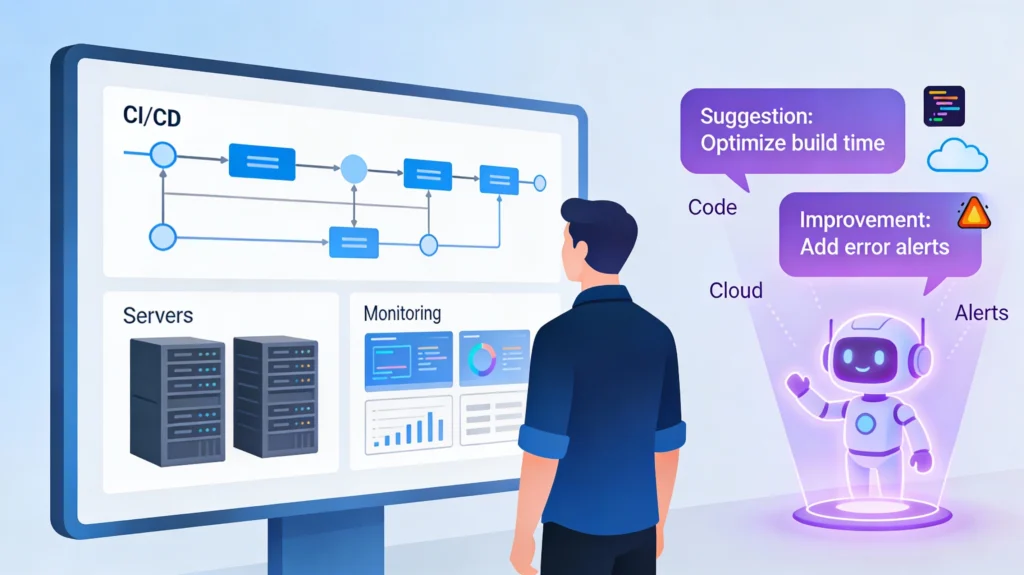
Here is the reality:
- AI tools can generate scripts, Dockerfiles, or Terraform modules, but they still require humans to design architectures, review security, and understand business requirements.
- DevOps work involves judgement: choosing deployment strategies, handling incidents, designing observability, and negotiating trade‑offs between speed, cost, and risk.
So instead of worrying, treat “AI for DevOps” as part of your DevOps engineer skills 2026:
- Use AI assistants to speed up YAML creation, error explanations, and log analysis.
- Learn to validate AI output, harden it, and integrate it safely into your CI/CD and cloud workflows.
In short, AI will replace repetitive tasks, not a DevOps engineer who understands systems end‑to‑end.
I covered this in detail in my article How AI Is Changing DevOps Automation — The Smart Revolution of 2025, where you’ll see real examples of AI helping with CI/CD, monitoring, and incident response.
Career transition examples into DevOps
You do not need to start as a DevOps engineer to follow this DevOps career path.
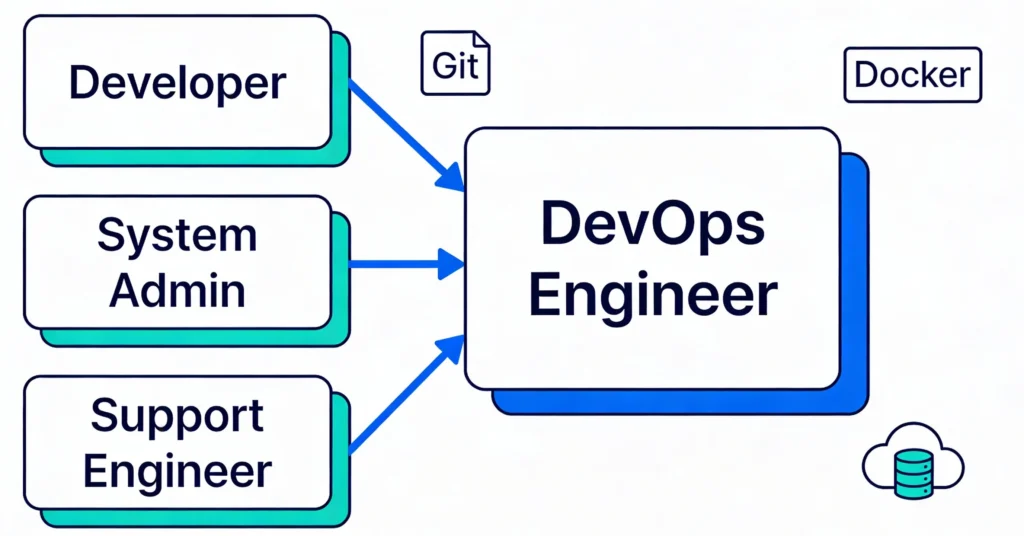
1. From software developer to DevOps engineer
- Start by owning CI/CD pipelines for your team’s application.
- Introduce automated tests, containerization, and basic monitoring.
- Gradually take responsibility for deployments, performance, and incident response.
2. From system administrator to DevOps engineer
- Learn Git and start storing your scripts in repositories.
- Replace manual server setup with Infrastructure as Code and configuration management.
- Add CI/CD pipelines to automate deployments and updates.
3. From support / QA to DevOps
- Learn Linux, Git, and scripting alongside your current role.
- Volunteer to maintain test environments, monitoring dashboards, or deployment scripts.
- Use this experience to move into junior DevOps or SRE positions.
These examples show that a DevOps roadmap for beginners is not only for college students; it works for mid‑career professionals as well.
FAQ: DevOps engineer roadmap 2026
1. How long does it take to become a DevOps engineer?
For most people, 6–12 months of consistent learning and projects are enough to reach a junior level, especially if you already know programming or system administration.
2. Do I need a computer science degree?
No. A degree helps, but many DevOps engineers are self‑taught using online courses, documentation, and projects. Recruiters care more about your skills, portfolio, and communication.
3. Which cloud should I pick for my DevOps engineer roadmap 2026?
Choose one based on your target job market: AWS is the most common globally, Azure is very strong in enterprise environments, and GCP is popular among data‑heavy and startup companies. Depth in one provider is better than shallow knowledge of three.
4. Is DevOps a good career path in 2026?
Yes. As long as companies build and run software, they need specialists who can automate delivery, keep systems stable, and control cloud costs. DevOps engineer salaries remain strong in most regions.
For a deep dive focused on India, read Is DevOps a Good Career in India? Salary & Job Reality.
Final thoughts: Start your DevOps journey today
The DevOps engineer roadmap 2026 you just read is not only theory; it is a practical plan you can follow month by month.
Focus on fundamentals, CI/CD, containers, cloud, observability, security, and real projects, and your profile will be attractive to employers worldwide.
If you treat this DevOps engineer roadmap 2026 as your personal contract—study daily, build things, share your work—you will be far ahead of most candidates who only watch tutorials and never ship anything.
2 thoughts on “DevOps Engineer Roadmap 2026: Complete Step‑by‑Step Guide”