

The global tech industry is watching China’s memory ambitions closely — and the spotlight is now firmly on ChangXin Memory Technologies (CXMT).
With reports that CXMT is eyeing a $4.2 billion Shanghai IPO, this is no longer just a funding story. It’s a signal. A signal that China wants a bigger role in the global DRAM market, and more importantly, in the AI hardware supply chain that will define the rest of this decade.
This isn’t just about memory chips. It’s about AI power, geopolitical tech independence, and who controls the next wave of computing.
Let’s break down what the CXMT $4.2B IPO really means — beyond the headlines.
Table of Contents
What Is CXMT and Why Is It Important?
CXMT (ChangXin Memory Technologies) is China’s leading domestic DRAM manufacturer. DRAM (Dynamic Random-Access Memory) is a critical component used in:
- Smartphones
- Data centers
- PCs and laptops
- AI accelerators
- Cloud infrastructure
Until now, the global DRAM market has been dominated by Samsung, SK Hynix, and Micron. China has long depended on foreign suppliers for advanced memory — a vulnerability exposed by trade restrictions and export controls.
CXMT exists to change that.
CXMT $4.2B IPO: What We Know So Far
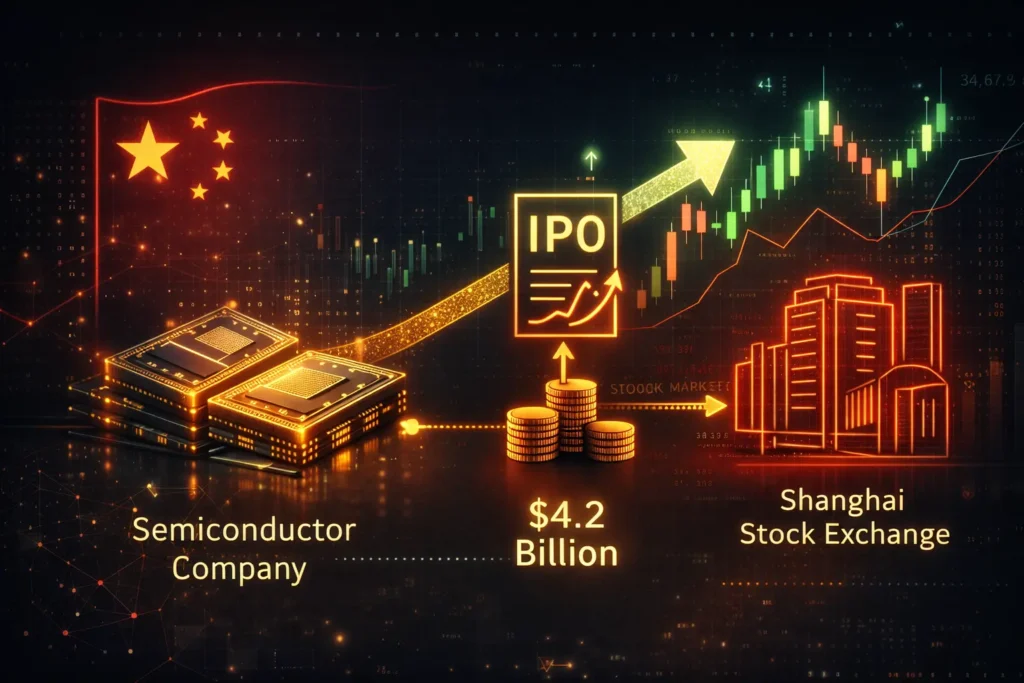
According to recent reports, CXMT is considering a $4.2 billion listing in Shanghai, with the goal of funding large-scale DRAM expansion.
While CXMT hasn’t officially announced a date yet, the intention is clear:
- Expand DRAM production capacity
- Invest in next-generation memory technology
- Reduce China’s reliance on foreign memory suppliers
This move aligns directly with China’s long-term semiconductor strategy — and it couldn’t come at a more critical time.
According to a Reuters report, CXMT is exploring a Shanghai listing to raise billions for expanding its DRAM manufacturing capacity.
Why DRAM Suddenly Matters More Than Ever
A few years ago, DRAM felt like a background component. Today, it’s front and center.
Here’s why:
- AI models need massive memory bandwidth
- Large language models (LLMs) rely heavily on DRAM and high-bandwidth memory
- Data centers are hitting memory bottlenecks faster than compute limits
- AI inference at scale demands efficient memory access
In short: no DRAM, no AI at scale.
This is why CXMT’s DRAM expansion isn’t just a manufacturing story — it’s an AI infrastructure story.
China’s DRAM Expansion and the AI Race
The CXMT $4.2B IPO fits into a much bigger picture: China’s push for AI self-reliance.
China understands that:
- AI chips need memory
- Memory supply controls AI growth
- Depending on foreign suppliers is risky
By expanding domestic DRAM production, China strengthens its position in:
- AI servers
- Cloud computing
- Edge AI
- Consumer electronics
This is especially important as AI demand explodes heading into 2026 and beyond.
Similar large-scale funding moves can be seen in the AI sector, including Elon Musk’s $140 billion pay package tied to Tesla’s long-term AI ambitions.
How CXMT Could Disrupt the Global DRAM Market
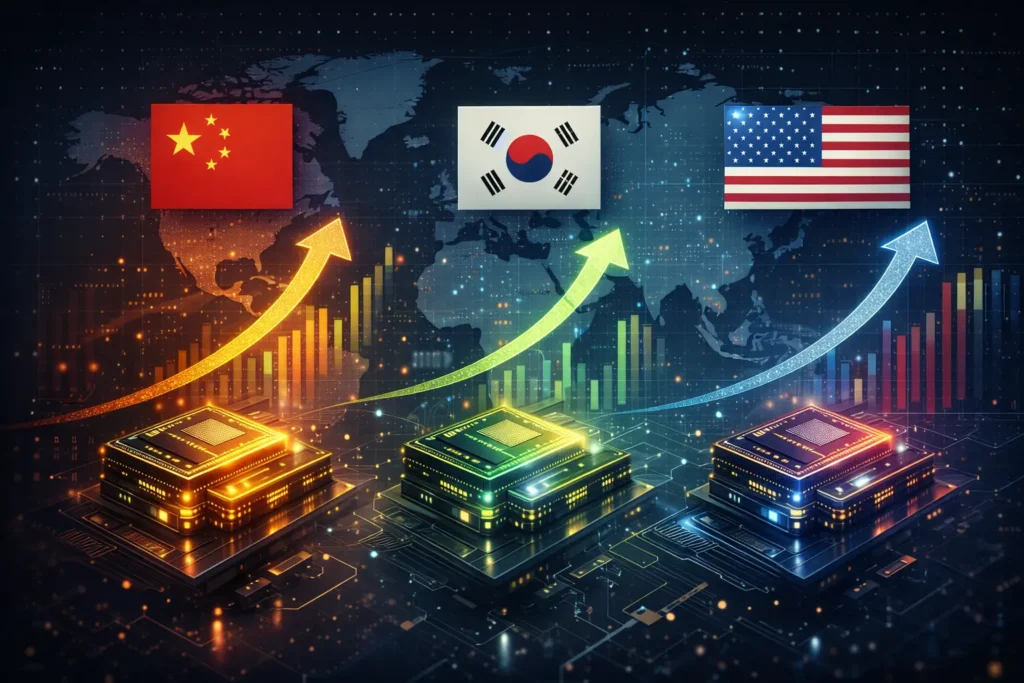
Let’s be clear — CXMT is not yet on the same technical level as Samsung or SK Hynix.
But disruption doesn’t always come from being the best.
It often comes from:
- Price competitiveness
- Domestic demand support
- Government backing
- Long-term scaling
Even a modest increase in China’s domestic DRAM output could:
- Reduce China’s import demand
- Apply pricing pressure globally
- Shift supply chain dynamics
Over time, this could reshape how DRAM is priced and sourced worldwide.
What This Means for AI Hardware in 2026
The timing of the CXMT DRAM expansion is critical.
By 2026:
- AI workloads will be significantly larger
- Data centers will demand more memory per accelerator
- AI inference will move closer to users (edge computing)
Memory shortages — not compute — may become the biggest bottleneck.
If CXMT succeeds in scaling production, it could:
- Stabilize memory supply in China
- Support domestic AI startups
- Reduce vulnerability to export restrictions
This makes the CXMT $4.2B IPO strategically important, not just financially relevant.
The Geopolitical Angle No One Can Ignore
Semiconductors are no longer just about technology. They are about power and leverage.
The CXMT IPO reflects:
- China’s response to US-led chip restrictions
- A shift toward domestic tech resilience
- Long-term planning rather than short-term profits
Memory chips may not grab headlines like GPUs, but they are just as critical — and often easier to scale domestically over time.
Risks and Challenges Ahead for CXMT
Despite the ambition, CXMT faces real challenges:
- Catching up on advanced process technology
- Competing with highly optimized global players
- Managing yields at scale
- Navigating geopolitical scrutiny
This IPO doesn’t guarantee success. It guarantees intent.
And intent matters in long-term tech races.
Why This Story Matters Beyond China
Even if you’re not following Chinese markets closely, this story affects you.
Because:
- AI hardware prices depend on memory supply
- Cloud costs are influenced by DRAM pricing
- Global tech companies watch supply shifts carefully
CXMT’s DRAM expansion could quietly influence:
- AI service pricing
- Cloud infrastructure costs
- Hardware availability
These effects won’t be immediate — but they will compound over time.
For readers interested in affordable consumer tech, our guide to the best tech gadgets under ₹500 covers budget-friendly innovation.
FAQs: CXMT $4.2B IPO & China’s DRAM Expansion
What is the CXMT $4.2B IPO about?
The CXMT $4.2B IPO refers to ChangXin Memory Technologies’ plan to raise around $4.2 billion through a Shanghai stock listing. The goal is to fund large-scale DRAM production expansion and strengthen China’s domestic semiconductor capabilities.
Why is CXMT important for China’s semiconductor strategy?
CXMT is China’s leading domestic DRAM manufacturer. Its growth supports China’s push to reduce reliance on foreign memory suppliers and secure critical components needed for AI, cloud computing, and data centers.
How does the CXMT IPO impact the global DRAM market?
If CXMT successfully expands production, it could reduce China’s DRAM imports and increase competition in the global DRAM market. Over time, this may influence pricing, supply stability, and long-term memory market dynamics.
Is CXMT competing directly with Samsung and SK Hynix?
Not yet at the same technological level. However, CXMT’s strength lies in domestic demand, government support, and long-term scaling rather than immediate performance leadership.
Why is DRAM critical for AI hardware in 2026?
AI models require massive memory bandwidth to process large datasets efficiently. As AI workloads grow, DRAM availability becomes a major bottleneck, making memory chips essential for AI servers and data centers.
How does CXMT’s DRAM expansion affect AI development in China?
Expanded DRAM production could help stabilize memory supply for Chinese AI companies, support local AI startups, and reduce vulnerability to export restrictions affecting advanced hardware.
When is the CXMT IPO expected to launch?
As of now, no official IPO date has been confirmed. Reports suggest it is under planning, with timing dependent on market conditions and regulatory approvals in Shanghai.
What are the biggest risks for CXMT after the IPO?
Key challenges include improving manufacturing yields, catching up with advanced memory technology, managing large-scale production, and navigating geopolitical and trade restrictions.
Could CXMT lower DRAM prices globally?
In the short term, major price changes are unlikely. However, over the long term, increased supply from CXMT could apply downward pressure on prices, especially in the Chinese market.
Is the CXMT $4.2B IPO a short-term news story or a long-term trend?
It’s a long-term trend. The IPO signals China’s multi-year commitment to memory independence and AI infrastructure, making it more than just a one-time market event.

Final Thoughts: Why You Should Watch CXMT Closely
CXMT’s planned IPO isn’t about one company raising money.
It’s about:
- China strengthening its AI hardware foundation
- Memory becoming the next battleground in tech
- The slow but steady reshaping of global supply chains
As AI accelerates toward 2026, memory will matter as much as compute — and CXMT wants a seat at that table.
Whether it succeeds or struggles, one thing is certain:
the DRAM market is entering a new phase, and CXMT is part of that story.
4 thoughts on “CXMT $4.2B IPO Explained: Why China’s DRAM Push Matters for AI in 2026”