
In this ai tools comparison, I ran one real content-production task through 25 tools spanning writing, research, image generation and automation, then judged them against the same checklist. Only four survived every stage without a workaround: Claude for drafting, Perplexity for research, Midjourney for images, and n8n for automation. Here is why, and where each one still falls short.
Table of Contents
Why Most AI Tool Roundups Don’t Help You Decide
Search “ai tools comparison” and you get two kinds of pages: fifty-tool listicles that repeat each vendor’s own marketing copy, or head-to-head pricing tables comparing specs nobody uses day to day. Neither answers the question that actually matters: which tool survives a real workflow, start to finish, without you patching gaps by hand.
That’s the gap this piece tries to close. Instead of scoring tools on isolated prompts, I gave 25 tools the same multi-step job and tracked where each one broke down.
The Task: One Workflow, Four Categories
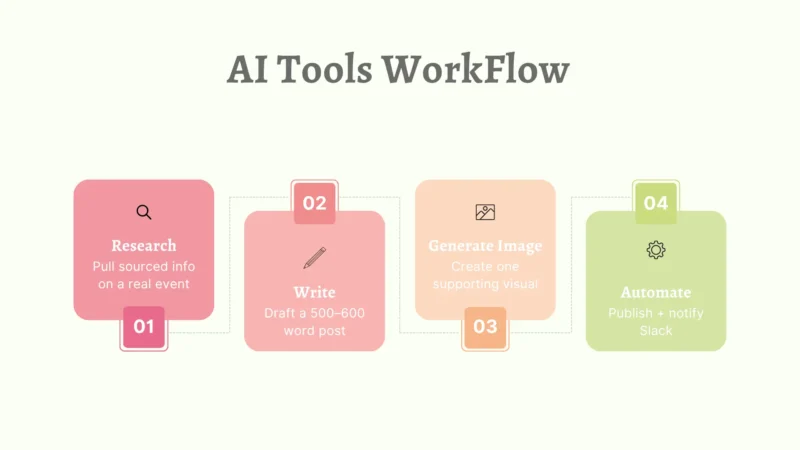
The test task mirrored a job a small marketing team does every week: research a competitor’s product launch, draft a 500–600 word announcement post based on that research, generate one supporting image, and set up an automation that would publish the draft to a CMS and notify a Slack channel.
That single task touches four categories most “ai tools list” articles treat separately:
- Research — pulling current, sourced information on a real, recent event.
- Writing — turning research into a clean, on-brand draft without heavy editing.
- Image generation — producing one usable visual from a short brief.
- Automation — connecting the output to a publishing step without custom code.
That single task touches four categories most “ai tools list” articles treat separately — and it’s also why lesser-known, free-to-use chat tools like Perchance AI Chat got tested alongside the bigger names, even though they didn’t make the final four.
Each tool was scored on four criteria: whether it completed the step at all, how much manual cleanup it needed, whether its free or entry paid tier could realistically do the job, and whether its stated limits (context window, task caps, generation credits) held up against the tool’s own documentation.
What the Competitors Missed
Reviewing the top-ranking pages for “ai tools comparison” and “best ai tools 2026” turned up a pattern worth naming directly, since it’s the reason most of those pages are hard to act on:
- They test tools in isolation, not in sequence. A tool that writes well in a demo prompt can still fail in a real pipeline if it can’t hold context from a research step through to a final draft.
- Pricing tables ignore usage caps that actually bite. Several guides list a $20/month price without mentioning that automation tools bill by task or operation, not by seat — so the sticker price and the real bill diverge fast once a workflow runs daily.
- Few pages separate vendor claims from tested behavior. Marketing pages describe “unlimited” or “advanced reasoning” without defining the ceiling.
- Almost none address failure recovery — what happens when an automation step errors out mid-run, or a research answer omits a source. That’s usually where real workflows lose the most time.
AI Tools Comparison Table
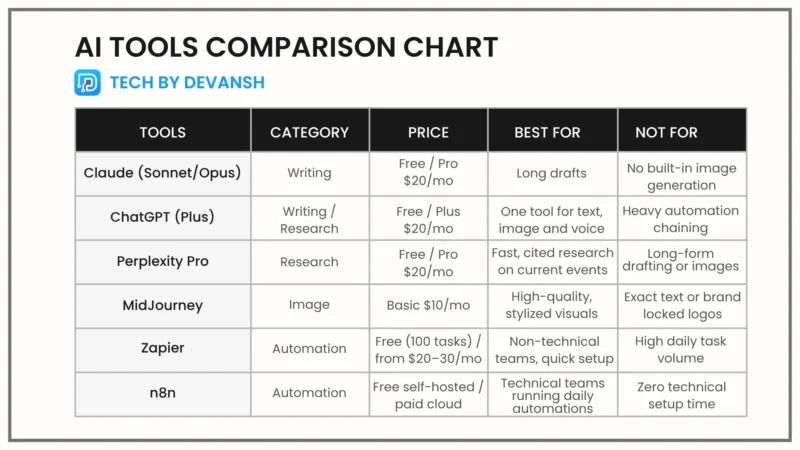
Prices below are cross-checked against each vendor’s own pricing page — Anthropic, OpenAI, Perplexity, Midjourney, Zapier, and n8n.
What I Found: Where Each Category Actually Wins
Writing tools: context survives, formatting doesn’t
Claude and ChatGPT both produced usable first drafts from the research brief.
The difference showed up in the second pass: Claude kept the announcement’s structure and tone consistent when asked for a shorter version, while ChatGPT’s rewrite occasionally re-introduced details that had already been cut.
Neither tool eliminated the need for a human edit pass — plan on light cleanup either way.
Best for: teams that draft long or iterative content and need a tool that remembers earlier instructions in the same thread.
Not for: anyone expecting a publish-ready draft with zero review.
Research tools: citations are the whole point
Perplexity’s advantage wasn’t writing quality — it was that every claim came with a clickable, checkable source, which mattered for a task built around verifying a competitor’s actual announcement.
Search features built into ChatGPT and Gemini got close, but mixed cited and uncited sentences in the same answer, meaning more manual source-checking, not less.
Best for: any research step where you need to trace a claim back to its source before publishing.
Not for: replacing a subject-matter expert on nuanced or contested topics.
If Perplexity earns a spot in your own stack, our guide on how to use Perplexity AI like a pro for free in 2026 covers the free-tier tricks that stretch its daily Pro Search limit further.
Image tools: quality is high, precision isn’t
Midjourney produced the most usable supporting image from a short brief, but matched the brief’s mood rather than its literal instructions — a well-documented behavior of diffusion-style generators.
If the brief needs exact text in the image or a locked brand palette, expect several regenerations or a different tool entirely.
Best for: editorial and social visuals where style matters more than pixel-exact accuracy.
Not for: logo work, exact typography, or anything requiring sign-off on precise wording.
Automation tools: the real cost is usage, not the subscription
This is where most comparison articles stop short.
Zapier connected the CMS and Slack steps fastest, with the least setup time. But Zapier bills per task — each action in a multi-step workflow, not each run — so a four-step publish-and-notify automation running daily adds up faster than the advertised monthly price suggests.
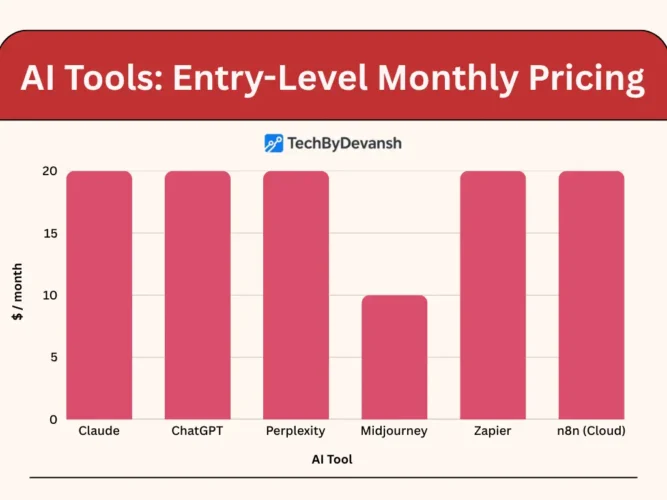
n8n’s free, self-hosted option and per-execution billing model made it noticeably cheaper at the same volume, at the cost of needing someone to host and maintain it.
Best for: Zapier — teams that want automation live today with no technical setup. n8n — teams with technical capacity running the same automation daily or at scale.
Not for: Zapier at high daily volume without budgeting for task overages.
If your workflow needs an autonomous agent rather than a rule-based automation platform, that’s a different category entirely — see our Manus AI review for how it compares to Devin on agentic coding and task execution.
Limitations of This Test
This comparison covers one workflow, tested once, in September 2026. It does not measure coding ability, enterprise security posture, or performance in languages other than English.
Tool pricing, usage caps and model versions change often — treat the figures above as a snapshot, not a permanent ranking.
No tool here is described as making a task-runner “rich,” “viral,” or guaranteed to succeed; the claims are limited to what each tool did or didn’t do on this specific task.
How to Test AI Tools Yourself
If automation is the category you want to go deeper on rather than just test once, our Agentic AI Learning Path 2026 walks through building real agentic workflows from scratch.
- Pick one real, recurring task from your own work — not a generic demo prompt.
- Write down every step the task actually requires, including handoffs between tools.
- Run the same task through each candidate tool without adjusting your instructions between runs.
- Log where each tool needed manual cleanup, not just whether it “worked.”
- Check the entry-tier limits against your real usage volume before comparing sticker prices.
- Re-test after 60–90 days — model and pricing updates in this category move fast.
FAQs – AI Tools Comparison 2026
Which AI tool is best overall in this ai tools comparison?
There isn’t one “best” tool for every job. In this test, Claude led on long-form writing and instruction retention, Perplexity led on cited research, Midjourney led on stylized image generation, and Zapier or n8n led on automation depending on task volume. Pick based on the step in your workflow that matters most, not a single overall score.
How do I actually test AI tools instead of trusting a review?
Give every candidate tool the same real, multi-step task you’d normally do by hand, run it without changing your instructions between tools, and log where each one needed manual cleanup. A single demo prompt won’t reveal how a tool behaves across a full workflow, which is where most tools actually fail.
Is Perplexity better than ChatGPT or Gemini for research?
For tasks that need traceable, clickable sources, Perplexity performed more consistently in this test because citations appeared inline with each claim. ChatGPT and Gemini’s built-in search features answered similar questions but mixed cited and uncited sentences in the same response, meaning more manual source-checking.
Why did Zapier cost more than expected during testing?
Zapier bills per task, meaning each action inside a multi-step automation counts separately, not each full run. A four-step publish-and-notify workflow running daily can burn through a monthly task allowance faster than the advertised plan price implies, a detail several pricing comparisons leave out.
Can free-tier AI tools handle a real workflow like this one?
Free tiers can complete individual steps — drafting a short paragraph, generating a few images, or running a handful of automation tasks — but most hit limits well before a recurring weekly workflow needs. Budget for at least one paid tier if the task will repeat regularly.
Do AI image generators follow exact instructions?
Not reliably. Tools like Midjourney tend to match the mood and style of a prompt more closely than its literal details, a documented behavior of diffusion-based generators. Expect to regenerate images several times, or use a different tool, for a brief requiring precise text or exact brand elements.
Final Thoughts
An ai tools comparison is only useful if it tests a real sequence of steps, not one prompt per tool.
Out of 25 tools tried against one shared task, Claude, Perplexity, Midjourney and n8n (or Zapier, depending on volume) were the four that finished their step without a workaround everything else either duplicated one of these four or failed to complete the task as documented.
If you’re weighing this against a bigger question — which AI tools actually let a small team grow without adding headcount — that’s a separate, deeper comparison we cover in Best AI Tools for Business Owners Who Want Faster Growth Without Hiring More Staff.